
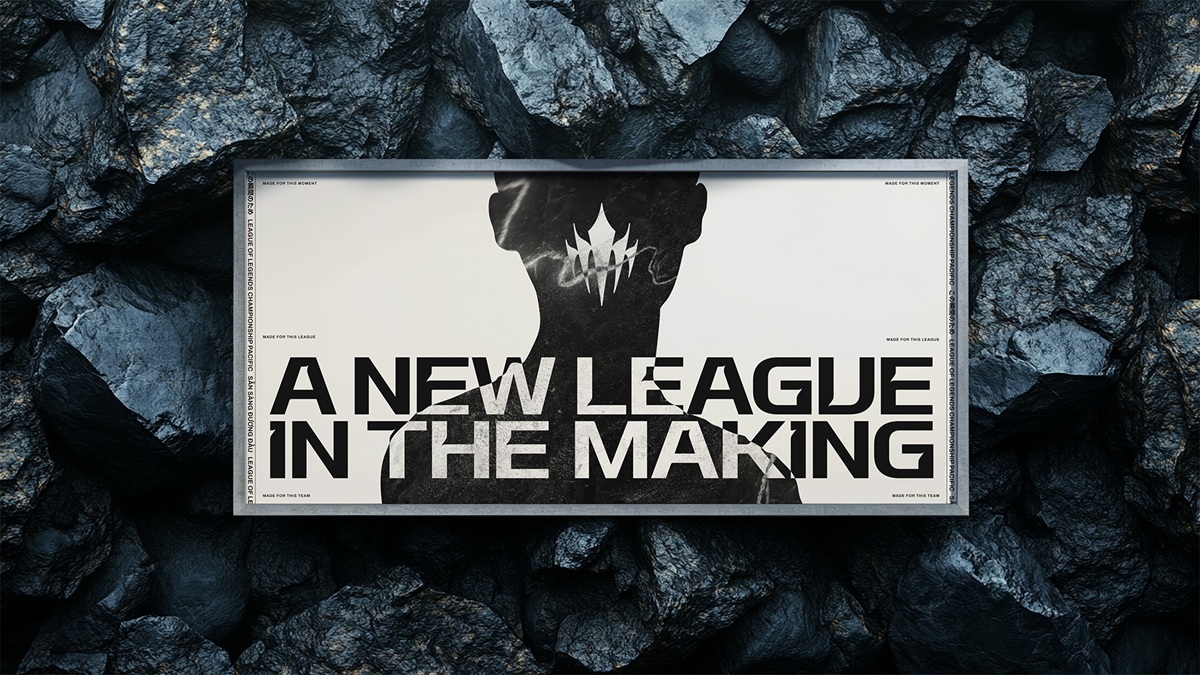
Riot Games has always had a strong identity for League of Legends in China, the U.S. and Europe. But as the game grew, it saw a need to establish a new brand and tournament structure in the rest of Asia beyond China.
And for that, it turned to Koto, a digital brand agency with an office in Sydney, Australia. Together, Riot Games and Koto worked to establish a new regional sub-league, the League of Legends Championships Pacific, known as LCP for short.
Riot has invested heavily in Asia Pacific expansion, and LCP marks its most significant regional league rollout to date. The new tournament region includes teams from Taiwan, Vietnam, Japan and Oceania (including Australia).
It comes as global esports viewership continues to surge: last year’s LoL Worlds hit a record 6.94 million peak viewers, underlining the staying power of League of Legends, which first debuted as a multiplayer online battle arena (MOBA) in 2009 — 16 years ago.
“It’s been a beautiful ride, and just seeing everyone celebrate the work online, from folks who are currently developing the brand — from Rioters, from Koto’s team, different agencies delivering,” said Anas Al Hakim, creative lead for APAC at Riot Games, in an interview with GamesBeat. “We’re already six months into the life of the brand, and I can see a lot of our partners, organizers, broadcast folks — everyone is starting to celebrate and share their version of the output of the brand. So that’s pretty powerful to see unfolding in real time.”
Brand-building work is very important when it comes to games, but it’s not always something that gets highlighted or even talked about. It’s a creative art, but also has some science of measurement behind it. And even elements such as typography matter a lot.

“You’re bringing together, you know, a whole range of different talented people, whether they’re people who are good writers, who people who are typographers, illustrators, photographers, motion designers. And it is a process of orchestration,” said Damian Borchok, managing director of APAC for Koto, in an interview with GamesBeat.
Koto delivered its own look-and-feel for the LCP and also developed a comprehensive system of hundreds of assets across broadcast, digital and physical. The aim of the branding was to reflect the diversity and intensity of how League is played – and loved – across Asia Pacific.
Carving out this new identity was necessary to distinguish the league from other Riot regions. But it was complicated, given all of the different languages and national identities that had to be recognized in the multi-vendor esports infrastructure. This kind of modular branding system in esports will be necessary for the games that break through the noise and become popular as esports around the world across many regions and languages.
Asia-Pacific has long been home to some of League’s most dedicated fanbases, but its competitive presence has often been fragmented, which the LCP aims to change. From Vietnam to Singapore, Tokyo to Taipei, the league brings the region’s pride, skill, and momentum together under one banner, with a brand system purpose-built for digital speed, broadcast polish, and regional reach.
“When a lot of branding projects are done, often they’re just treated as the delivery of a bunch of assets. So logo, color, palette, typeface, but that’s really that’s not the whole point of why you do a branding project,” Al Hakim said. “The whole point of doing a branding project is to make people feel something, tap something in their fandom. [You have to] tap something in their in their culture, in their way of life, that makes them feel like they want to be part of something. And if it’s the combination of those elements with everything else that an organization’s doing fit together properly, it takes off, and then your brand’s actually doing the job.”
Doing the brand design work

Riot Games itself has a hub in Singapore. But this idea involved combining all of Asia Pacific and Oceania, including Australia and New Zealand. Riot has tournament regions such as LCK in South Korea, LEC in Europe and LPL in China. North America was a hub for the LCS, but now the LCS has been extended to include all of the Americas. LCP is now a new major tier one league, Al Hakim said.
“When we try to communicate, [it has to] show some diversity,” Al Hakim said. “Everything has to be adaptable. Whether you’re communicating through memes or culture or broadcast assets, you have to be able to communicate honestly and fairly with different folks from APAC, which presented a challenge, but it came out in a beautiful way.”
As an example, the team delivered a new typeface it called LCP Ignite. Koto was able to handle some of this work because it is a global studio. It works with other global brands as well. It was inspired by the Summoners Rift league map.
“We might start with a Latin typeface, but so often that is not where we wind up. So many of our clients do have representation across the Asia Pacific region. It’s a natural consideration of our work that we’re also thinking about typography,” Borchok said. “When does it need to show up in simple Chinese characters or Japanese characters? From the very beginning, we’re thinking about a system where you’re not bolting these things on. It’s build from the start.”
As an example, the Latin typeface is used to create the Vietnamese language version of the brand, as that is the foundation for the Vietnamese written language.
The brand creators have to get some sense of cultural references that the subbrand brings to mind. The branding specialists create a kind of brand book. But they also have to get feedback from people in the field who are broadcasting elements of the branding. Does it really resonate when it is put into the field?
Koto said the system was designed for streaming overlays, multilingual fandoms, and meme culture.
LCP is the newest addition to the League of Legends esports for the Asia-Pacific region, Al Hakim said. In the past, there were more minor regions for Vietnam and for Taiwan, but this Riot decided to make like a bigger commitment for APAC, he said.
The League of Legends Championships (Worlds) is the top final esports tournament in the world, but LCP fits as a subbrand. Koto began work on it around the beginning of 2024 and it performed the work for nine months. Now it’s taking root.

“It was a very, very intensive program,” said Borchok at Koto. “Our role was to really to collaborate with the team and to understand the dynamics around what Riot was trying to achieve. To be able to create a league that was new but that people could immediately feel like they were part of it. And to develop the brand strategy that was a platform for and then how do we bring that to life. How do we express that as it shows up, whether it’s in events, in digital media, in motion design, pretty much anywhere.”
Borchok added, “We have to establish the foundation for how you visualize it, how it comes to motion design. We build out a toolkit for that, with incredibly close collaboration with teams at Riot to ensure that the work that we were producing could integrate” well.
The Riot team wanted to recognize the growth of the APAC region, but it also had to make sure that it was a subbrand built in a way that fit with other subbrands in other regions. Riot Games had to first make the assessment that Asia Pacific was ready for its own league, separate from leagues in South Korea or China. That meant it needed its own branding and storytelling and lore, Al Hakim said.
“For us, building the LCP brand was not just about all we need to do with the name and the logo and the colors. It’s also laying down mythos of like APAC esports, which is, branding for the first chapter of a very long saga,” Al Hakim said. “It needed to honor the legacy of past icons, like VCS and PCS. There were leagues already here that ultimately produced teams to go to Worlds, but it was not one league for them.”
The brand

Crafted around the idea What We’re Made Of, the brand celebrates APAC’s communities, rituals, and fandoms. It’s built to stoke rivalries, build narratives, and feel responsive to the energy of live play. Koto worked closely with Riot’s APAC PubSports team to develop not just a logo, but a complete esports toolkit—from social assets to motion design to arena environments.
At the centre of the identity is The Pinnacle – a battle-forged emblem symbolizing five players locked in formation. A modular lane-based design system reflects League’s core gameplay and enables versatile storytelling across match-day hype, player stats, team intros, and more.
The motion principles mimic the rhythm of streaming culture, with dynamic framing, fast-paced type treatments, and countdown sequences that reflect the energy of online fandoms. It’s a system designed to feel live, alive, and instantly shareable.
Typography plays a key role too, as the LCP Ignite typeface pairs with language-specific scripts to ensure seamless, expressive communication across APAC’s multilingual audiences.
Koto also delivered the technical rigour required for long-term success, building out hundreds of templates and flexible assets that can be used across seasons by Riot’s regional partners and vendors. The result is a system that isn’t just built to launch, but built to last.
There was a lot of back and forth with the fan reaction. The Koto team had to react when some characters of the typeface looked too similar, so that it was hard for players to tell apart certain characters.
Good results

Riot Games unveiled the logo in September 2024. It also released a brand trailer in November 2024. January was when the branding started going into effect.
Melissa Bailache, creative director at Koto, said in a statement, “From the start, this wasn’t just about making a logo. It was about creating something that fans would feel proud to be part of. We immersed ourselves in the culture of the region, and that shaped every design decision we made.”
With APAC esports entering a new chapter, and Riot continuing to invest in regional infrastructure, the LCP is a brand made to evolve with the game, the players, and the fans.
“We are extremely heartened by the response from fans across the region towards the LCP,” said Piotr Pilich, head of product for esports at Riot Games’ LCP, in a statement. “During the Mid-Season Finals between CTBC Flying Oyster and GAM Esports, we achieved a record-breaking 483,444 peak viewership. Our fanbase is certainly growing, with peak viewership increasing by 85% compared to our last split. This is a nod towards the blood, sweat and tears poured into the league from everyone involved.”
Pilich also said that at the start of Mid Season, Riot Games also celebrated the opening of its new home, the LCP Arena.
“We’re proud to have tickets sold out every matchday, having fans live at our games has been a dream of ours for a long time, and seeing the arena filled with fans cheering for their team every week is amazing,” Pilich said. “There’s also something to be said about the cross-pollination of fans between teams. We’re seeing the local crowd cheer not only for their home teams but also show support and encouragement when others put up a strong showing. I’m excited for what the future holds, and confident that we will continue to achieve great things together.”
“It’s still a baby brand, but it’s making the rounds,” Al Hakim said. “The brand is meant to evolve. It’s never meant to be static. Until that one day, it hardens into something iconic.”
As for the brand building, he said, “It becomes a living system that can change and adapt over time. In all these esports organizations, all these pro players, all the fans, are trying to support the LCP,” Al Hakim said. “So you can see there’s actually hunger from the players and the viewers and the audience. There’s a sense of pride when it comes to like, ‘this is our team.'”