
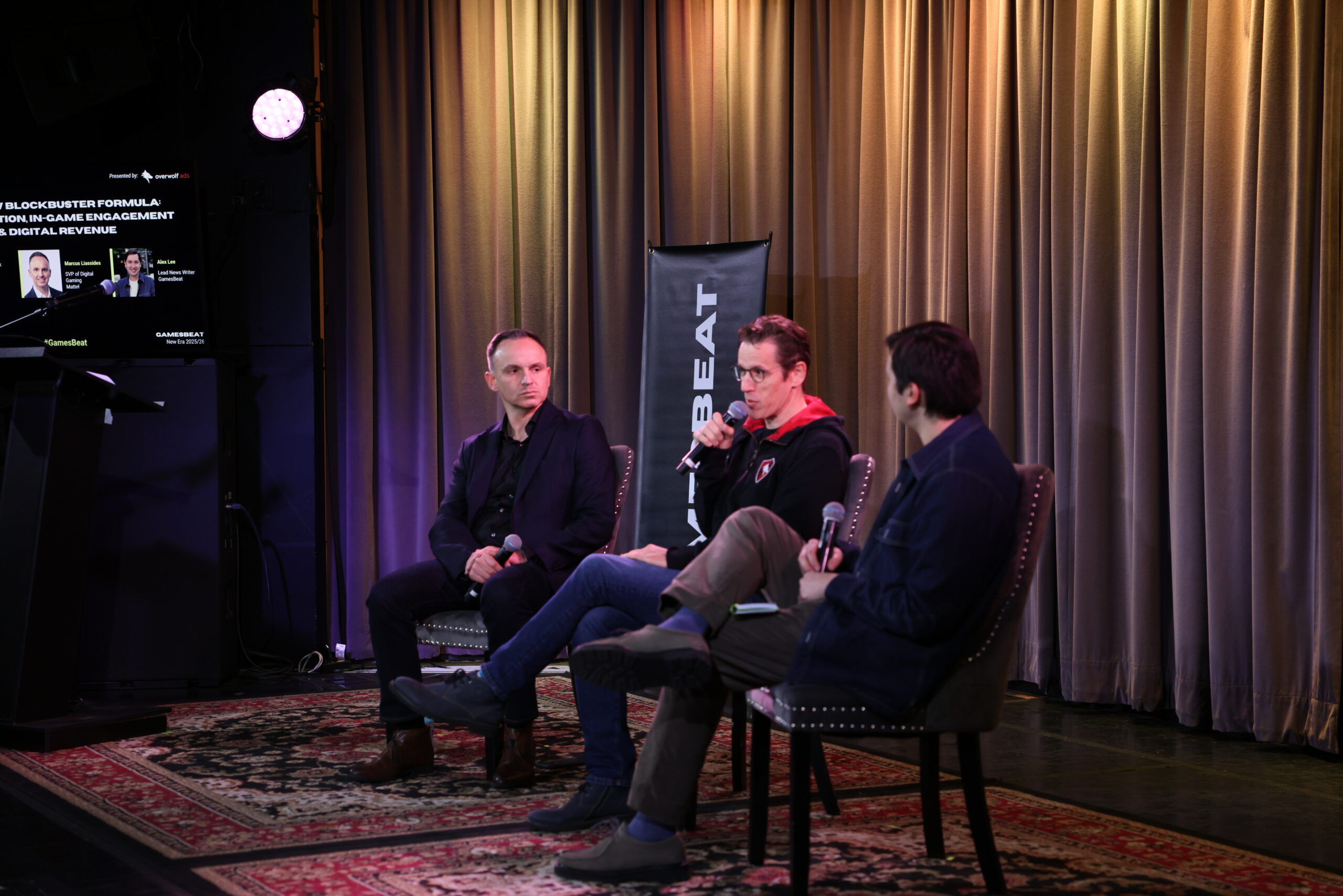
At the GamesBeat Insider Series: Hollywood and Games conference, leaders from across the industry and Hollywood descended on Los Angeles for a star-studded gathering of minds.
The New Blockbuster Formula: IP Activation, In-Game Engagement & Digital Revenue panel brought together leaders from Overwolf and Mattel, joined by GamesBeat lead news writer Alex Lee, to discuss how user-generated content is no longer a side channel for experimentation, but a core driver of engagement, creativity, and long-term franchise value.
The panel explored how creators are reshaping the way studios and IP holders think about ownership, participation, and scale. Overwolf chief marketing officer Shahar Sorek framed the rise of user-generated content (UGC) as something that has existed for decades, but is only now being fully embraced by rights holders.
He argued that the most compelling expressions of game worlds often come from players who are deeply invested in them, rather than from official pipelines alone.
Passion breeds authentic creativity
“Passionate gamers create passionate expressions of IP that mostly cannot be produced or conceived by the IP owner,” Sorek said. “These are people who live and breathe the game, who understand it on a level that goes far beyond what a traditional production pipeline can usually support.”
That passion, Sorek explained, is what allows UGC ecosystems to sustain momentum over long periods of time. Instead of competing with official content, creator-made experiences frequently extend the lifespan of games and franchises by offering new ways to engage that developers simply don’t have the bandwidth to produce themselves.
Sorek also pointed to a clear shift in how publishers approach creators today compared to the past. Where modding was once viewed primarily as a legal or brand risk, studios are increasingly recognizing that enabling creators can unlock value that would otherwise remain inaccessible.
“Historically, studios wanted full control,” Sorek said. “The instinct was always to lock things down. Today, there’s a growing understanding that giving creators tools, structure, and a way to participate actually strengthens the IP instead of weakening it.”
Why brands are betting on UGC for growth
From the brand perspective, Mattel’s senior vice president and global head of digital, Marcus Liassides, shared how the company’s experience with creator platforms fundamentally changed its gaming strategy. What began as an experiment quickly revealed that fans were eager not just to play with Mattel’s brands, but to actively build around them.
“What went from a partnership relationship at the beginning is now a pillar of our gaming strategy,” Liassides said. “Creator platforms are now one of our four pillars, and they sit alongside everything else we do in digital.”
Liassides emphasized that creator-driven platforms offer something traditional game development often struggles to replicate at scale: constant reinvention. Because creators are motivated by personal expression and community response, UGC ecosystems naturally generate a steady stream of fresh ideas and interpretations.
That dynamism has also begun translating into measurable business outcomes. While attribution remains complex, Liassides noted that Mattel has already seen encouraging signals connecting digital engagement on creator platforms to real-world brand impact.
“We’re starting to see early signs of retail lift that correlate with these large-scale UGC experiences,” Liassides said. “It’s not always a direct one-to-one measurement, but the signals are there, and they’re getting stronger.”
Both speakers agreed that UGC is no longer confined to a single platform or genre. Instead, it represents a broader shift in how entertainment brands interact with audiences and how creators act as cultural translators, turning static IP into living, evolving ecosystems that can move fluidly between games, media, and commerce.