
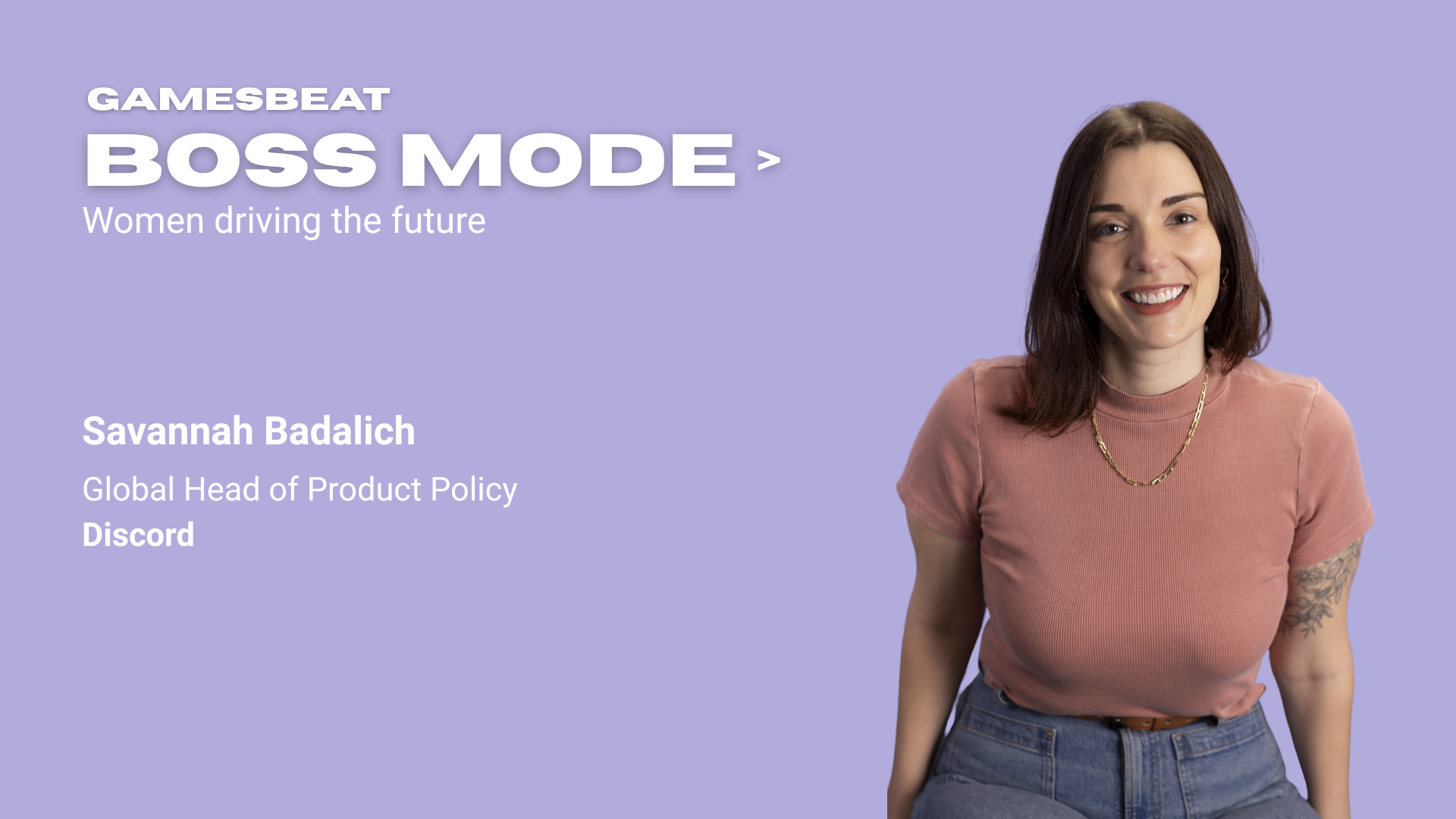
BOSS Mode: Women Driving the Future is a groundbreaking new series by GamesBeat, led by Rachel Kaser, that finally puts the spotlight where it belongs—on the women transforming the business of games, entertainment, and tech, and the industries it touches.
It’s the B2B POV, where women leaders will provide critical business insights you need to make more informed decisions, and an inside look into how women leaders driving the future are navigating their business strategy.
From tech to healthcare, entertainment to retail, gaming is no longer a silo—it’s the connective tissue of the modern economy. And women are driving that evolution. In this ongoing series, we go beyond titles to showcase women whose influence is shaping the future of gaming and the industries orbiting it.
This isn’t a moment. This is a movement.
New chapter. New era. Welcome to BOSS Mode.
Back in the late Jurassic of 2015, a little voice chat platform called Discord launched. I can put it in those terms because I was in its first wave of users. While today Discord is known to be a home to all – good, bad, and ugly – it originally began as a chat feature in a video game, a mobile MOBA called Fates Forever.
In the years since, Discord has honored that part of its DNA, with gaming being a major part of its feature development. It’s even offered a platform for casual games called Activities. But what I wanted to know was how both Discord (and community platforms generally) can be used alongside games to create good.
To that end, I decided my next interview for Boss Mode had to be with Savannah Badalich, Discord’s Global Head of Product Policy. Badalich began working with Discord in 2021, and when you want to talk trust, safety and policy, she’s the person on whose metaphorical door you’d knock. She proved that earlier this week when I spoke with her about Discord’s updates to its Family Center.
I spoke with Badalich about her position at Discord and her own history with gaming, and how one influenced the other. We also spoke about safe spaces and how Discord works with companies both within and without the games industry to create them. Below is an edited transcript of our interview.
GamesBeat: I gotta give you a little bit of setup. Maybe give me a bit of background on yourself?
Savannah Badalich: I grew up playing video games and one of my favorite was World of Warcraft. As I was playing, I explored parts of my identity within the community. My physical community was not accepting of queer identity, so it was very nice to be part of those guilds. Online communities were really important.
After college, I wanted to focus on how we can use online communities and activism to talk about hard subjects — human rights, gender-based violence, interpersonal violence, etc. I worked at a human rights organization when I started my career, and I saw more and more how you could use tech for the public good.
What I learned was that you can’t solve a social issue with tech. Often the advice I was given was, “You have the best intentions, but it might negatively impact that people you’re trying to help.”
When I joined Twitter, I learned how to build products with safety mitigations built out. When Discord reached out to me, all of my online fandom, knowledge of subcultures and my love of gaming all came back to one space.
GamesBeat: Gaming is no longer a siloed industry or “just a hobby.” It’s become part of the fabric of multiple sectors. How does gaming influence what you do?
Badalich: Personally, gaming gave me a community when I didn’t feel safe to find one in the physical world. We see the ways in which gaming is an opportunity to talk about what they’re going through. There’s also the element of creativity and understanding someone else’s lived experience. You can play parts of yourself that you didn’t even know about via character creation and avatars.
We’ve always, as humans, played games. Video games offer a lot more for people to explore and understand. I enjoy it as entertainment and stress relief, and also as a vehicle to have hard conversations or to explore, test out, practice what it means to be human. Video games are a really cool way for young people, who may not have the space or support from trusted adults, to explore parts of themselves within safe constructs.
GamesBeat: Discord began as a gaming-adjacent service, and it still is now to a certain extent. What kind of lessons do you think non-gaming companies can take from the games industry?
Badalich: There’s a piece there around loyalty, and one around world-building, identity creation. I think games can be a vehicle for so much, whether it’s sending a message, trialing out an experience. It can be as silly as the KFC dating sim, or as serious as the VR games about the immigrant experience. There’s a whole gamut.
For folks who aren’t in gaming, I would say to leverage gaming as you would any other piece of media, but think of it as more immersive and one which touches more of the human heart. [Gamers] are experiencing it; it’s different from the passive experience of a movie. They have agency. They have control.
GamesBeat: I’m curious about the cross-pollination between industries. How do you balance the needs of, say, a young gaming audience with your other demographics? As the Trust and Safety person, you have to see everything, right?
Badalich: These platforms are a microcosm of the world, and it’s foolish to think we’re going to solve world problems via only our platform. So it’s incredibly important for us to be working in collaboration with other companies, other nonprofits, other governments that care about these issues.
Cross-pollination in terms of best practices sharing, pulling from human rights norms, or best practices from nonprofit, or trying to leverage government to support more initiative, especially for indie gamers … there’s so much you can do when you collaborate. Discord is very much a convener. We are the social layer of gaming, and we have a cool opportunity to bring folks together and talk about the overall benefits of gaming. The more we can do around leveraging games, the better we’ll all be for it.
The thing that helped me most in my career is something I learned from nonprofit, and that’s community organizing. People care very, very deeply about what they believe, and their “thing,” whatever that might look like. If you’re able to meet them where they’re at, understand what their motivations and needs are, and help bring them along; it can be used in nonprofit for pushing social issues, or it can be used in working with a product manager who has a very specific goal in mind and I need them to understand the potential consequences of not mitigating risk.
I often find folks in the policy and trust and safety space to be very interdisciplinary. No one gets a degree in Trust and Safety or in Policy. Usually they’re coming from different experiences: Academia, nonprofit, direct service work or law enforcement. By nature, you have to work with more people, work with them, and figure out the ways to reach them.
GamesBeat: How would you describe your impact, your legacy within the industry?
Badalich: I want people to thrive. You need base-level safety in order to do that. You need to understand each other, think about different norms and practices, think about the overall culture, think about all these different systems that interconnect. I think I’d refer to my impact as digital thriving.
I’m not the user for every use-case. I really try not to put myself in the user, but if I was looking at 13-year-old Savannah, what she wanted was a safe space to be able to explore herself. And I really want that to be something that someone else can still do, even if they are not safe in their physical environment.
GamesBeat: If you could share one insight with the decision-makers in the gaming and tech industries, what would it be?
Badalich: I’ll say two: In order to have the most fun, playful, great experience in a game, safety is a bare minimum. Safety is a part of retention, growth and revenue generation. So there is a business imperative, which Discord clearly sees, for doing more with safety.
The other is: Please still give teens agency and space to grow. Allow them, via typical and natural teen development expectations, to still have some autonomy, still have some agency, and have guidance. Don’t nerf their entire experience. You can have the constraints of safety, but let people play!
GamesBeat: What was your “Boss Move” — the decision you made that has defined your impact across the industry?
Badalich: Not a literal boss move?
GamesBeat: Whatever answer you want to give!
Badalich: I think my Boss Move was when I was in nonprofit, still part-time in grad school, and researching these platforms. I was lovingly told by a mentor — and I took her up on the advice — that it’s easier to throw a rock from the outside than change from within. I think me moving over, to go from having criticisms of an industry to then working within it to address those criticisms was probably my Boss Move.
It also gave me more context. I’ve always wanted to do either human rights at a tech company or tech at a human rights company, and I feel like I’d be able to help other nonprofit or human rights organizations to understand how it works or how best to get what they need.
GamesBeat: And if you had boss music, what would it be?
Badalich: A combination of Dark Souls and Stardew Valley!