
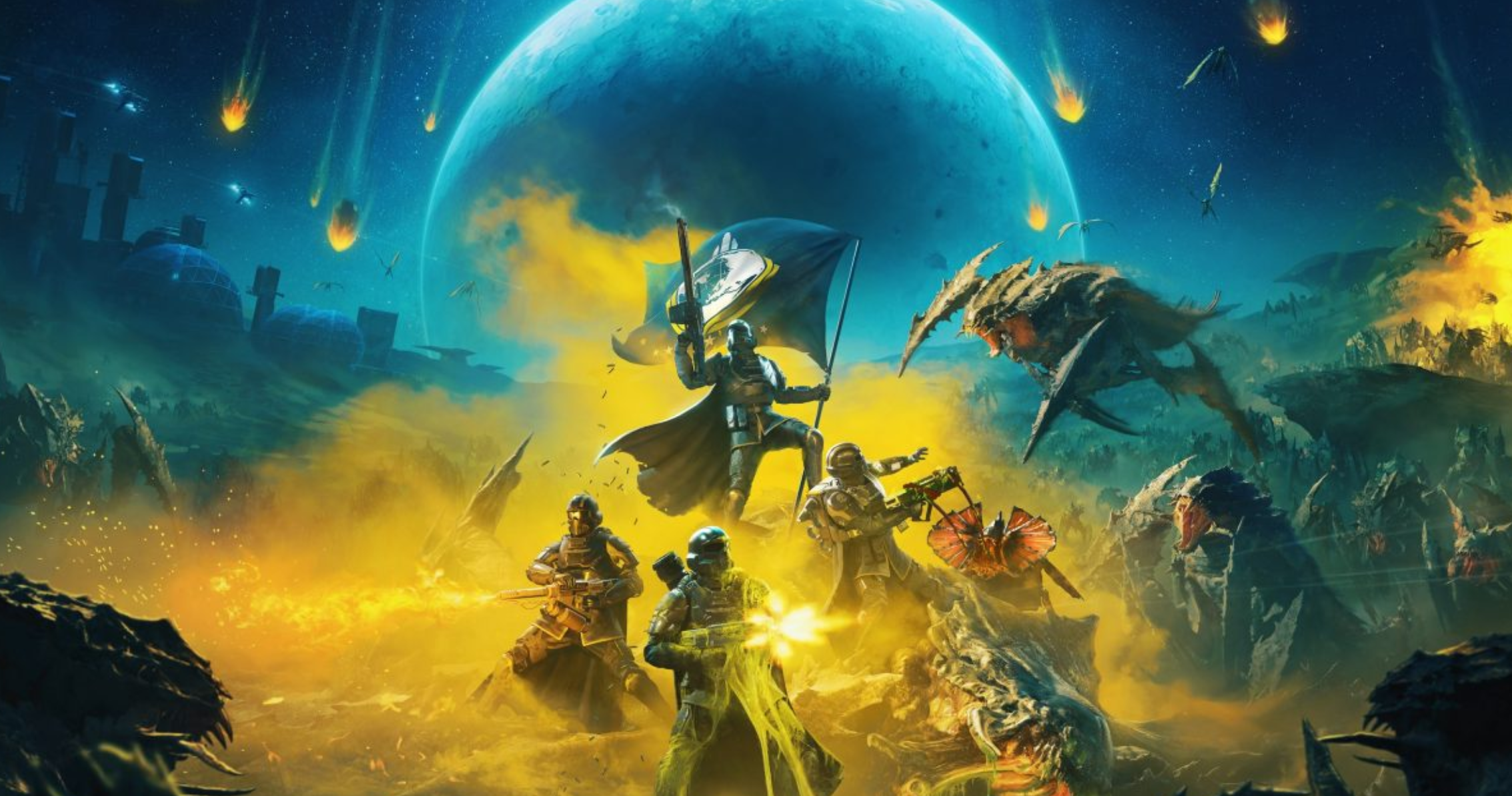
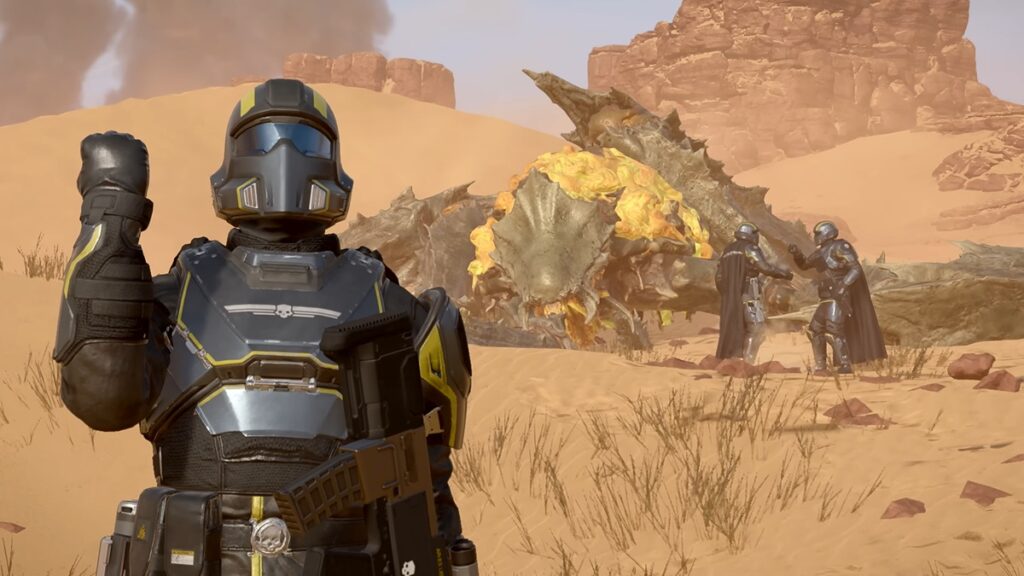
Arrowhead Game Studios, a mid-size independent studio based in Stockholm, Sweden, struck gold when it launched Helldivers 2 in February 2024 on the PC and PlayStation 5. Now the game devs are spreading out to bring more delight to players.
The game took the top-down Helldivers game of 2015 and turned it into an exciting co-op third-person shooter that soared in the charts. In its first three days, it hit one million games sold. As more time passed, Helldivers 2’s dev team had a hard time keeping fans happy because of the crushing demand.
Within 10 days, it surpassed 330,000 concurrent players on Steam, outperforming many of the most popular live-service titles from triple-A game companies like Bungie’s Destiny 2 at the time. And by 2026, industry analysts at Alinea estimated the game had sold more than 20 million copies, generating over $700 million in gross revenues. The title won the best multiplayer game and best ongoing game at The Game Awards 2024. A year ago, the game also launched on Xbox Series X/S.
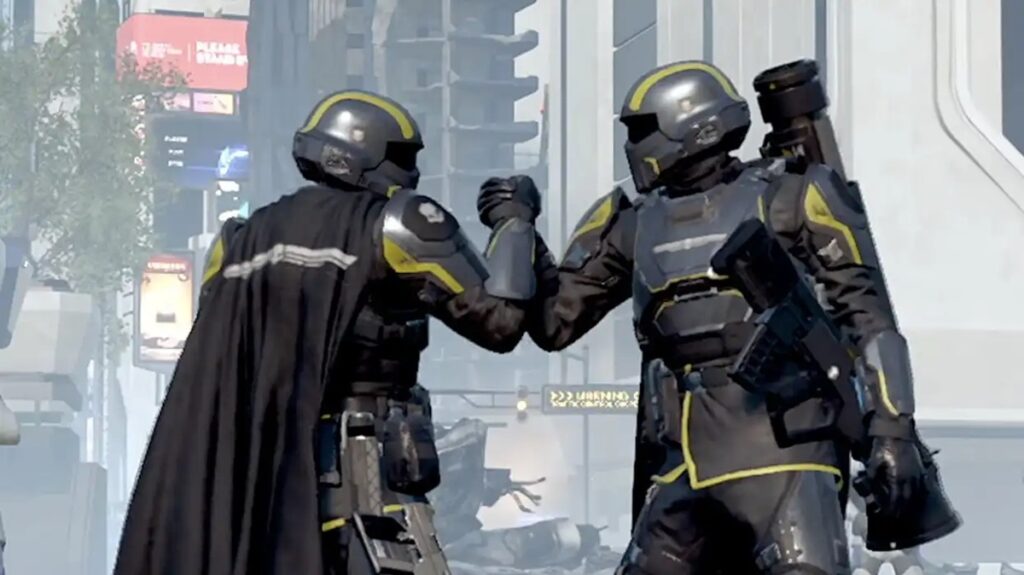
Part of the appeal was the Starship Troopers-like environment, including sarcastically rendered patriotism and heroism that left players smiling at the game’s underlying cynicism. In the matches, your team lands on an alien-controlled planet and you dive into combat with all sorts of alien monsters or robot fighters. The intensity of the combat was one of the things that made the game one of my top three games of 2024.
After that success, the pressure was on Arrowhead Game Studios to step up and take advantage of the once-in-a-lifetime success. It was one of the rare reminders that great games could come from anywhere — like Palworld, Clair Obscur: Expedition 33 and Black Myth: Wukong.
And it also put the burden of responsibility on leadership at Arrowhead Game Studios. Cofounder Johan Pilestedt stepped down from CEO into a creative leadership role and chairman so he could focus on game development.
In May 2024, Shams Jorjani joined the team as CEO of Arrowhead Game Studios to make the decisions necessary to allow the studio to move forward while preserving the magic that allowed it to make the right decisions on Helldivers 2. The team at 150 people is bigger than the 110 that Arrowhead had at launch, but it’s still smaller and so Jorjani has to make his decisions wisely on the field of battle.
“We want to become the undisputed masters and pioneers of massive co-op action games, like what we made with Helldivers 2,” Jornani said.
For sure, Arrowhead is feeding the beast of live services for Helldivers 2. But it’s also working on future titles that go beyond the work on Helldivers 2.
Here’s an edited transcript of our interview.
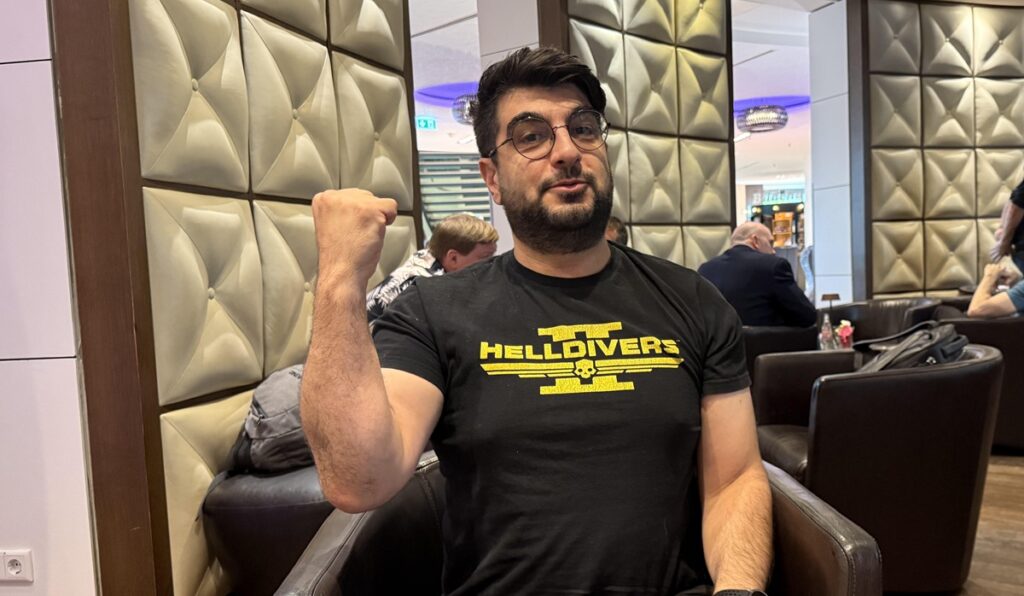
GamesBeat: The excitement must have died down for you if you’re able to make the time to do interviews.
Shams Jorjani: Honestly, things are just as crazy as they ever were, but they’re crazy for different reasons. When Helldivers 2 came out things were crazy because it was just like, “Oh my God, we caught lightning in a bottle. It’ll slip out of our hands if we don’t capitalize.” We wanted to give the players what they wanted. We managed to do that, but then it became crazy because–okay, now we’re on that level. We need to deliver stuff all the time. We went from survival to pressure. It’s been a wild ride. It’s still crazy.
We can scale up. We can also do the opposite and say, “Sorry, this is too much for us. We want to be a small indie studio.” We can go and just do indie stuff. We could do just about anything. So what is it that we truly want to do? Through those discussions, a couple of truths came out of it. One of them was that we did not have a great desire to grow the studio. We were around 110 people by the time Helldivers 2 launched. We wanted to stay under that 150 limit. If we could make two games under that umbrella, that would be cool, but it’s not something that we needed to focus on.
It was this rare situation where we had–a developer is normally constrained. You look at what the limitations are and then you build a business around it. Suddenly, when you have a blue ocean in front of you to decide whatever you want to do, things become harder. Arrowhead had operated in a reactive, firefighting mode for a long while. Suddenly we found ourselves–we tried to split the difference. We definitely didn’t want to grow too much. Most of the growth of Helldivers is coming through PlayStation and a lot of great co-dev partners, while we try to be the creative brains. Then we’re slowly spinning up a second project.
We’ve invested heavily in the studio. We moved from a smaller space to a slightly bigger space locally in Stockholm. That allows us to attract more people. More people want to come into the office. We’ve put more effort into tech. Just making it a good place to work. But it’s going to be a long journey. We’re not there yet. In the back of my head–I’ve seen the downsides of what uncontrolled growth leads to. If you don’t have the strong scaffolding and foundation in terms of culture, process, leaders, clarity on the road to where you’re headed, adding more people is not the best way to find success. In fact, it can fly apart. Then people end up getting the short end of the stick. It’s maybe not the executives, the seniors, but the massive amount of staff that end up losing their jobs because of those decisions.
That was something we were very mindful of. At the same time we were having a lot of success, a lot of companies were laying people off because of poor decisions and scaling up too fast. We felt like we didn’t want to scale up too fast. Again, you don’t know what’s going to happen in the industry. We don’t have infinite money. It doesn’t take more than one bad swing to put things in a tough place. We’re also very grateful for what we have in Helldivers. We know that this success could end at any moment. It’s so competitive right now, with so many games coming out. We try to stay humble and stick to our roots of what we’re able to do.
For the next game–it definitely has the potential to be very big, but it’s not the same level of operation. We’re approaching it from a standpoint of–we think games in the future will be made by smaller, leaner teams. We were never one of these 500-person teams. We don’t see the need for that many people. You need that if you want to be more content-driven, but our focus is to be more systemic, more systems-driven.
GamesBeat: How do you think about choosing some of those different options that are in front of you? Looking at Supercell, they’ve had great successes. For the longest time they tried to stay under 250 people. They wound up with games like Clash of Clans running on a team of about 15 people. But they figured out that when live services are bringing in the bulk of revenue, you have to have a large team on it, even bigger than the original design team. They had to deal with that change. They also didn’t do much with their cash reserves for a long time. Then all of a sudden they decided to invest it. They spun up an investment arm to go fund things.
Jorjani: I follow Supercell quite closely. They really had the golden rule of, “let’s not grow.” They stuck to it and stuck to it. There was this theory that you could achieve a lot of success without growth. I think they tried a lot of things, and they didn’t see the same level of success. They killed the sacred cow, and now their business has grown.
We might find ourselves in that position, but I think it’s a wildly different proposition to do that once you’ve gone through the motions and you’re the undisputed masters of your genre. You have money in the bank. You’ve tried everything. Then you go about challenging your strategy. That’s the natural cycle of building it. For us, we need to consolidate for a while and then see how that pans out. Then maybe you and I will be talking again in five years, and I’ll say, “It turns out we couldn’t achieve growth with less than 150 people.” But I hope that at that point we’ll have the scaffolding and the culture and all the things we need to grow to 200 or 250 people in a contained, controlled fashion where things can go better.
It does come back to the ultimate driving strategy behind things. I can’t speak for Supercell or why they did what they did. I assume there were a number of things they wanted to do that they couldn’t achieve without growing. Maybe it was the type of games they wanted to make, certain experiences, or maybe it was just to make more money. For us the driving force is not necessarily to make more money. Money is how we measure the success of the creative endeavors we undertake.
Coming back to your question about how we choose, that’s the primary driver. We want to become the undisputed masters and pioneers of massive co-op action games, like what we made with Helldivers. More of that. We want to continue to create these systemic experiences. We have a couple of ideas about IP and worlds we want to play around with, and some others we would like to play around in. Again, coming back to the life cycles of games, that’s the next 10 years for us. If we bang out two of our own and work on another cool IP somewhere, what more could we wish for? Then the 10 years beyond that, if those are successful–then you can think about, “Okay, maybe it’s time for us to spin up some other initiatives and put money back into the industry in different ways.” Some of our founders are doing this themselves, but that’s outside the umbrella of Arrowhead.
GamesBeat: I used to think about how all the growth happens in the industry if there is or isn’t money coming in. The Saudis would bring it in. The Koreans now. The Chinese might be finishing up. But you guys are in this layer where the money has come in. It’s come in from gamers spending on games like Helldivers and Palworld.
Jorjani: ARC Raiders.
GamesBeat: Clair Obscur. These are companies that have money now. It’s an interesting layer. Maybe it’s not yet realized–
Jorjani: There is a certain amount of responsibility on our part to establish new structures. We’re at an inflection point in the industry right now. I don’t think there’s a shortage of money. There’s a hesitation about how to use the money. Every single playbook that worked between 2010 and 2020, when it’s applied today it just doesn’t work. There’s a hesitancy on the part of the bigger companies when it comes to deploying their capital on safer bets when there’s so much uncertainty.
I had a conversation with Søren Lundgaard. He’s the CEO of Ghost Ship Games, the guys that make Deep Rock Galactic. We talked about the differences between the Swedish games industry and the Danish games industry. He was very interested in understanding how we approach this on the entrepreneurial side, understanding why Denmark is far behind Sweden. His theory – not mine, but I think there’s a kernel of truth to it – is that in Sweden, all the early successes, those people ended up investing in the games industry again, or starting new companies or adjacent ones. There was this fertile ground in terms of access to capital and different teams doing it. Whereas those initial successes in the Danish games industry invested mostly in their own companies, or exited. I don’t know the details. But I think that’s it to a certain degree. We see this in local hubs in Sweden, for instance in Skövde, where Coffee Stain is. Just yesterday there was another game coming out of that city. There’s that factor.
We find ourselves in a position where we should be asking ourselves, “What can we do to make sure that the future Arrowheads have access to funding?” It’s a mixed bag, because we then–I go through the same analysis paralysis that some of the bigger players are going through, despite not having a portfolio. What do you bet on today? Figuring out a way to get capital where it needs to go. We’re still open to it. The question is, what is the right time to do it, and what is the right format? We have a bit too much to deal with at home right now to be able to think about how we fix other problems.
GamesBeat: Everything you said there could also be applied to the AI question. How do we absorb AI into our process?
Jorjani: Exactly. That adds more uncertainty to it. Some people are going full bore and adopting it wholesale. Others are ideologically opposed. My perspective is more–like with any tech, where there are uses, that’s great. Then there are a bunch of cases where it doesn’t make sense and doesn’t solve problems. I think a lot of people look for–especially in times of uncertainty, we look for silver bullets that will solve a bunch of problems. There’s surely a bunch of problems that AI can solve. I love not having to do my receipts myself. But the core creative challenges, I don’t think AI can solve any of that. I haven’t seen any real, meaningful change, but I know everyone, every major company, is experimenting like crazy. You can’t afford not to educate yourself on this stuff. We’ll see how the chips fall.
GamesBeat: The only thing people seem certain about is that right now is not the ideal end state for AI. The tools are not where anyone wants them to be.
Jorjani: Nine months ago Claude was barely usable. There was a point at the end of last year when things rapidly started to change. Ever since the changes have come faster and faster. Everyone has so much skin in the game that they’ve become evangelical. Not because they actually have the bonafides, but because they’re driving a narrative. We’ll see where it ends up.
GamesBeat: Are there things that make you worry about the industry as a whole?
Jorjani: A couple of things. We need business diversity. The more diverse the ecosystem, the better it is. The worst thing–we’re going through consolidation. Companies are getting gobbled up with the old playbooks not working. We need more robust platform holders, more than ever. There was a news piece about the challenges at Xbox. I think the worst thing for the games industry would be if Xbox wasn’t robust. It’s the same with the competition in the PC space in terms of–there was a piece the other day about the Epic store and whether it’s going to make it. I think it would be fantastic if Steam did face competition. Competition makes businesses sharper. We need that. We need more players that can enter and challenge things. That leads to diversity.
I don’t want an environment in the games industry where two major players control just about everything. That’s the cool part about PC gaming and Steam itself. It does allow just about anyone to deploy by themselves and have a great success and build on it.
GamesBeat: Those two players maybe aren’t as powerful as they seem. They’re at the mercy of chip prices.
Jorjani: There’s been a lot of talk about diversity in the industry, but I don’t think there’s been enough talk about business diversity. That’s what creates a lot of opportunities in a lot of different ways.
GamesBeat: Are there hopes that some of this gets addressed?
Jorjani: I think so. I can’t pretend to understand what the big companies are thinking. We’re a relatively small player. We are primarily–we’ve always seen ourselves as a PC developer, but we’ve worked with PlayStation for the past 12 years. We were happy that PlayStation made the decision to move games to Xbox. That meant more business diversity for Helldivers. We’re always in favor of that in any shape or form. When PlayStation asked us about it, we were super positive.
What I hope to see in the next few years is more players deciding to deploy their money and resources in areas where it fits. I’m super happy about Kepler and Expedition 33, people who are more business-minded having that success, because I know that money will be used in different places. My old alma mater, Paradox Interactive–this is something that Fredrik Wester talks about all the time as well. The success of Paradox has resulted in multiple people becoming quite wealthy. If you then look at what those people are doing, they’re putting their money into entrepreneurial projects in the games industry. That success can branch off and you get new offshoots. Others build empires around that and get things going. But it requires a bit of shedding. Otherwise you keep growing that one vertical.
GamesBeat: Have you gotten to the point where Arrowhead needs more offices in different regions?
Jorjani: It’s not been a focus. Sweden has some of the best density of game talent in the world. Literally, on the street we’re on we have DICE, Paradox, Star Stable, Fatshark, Epic. That’s all within 500 meters. There’s so much talent. Mojang is down the street. We joke that one bad taco truck could take out all of Q4. We have that in Sweden.
We’re open to the idea of having developers elsewhere. I’ve been to China a couple of times recently, trying to understand that market. I get the feeling–I have yet to fully confirm this, but I think that if you want to make content that’s truly bespoke for a global audience, you need a diverse staff as well. I think we carry that off. But it’s not something that’s a focus right now. It’s not a core challenge we’re facing. In the future, once we get to that second stage that we’re talking about–once we get to the Supercell stage and want to move beyond it, that’s definitely something we need to consider.
We struggle with the challenges that exist with running a business in Sweden. It’s not a business-friendly environment, exactly. I say that, but at the same time, I’m quite wary of subsidies and help. One of the reasons why the Swedish games industry is so robust is because we haven’t been getting a lot of subsidies. We haven’t had that crutch. We know that if a business idea is going to survive, it has to be robust. If it makes it to market, it’s quite robust. In other situations it might be like, “We were propped up. The P&L never held up, but with these grants it kind of worked.” Then those grants disappear and you try to stand on your own feet. It can be tough.
Sweden doesn’t have any level of grants or incentives or tax breaks at any meaningful level whatsoever. Plus the tax rate is incredibly high. But despite this, Sweden manages to produce robust games businesses.
GamesBeat: It’s interesting. I come from California. Amir Satvat was saying that California had 47% of all the layoffs in the entire global game industry last year. There’s nobody in California talking about, “Hey, should we do tax subsidies? Should we do grants for companies? Do we care that these jobs are going elsewhere?” It’s so laissez-faire. It’s the opposite of places like Canada and many others.
Jorjani: I can’t pretend to understand the strategy behind government policy. It’s a question that’s asked all the time in the Swedish games industry. Should we be lobbying our politicians for bigger breaks specifically for games, since gaming is such a powerhouse? The Sweden discussion ends up being about–are games culture? If they’re culture we need to tax them differently, because the tax rate for culture is different. I think there’s a fair bit of snobbery. Theater is considered culture and video games are not. But again, they can hash that out and I don’t really care. We’re focused on running a business that’s global.
It’s interesting. These are the kinds of things that are changing in the industry. When I saw that number of global layoffs, not just in the United States but California specifically, it was horrific. That’s such a fast change. Sweden has also had layoffs, of course. I think we’ve contracted a bit. It’s been a difficult time.
GamesBeat: And yet San Francisco and Silicon Valley are thriving because the AI people are coming in. They don’t even miss the games people.
Jorjani: I’m very thankful for the continued success of Steam and PlayStation and Xbox. Nintendo as well to a degree. They’re platforms that are available to developers. They’re able to find success in different ways despite these hard times.
GamesBeat: Coming back to Helldivers 2, what does it need day to day or month to month now? What kind of attention goes into it?
Jorjani: The other day we were talking about GTA VI. The elephant in the room that everyone’s scared about. One of our friends over at PlayStation said, “Helldivers has become like a pub in England. It’s just down the street. It’s always available. It’s like a second living room. You pop in and play a couple of games and then go back to your main thing.” The strength of Helldivers, what made it successful in the beginning and still successful today, is it’s easy to pick up and play. There’s always something happening in the game. Sometimes we have big beats and sometimes we have smaller ones. There’s always something going on. The longer the game goes on, the more diverse and interesting those things are.
My hope for Helldivers–I always have DOTA installed on my computer. I always have Counter-Strike. I don’t play them every week, but once in a while I’ll fire up a game. My hope is that Helldivers becomes one of those staples that lives on. It’s easy to come back to it because the game makes that easy for you. The action is immediate and rewarding. That’s our hope and intent. We have those big beats to bring people in, but in the end, Helldivers is always there. It always gives a reliably fun game experience that’s still unique. It has that level of visceral action.
I’ve been surprised. Two and a half years on, I always assumed there would be others that came to try and deliver that. ARC Raiders is super exciting, but it scratches a different itch. The overlap between the action and the humor, the fact that there’s a game master pulling the strings behind the scenes, that all makes it an evergreen, ever-blooming opportunity.
GamesBeat: Arrowhead sent over another comment from Jorjani about the expected impact of GTA VI.
Jorjani: Rockstar makes ridiculous, high-effort stuff and it’s awesome that games like this get made. On a selfish level I’m happy it’s not hitting PC right away, and that online isn’t dropping at launch. It means Helldivers 2 gets to keep crushing it in our own space, and is also why it won’t be the all consuming behemoth everyone’s worried about.
Everyone in the industry right now is constantly pivoting strategies and obsessing over early player feedback just to survive. But Rockstar has the brand power to confidently take their time and run their classic play. They have the confidence and freedom to spend a decade doing things the old-school way because they know the core game will deliver. It’s going to raise the bar for sure.
Disclosure: Gamescom paid my way to Germany for the event. The content of this story is solely the responsibility of GamesBeat.