
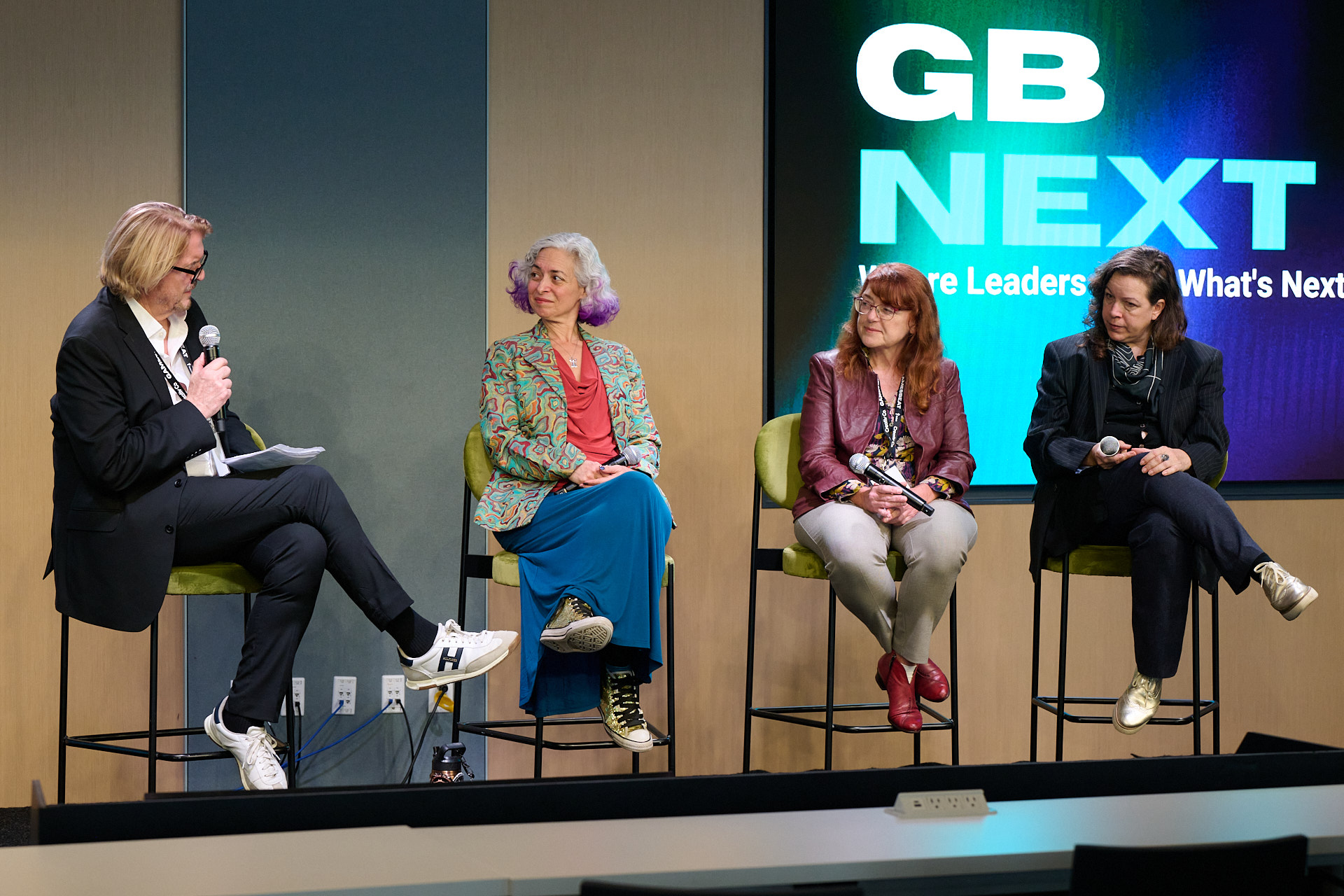
At GamesBeat Next 2026 in San Francisco, a panel of immersive-media creators discussed how spatial computing could turn places like Hollywood into worlds people can enter, not just watch. Moderator Shawn Barrett of TCL Chinese Theatres framed the session around Hollywood 3.0 and the “Hollyverse,” a planned interactive platform tied to the physical location.
Barrett said about 350 million people have visited Hollywood in the past 20 years, compared with 4 billion gamers worldwide. LED panels will move along Hollywood Boulevard starting December 15 so visitors can interact with games. “We think that there’s going to be tourism gaming that will explode,” he said.
Evo Heyning, who leads Reality Craft, said immersive media used to be locked inside apps and platforms. “With WebXR and now with the Immersive Web SDK, game developers can produce their own work straight to the web,” she said. “They can own the relationship with the audience, and they are not bound to a platform taking 30 or 50%.” Web games aren’t for everyone, Heyning added, “but for game developers who were looking for a way to get into this industry, it becomes a much more even playing field.”
Heyning is releasing games built from Gaussian splat scans of real places, plus the family-friendly titles Leader Legacy and Town Life. She shared that cross-play has been the hard part. “You can’t use your AI bots to do the testing,” she said. “You have to really do it with humans. You have to do it across lots of different devices. There’s like 70 different smart glasses, along with all the different XR headsets. So getting something to work just on 10 of them is not an easy task.”
Athena Demos, CEO of Big Rock Creative, said her team was on Microsoft’s AltSpace VR when it shut down in March 2023. They looked at 40 platforms. “Nobody had everything that we were looking for, and nobody was willing to build everything we wanted,” she said. “So then we made the executive decision, as burners often do, to say, ‘Yeah, sure, we’ll just build it ourselves.’” The result was Burnersphere, a virtual Burning Man.
Demos argued that shared immersive spaces change what an audience does. “We’re transforming storytelling into story living, and when you live a story … it becomes more compelling. You’re more engaged,” she said. Her team stopped designing for UX and started designing for what she calls PX, the participant experience. “It’s not user, which tends to be passive and spectator,” she said. “They’re actually participating with it, so there’s a give and a take.”
Nathalie Mathe, founder of NativeVR and a professor at Northeastern University, said immersive work affects people physically and emotionally because it “involves bringing your body with you.” She contrasted that with the usual approach. “Most of the time nowadays, you build some tech, you launch it out there, and then you worry about how it’s going to impact people,” she said. “But we are really working in a different framework.”
That means asking about safety and privacy at every mechanic, co-designing with diverse communities, and measuring results. On AI, she said, “No AI is going to replace artistic taste and judgment.”
Asked for one opportunity to embrace, Heyning pointed to distribution. “As a 360 storyteller right now, there are only a handful of places on the planet that I can put my content for the audience to find it,” she said, adding that she wants the next generation of storytellers to be “more discoverable.” Demos said accessibility matters because many people can’t travel to Los Angeles. Mathe urged developers not to forget young people.
“They are the future creators and they have lots of ideas and talent,” she said.