
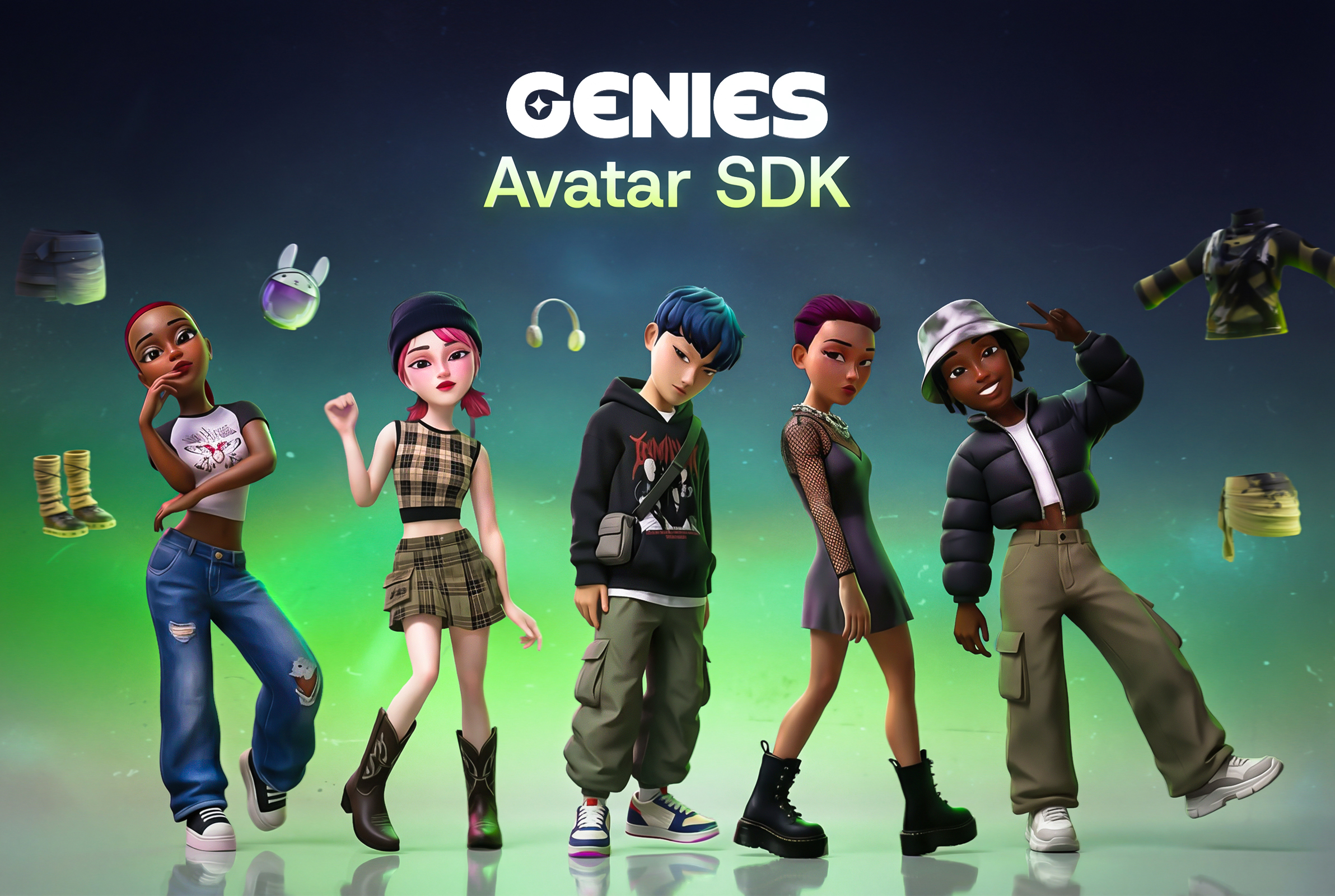
Today, Genies launched its Avatar SDK for Unity developers, a drop-in package that brings the same expressive, AI-ready avatar technologies to game studios across the Unity ecosystem.
Earlier this month, Genies made headlines for pushing deeper into AI-driven digital identity with tools designed for celebrities and talent groups, allowing them to build custom companions and avatar-based experiences. Now the company is broadening that strategy in a major way.
Today’s move marks an evolution from Genies’ work with entertainment partners toward something much more foundational: a developer-facing identity layer intended to power the next generation of UGC, AI characters, and cross-game player expression.
Instead of serving a specialized entertainment niche, this new initiative helps Genies position itself as a key piece of infrastructure—the kind of system developers can adopt to shortcut years of engineering and content pipeline work.
The Avatar SDK bundles together Genies’ full avatar framework, including customizable full-body characters, facial detail systems, wardrobe and asset management, persistent player accounts, and a unified login flow. Developers integrating the SDK gain a fully functional avatar creator immediately, and they can tailor the UI to match stylized, realistic, or genre-specific aesthetics without rebuilding core systems.
Everything is delivered “game-ready,” which is exactly the kind of reduction in complexity that smaller and mid-size Unity studios often need.
Unlike many character-creator kits on the Unity Asset Store, Genies’ SDK is designed around interoperability. Any game using the Genies Framework becomes part of a shared identity system: a player’s avatar, outfits, and cosmetic items persist across every connected title. That model wasn’t present in the celebrity-focused tools announced previously, but here it becomes a central value proposition. For developers, this means players bring their identity with them, not just within one game but across an ecosystem of experiences. Theoretically, it connects layers across games, similar in concept to avatars in Roblox.
The SDK also includes support for generating and storing NPC definitions using the same avatar infrastructure, which can save production resources for teams building large worlds or character-driven environments. With modular rigging and automated clothing refitting, studios can populate their worlds faster and reduce manual art bottlenecks, all while keeping visual consistency across avatars and outfits.
Unity’s massive developer base gives this launch additional significance. As many studios look to prototype more quickly, support UGC loops, or introduce live-service identity systems without building them from scratch, Genies is aiming to fill a gap. Unity itself has been expanding its ecosystem to support creators with more modular and AI-assisted tools, so this partnership slots into a broader shift toward studios outsourcing complexity in favor of iteration speed.
Genies says the SDK will continue to evolve with expanded clothing libraries, deeper customization components, non-humanoid rigs, Unity 6 support, and native desktop builds. Meanwhile, the Creation and Smart Avatar SDKs are expected to push even further into UGC and AI-driven behavior later next year.
With this launch, Genies is no longer just building digital personalities for high-profile talent. The Avatar SDK is a signal that Genies is now aiming much broader, positioning its identity and AI systems as core infrastructure for the next generation of interactive experiences.