

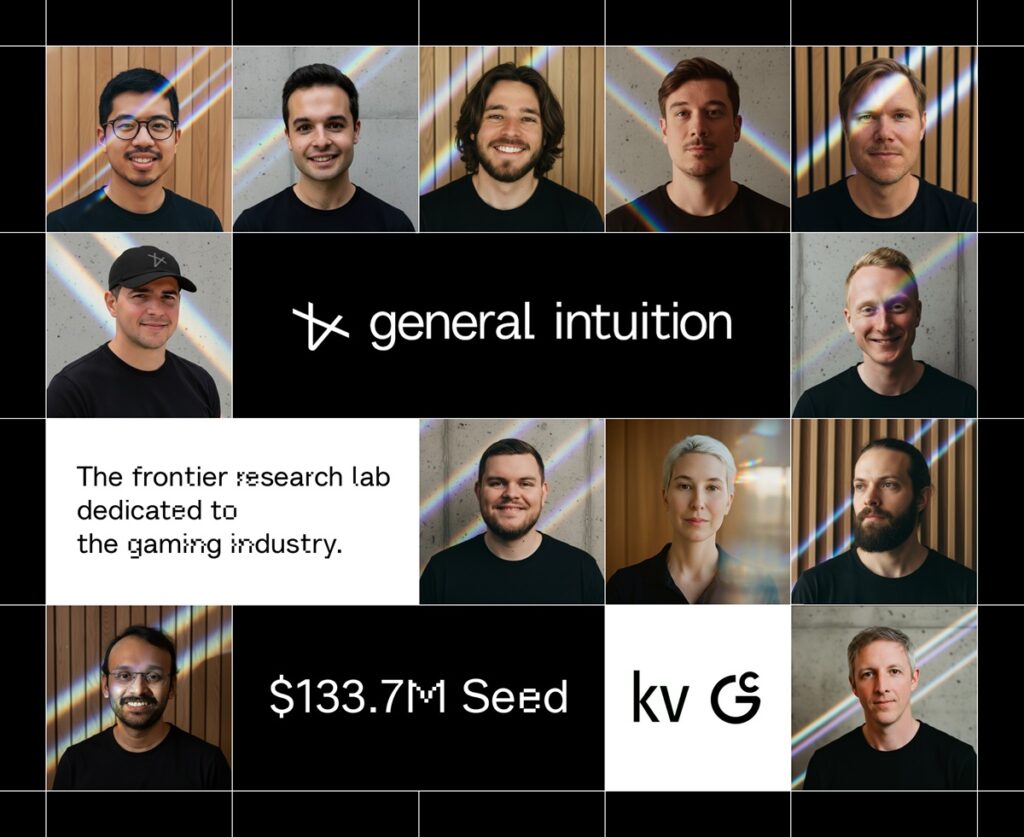
General Intuition raised $133.7 million in seed funding to build the “frontier research lab” dedicated to the gaming industry. It’s perhaps the biggest seed round in the history of gaming.
General Intuition aims to unlock intelligence through games. Khosla Ventures and General Catalyst led the seed funding round, with participation from Raine Group.
New York-based General Intuition builds AI foundation models that require deep spatial and temporal reasoning, for games—and the real world. But part of the reason that it is such a big round is that it has a stable ongoing business, as General Intuition is part of the same company that produced Medal, a social video sharing site for gamers with 10 million monthly users, said Pim de Witte, CEO of General Intuition, in an interview with GamesBeat.
The most powerful foundation models are trained on written words but human intelligence far exceeds language. It emerged over millennia of interaction and exploration—through the endless cycle of intent, action, and consequences across diverse environments, the company said. And it’s hard to translate a text prompt into a full game world, but that’s what General Intuition hopes to go beyond in its research, de Witte said.
The company said it embraces games as the ultimate expression of ingenuity and problem-solving.
General Intuition builds on the strength of Medal, the world’s largest and fastest-growing platform for sharing gaming moments. It is generating two billion video views per year across tens of thousands of games. Again, that’s a lot of data.
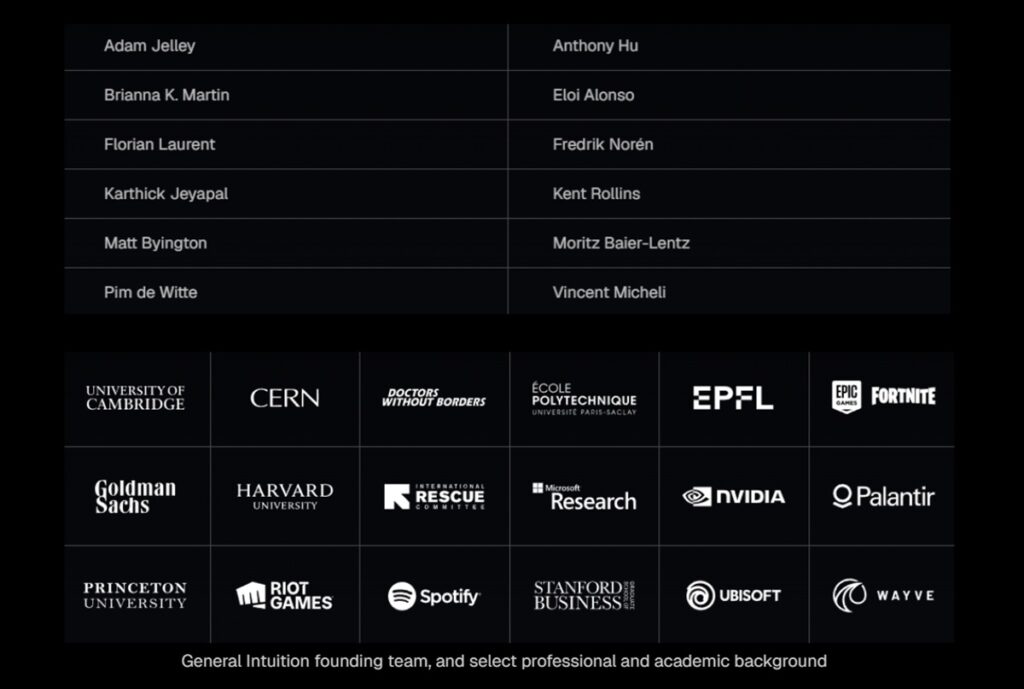
“The most powerful foundation models are trained on written words,” said Moritz Baier-Lentz, partner at Lightspeed and founding team member at General Intuition, in a message to GamesBeat. “But truly intelligent machines must acquire the capacity to perceive, anticipate, and improvise within the unfolding dynamics of reality. From the relationships of intent, action, and consequence, to the irreversibility of time and spatial awareness. Building general artificial intelligence isn’t just about scaling data and compute; it’s about teaching machines to play.”
While Baier-Lentz is part of the founding team, he will remain in his full-time role at Lightspeed.
Starting Medal

At 14 years old, de Witte started Soul Split, which was a private server on the game Scape. He was one of the top players on Scape, and he was motivated to help top players get what they wanted.
Then, in 2018, he started Medal, which began as a game studio and then evolved into a social ecosystem. It exploded in growth as people shared moments with each other from their gaming exploits. Over time, the company zigged and zagged and it made a successful business. Back in 2019, the company bought a firm in Norway. To better manage everyone, the leaders of Medal moved from California to New York.
And Medal turned out to be one of the perfect things that could lead to AI and General Intuition, de Witte said. That was because Medal had so many users and it generated a ton of data that the AI researchers could use. As they dove into that data, they learned new things.
Every month, players capture and share hundreds of millions of gameplay clips—each representing a unique, action-packed highlight. Across countless environments, this diversity leads to uniquely capable agentic systems.
For the past year, the company has been pushing the frontier across:
Agents capable of deep spatial and temporal reasoning,
World models that provide training environments for those agents, and
Video understanding with a focus on transfer beyond games.
How it works
The good thing about General Intuition’s approach to large language models is that it focuses on spatial temporal reasoning. It sets an entity in a 3D space and allows it to figure out things in a visual way, as opposed to trying to parse text prompts or speech prompts.
“Text will do really well for dialogue, but if you ask [the AI] to unlock the lock on a door, it wouldn’t know what that means, spatially.
“If you asked an LLM to do it, it wouldn’t be able to do it. And so it is about the ability to understand the world and act in the world in three-dimensional space that we describe as spatial-temporal reasoning,” de Witte said. “You could try to hard code the understanding of how to unlock the lock, but that doesn’t scale. This is general. This [works] in any brand new world. It can understand what is going on there and take actions there.”
He added, “If you look at actual human intelligence history, text came after our ability to do spatial-temporal reasoning. Text actually is a function of what we as humans invented text to describe our own spatial temporal reasoning. If you are very abstract about it, text is a compression method of spatial temporal reasoning where you basically lose a lot of information.”
And he said, “If you had true spatial-temporal reasoning, the actual environment would adapt to you, right, as opposed to just a few deterministic knobs that are deterministic in code. The whole beauty of a system like this is that it allows you to go beyond code space. I think that’s going to be the magic. Others can build a smart NPC. But we’re going to be able to create, in addition to interactive environments, agents or bots that are maybe indistinguishable from humans, that feel fun and fair to play against. And it doesn’t feel like I’m playing against some bot. It feels like that’s a person.”
De Witte said the company has made progress with big companies and it has a set of partners locked down that it can work with.
Not a replacement for people
As a public-benefit corporation, de Witte said the firm will not develop technology that replaces game developers, designers, or artists.
De Witte said the company feels a sense of responsibility because game developers don’t want to be replaced by AI. And so it is paying attention to how its technology can be used.
“We have a different perspective that we want to share,” he said.
It’s like making your artists superhuman with AI.
The company’s aim is not to train models that will replace artists, de Witte said.
“We focus on action prediction, right? So we focus on models capable of deep spatial temporal reasoning,” he said. “We’re generally trying to position as representing the games industry. A lot of these labs are using data from the games industry in various ways, right? You only need to go and look at some of these generations from these models to see that, very clearly, they’re trained on video games.”
He said that General Intuition knows that “games is one of the last little weird places on the internet, and it just needs to stay that way. And what I would hate to happen is for games to get caught up in this big tech race where, I think realistically, right now, there is a very real chance of the games industry becoming like collateral damage.”
He said the game industry needs to stay weird and continue to be a breeding ground for cool ideas.
“That’s really what we’re trying to represent. AI has a role to play in those weird ideas, in that human expression and creativity. But it isn’t about cutting down your number of artists. It’s like letting your artists do artists do something they were never able to do before, or let your designer design a bot that’s way more engaging and humanoid and compelling than a normal heuristic-based approach,” he said.
“Instead, we believe that we can drastically improve the gameplay across existing games—and create entirely new, previously impossible experiences,” de Witte said.
Its plan is to hire the most talented researchers and engineers with a love for games.
“We believe the next breakthroughs in intelligence research will come from interactive video data, and we are in a unique position to discover them,” de Witte said. “We are assembling a world-class team with the expertise needed to build groundbreaking, scalable systems. Our team includes leading researchers, infrastructure experts, video processing specialists, and the people behind games you already love.”
De Witte added, “We’re hiring ambitious researchers and engineers with experience in games, consumer, mobile, social, video, and large-scale model training and data processing.”
General Intuition’s origins
The lab started in January 2025.
“We had the opportunity to sell the company earlier this year,” de Witte said.
Instead of doing that, the leaders chose to change the ownership within the investor ranks and come out of the process as a new seed company. Then it raised the seed round. The investors who wanted exits got them, and General Catalyst and Khosla Ventures started acquiring shares, giving a generous premium to those selling.
The new result was a new round of $133.7 million, all generated for the new company from new investors. Another chunk of money went toward investors who sold their shares. Even so, judged on that basis, $133.7 million is a huge funding round in games.
“Genuinely, I think we landed somewhere really good. The best way to think about it is that a large portion of cumbersome work — deterministic engine programming of NPCs and bots and things like that — is going to no longer be as necessary.
“People are just going to have a lot more fun in video games, with these types of models,” he said. “And again, not just in games, right? I think that the name is general intuition because we generally figure out how to model the action space of a human and how they act in different situations. And so games is like the first way it comes out. But I think you’re going to see it come across in a lot more industries.”
He said the company is hot because of AI, but the fundamentals of the valuation are strong because the business generated by Medal is substantial.
“With Medal, we just crossed 10 million monthly active users,” de Witte said. “This was the fastest growth year ever. We still grow organically. So the Medal story continues to just be a good one. I think the other thing that’s also interesting is the bet that we’re making is that with AI-generated video, for example, people are just going to spend less time on social media because it’s so much harder to enjoy it when you don’t know if what you’re looking at is real.”
De Witte said, “The other thing is that’s going to lead to just more people playing video games and interacting in these types of environments. And so you see, so we think Medal as a company also does really well, but the valuation and hype is definitely driven by the lab. They’re highly related.”
In fact, the company was able to attract researchers because of all of the data generated by Medal. Those researchers also liked the fact that Medal had made the company into a stable firm with a sustainable future.
The game industry’s challenges
De Witte knows that games have a real problem competing with TikTok and other short-form video. A way to fix that is to make games more entertaining and engaging and fun, he said. He thinks games right now are capped on fun because the environments aren’t intelligent enough.
“If we level up the intelligence in the environment by giving you better bots, better intelligent objects in the environment, in the engine, and things that are just more fun, then I think that’s the best thing,” de Witte said. “Another way of looking at it is replacing the player controller in the game engine. It’s like one of the things that I like to say, for instance, is where you’re able to just create completely new type of experiments. I think this is the best shot at fighting back.”
At this moment in the conversation, I noted that this reminded me of Will Wright’s intention when he was creating The Sims, one of the most creative and successful games of all time. He thought of The Sims as relatively dumb people, surrounded by intelligent objects. The Sims were driven by instincts like hunger. If a Sim was hungry, the surrounding objects would intelligently advertise themselves to the Sim. So the refrigerator would say, “Come to me and eat something.” It was kind of a kluge for the lack of real intelligence in The Sims, but it worked to create more realism. The end result was The Sims appeared to behave like real people.
De Witte agreed this was a similar situation.
“Now, imagine if every object in the environment could behave at an intellectual capability of an agent capable of spacious plural reasoning, meaning that, in an ideal world, you have these, really intelligent interactions with things that genuinely push your own understanding,” de Witte said. “I play high-level Rocket League. The bots cap out at a very low rank. So if I want to practice specific things, there’s just no way for me to get engaged in those types of loops. It is genuinely a bottleneck. I think also, for instance, people just want smart bots to play with. If we generally get bots that are as good as humans, I would duo with a very intelligent version of myself.”
This made me think of Krafton’s announcement of an AI-driven player companion in the battle royale game PUBG Battlegrounds. It announced a companion that would stick by you and behave like a human should. Many humans will abandon you in that game even though they would be better off sticking together. Separately, it’s easy to get shot and together you can at least heal or rescue each other.
Anyway, de Witte said he likes humans having a role as orchestrators of armies, like a human that controls a lot of bots.
“This unlocks new genres, right? And I think the game industry is in dire need of new things,” de Witte said.
In other words, he’s saying we need new game loops. Innovation has stalled, and we’re getting lots of clone games.
“One way we make the gaming industry more competitive is we just unlock new types of loops to exist that then retain players. The problem that I see is a lot of games are failing to get the player liquidity,” said Kent Rollins, CTO of General Intuition, in an interview with GamesBeat. That’s a reference to not having enough players at any given time.
He added, “And the reason they’re failing to get the player liquidity is because they’re competing with TikTok on time spans. I used to play RuneScape growing up, and we would all be on RuneScape, all times after school, and that would fill up the player liquidity, which would make for how you retain users.”
Now, with attention so spread out between YouTube and Tiktok and games, it’s harder to get that density right, he said.
“If you solve for liquidity and density with just better environments and better bots, then I think you unlock viable loops that weren’t viable before. We look at it as solving a fundamental problem that the games industry has been stuck in for maybe the last five years or so,” Rollins.
At Epic Games, Rollins’ former workplace, the company still struggled with player liquidity and bots in Fortnite. It was one of the largest games in the world and still had challenges dealing with player liquidity. By extension, smaller games have no chance at getting enough players together, Rollins said.
Helping game publishers and studios
While General Intuition has a lot of researchers and data in the form of its player videos, the company isn’t going to make its own games. Rather, it wants to work with some of the biggest game publishers in the world to help them solve their problems.
De Witte said, “We cannot turn Medal into automated game-playing software because then game developers wouldn’t like that. The path is going to game developers to work with them. I’m interested in the idea of developing native content around what it could be, but I think we very much want to be serving the games industry.”
It’s kind of similar to how X (Twitter) coexists with other companies like XAI inside Elon Musk’s business empire.
“If we were to make a game, it would be about demonstrating capabilities and content, rather than trying to compete in the market,” de Witte said.