
The average salary for U.S.-based game professionals in 2025 was $142,000, slightly up from a year before, according to an annual salary survey by the GDC. But 24% of game professionals also said they had been laid off in the past two years.
Those two facts in a nutshell tell you the opportunity and the heartache of making games in the U.S.
The full report includes findings that provide a snapshot of industry salaries and key topics surrounding them, including the following survey data:
- The median salary is $129,000 (the median data reflects the “typical” value in the middle of the dataset, while the average is the total sum divided by the number of respondents and can be skewed by extreme results).
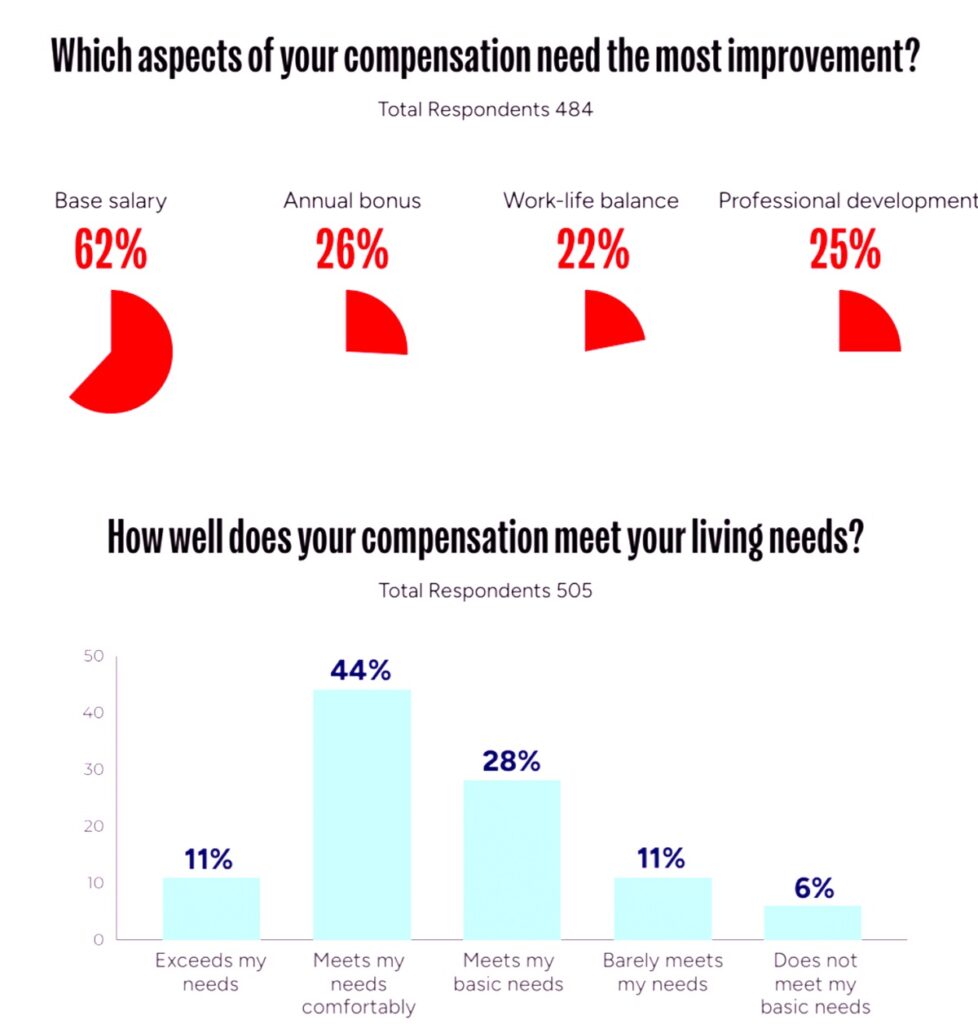
- Around 80% of employed respondents said their current salary meets or exceeds their basic needs.
- Over half (53%) of respondents say they feel somewhat or significantly undercompensated at their job—based on their role, experience, and market conditions. That number increases to 69% for contractors, consultants, and people working part-time.
- 60% of women and non-binary people report feeling undercompensated (compared to 50% of men), along with 62% of non-white game workers (compared to 50% of those who identify solely as white).
- A whopping 98% of respondents rate the game industry as less secure than others, and 29% of them said they are unlikely to stay (21% were unsure).
- Almost two-thirds (64%) of respondents said they support the unionization of game industry workers, with over half of respondents (56%) saying they are interested in joining a union.
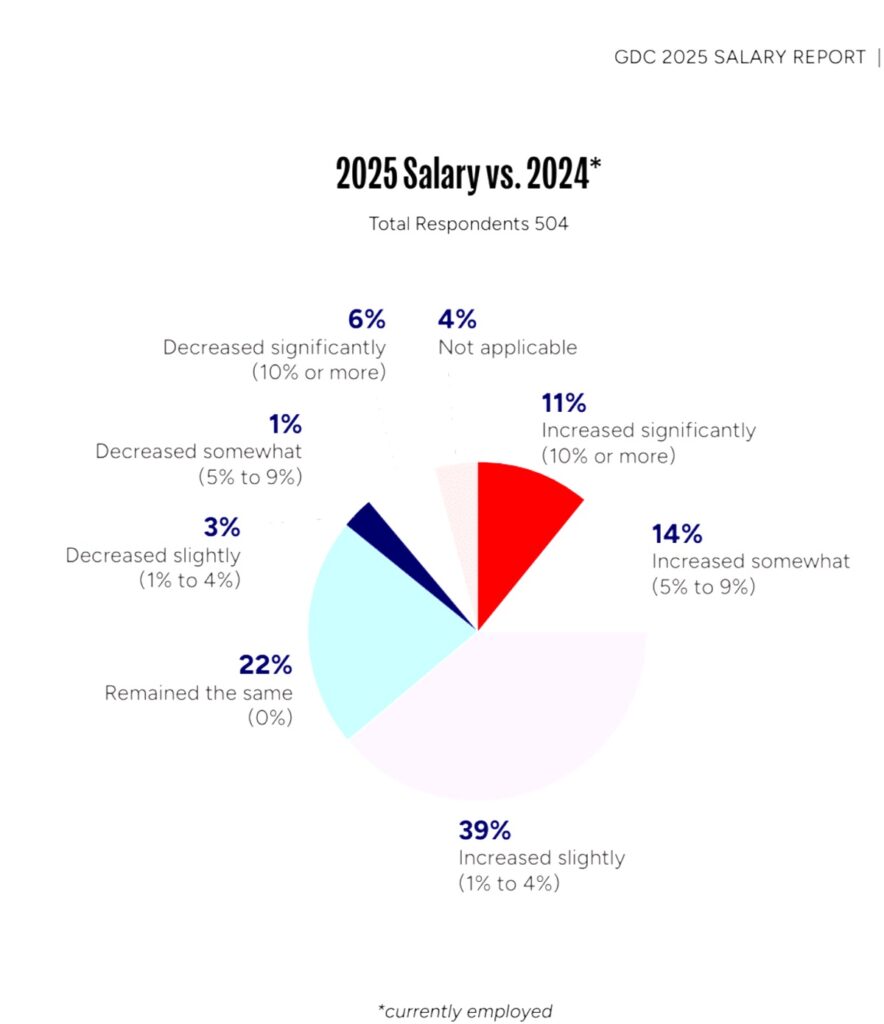
The game industry has been through a hard time, to put it mildly. One-fourth of game
industry professionals have been laid off sometime in the past two years, with many of them still looking for work, the GDC said.
Add studio closures, mergers, and potential automation via generative AI: It’s enough to make anyone think twice about a viable career in the game industry.
But the industry persists. Studios are recruiting, developers are making games, and mentors are guiding the next generation. There’s so much passion that goes into games, and it’s reflected in the people getting paid to make them. But are they being paid enough?
In July 2025, GDC surveyed 562 game industry professionals based in the United States. The Informa-owned group, which will put on the GDC: Festival of Gaming in March 2026, wanted to see how salaries have grown (or not in some cases), along with how layoffs have impacted the job landscape. This survey has a 3% margin of error at a 95% confidence level.
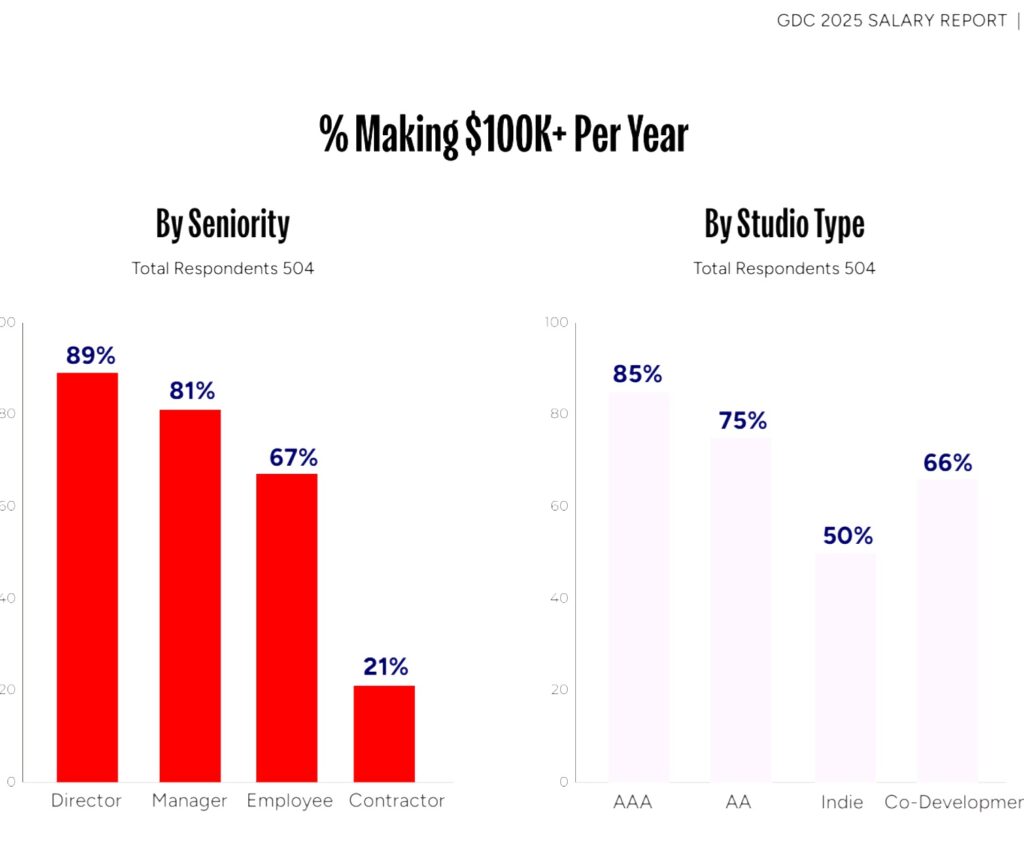
According to the survey, salaries tend to be higher for professionals in triple-A studios, individuals working at larger companies, and those who were recruited or referred for their current positions instead of applying through a job posting.
Not surprisingly, seniority and years in industry also have an impact on salaries, with more years (or a higher title) usually resulting in higher pay. However, for the most part, education levels don’t seem to significantly impact average salaries—except for those with a master’s degree or PhD, who tend to get paid more.
About 85% of game industry professionals employed by another person or company receive health insurance. Some of the other more common benefits received are employer-matching contributions and stock options. Interestingly, developers working at companies with fewer than 50 people were less likely to report having health insurance, but they were more likely to have stock options.
Some of the least common benefits include certification/tuition reimbursement and childcare subsidies.
Around 80% of employed respondents said their current salary meets or exceeds
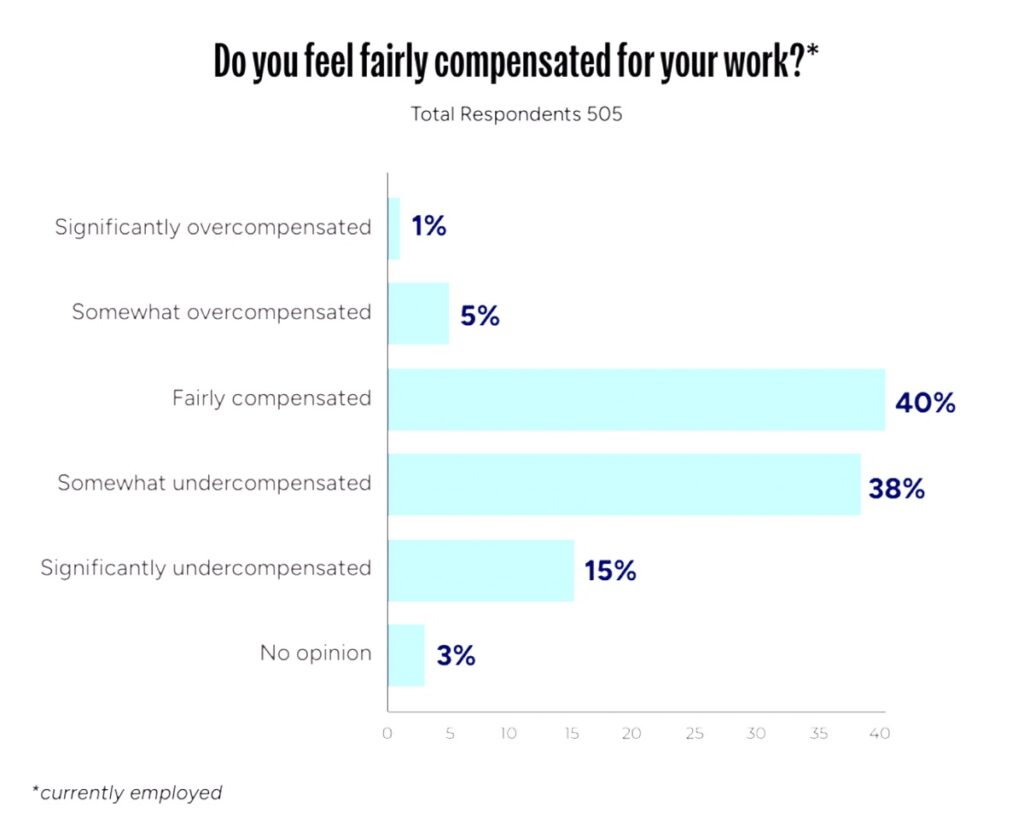
their basic needs. The highest levels of comfort were reported among workers in programming, visual arts, and management/operations. Overall, one-third of respondents feel they are fairly compensated for their work (5% say they are overcompensated). But not everyone feels as fortunate.
Over half (53%) of respondents say they feel somewhat or significantly undercompensated at their job—based on their role, experience, and market conditions. That number increases to 69% for contractors, consultants, and people working part-time.
Respondents working in business/marketing, visual arts, and management/operations were more likely to say they feel undercompensated, along with those holding a supervisor or managerial position.
In addition, 60% of women and non-binary people report feeling undercompensated (compared to 50% of men), along with 62% of non-white game workers (compared to 50% of those who identify solely as white).
For the most part, working in games is a full-time commitment. Three-fourths (74%) of currently employed respondents work a single full-time position, while one-tenth are freelancers or contractors and 2% have one or more part-time positions.
For those who work directly on games, one-fifth say they also perform outside tasks like marketing, sales, business development, and research. In addition, 11% of employed respondents (including 11% of full-time workers) take on additional work outside of their primary job.
The most popular side gigs are independent game development, consulting, and contract work for other studios. One-tenth of respondents with side jobs are streamers or content creators.
When asked why they take on additional work, over half (57%) said it’s because they need additional income. This was followed by creative fulfillment (52%), career development (31%), and project diversity (30%). 11% of employed respondents take on additional work outside of their primary job.
Current state of layoffs
The game industry can be a tumultuous place—especially for those in the more creative fields. According to the GDC survey, 32% of folks working in audio, game design, or visual arts have worked for at least five companies over the past 10 years (compared to 13% of those in programming, business, or operations). This includes people working full-time, along with those who’ve done freelance, contract work, or part-time.
This is also reflected in the layoffs crisis. According to the survey, 28% of people working in audio, game design, or visual arts experienced a layoff during the past two years (compared to 22% of those in programming, business, or operations).
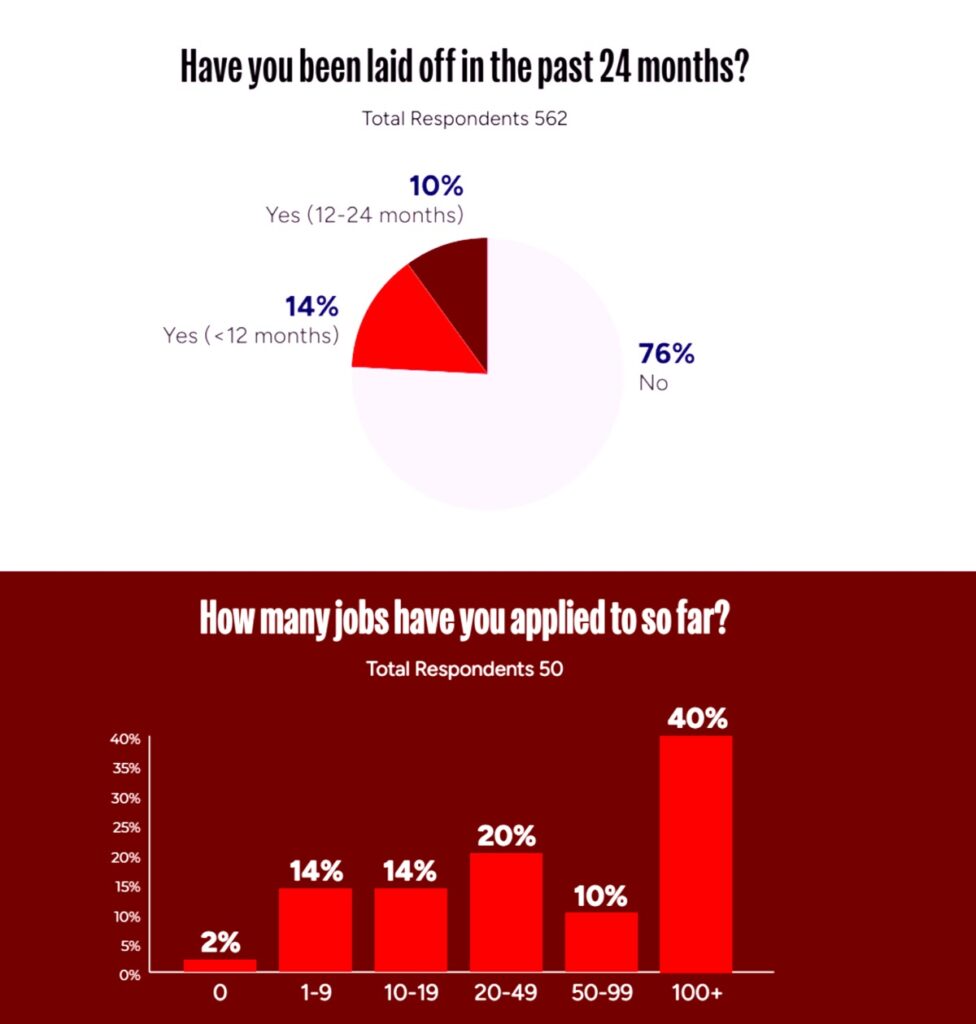
Overall, one-fourth (24%) of respondents say they’ve been laid off at some point in the past two years. Almost half haven’t found another job yet.
When asked about their current job search, 44% of still-unemployed respondents said they spend 6-10 hours per week looking for work, and 40% noted that they’ve filled out at least 100 applications so far.
For those who’ve found work after being laid off, 90% said their new jobs are at least somewhat like their previous ones. But their salaries might not be. While 19% of respondents did say their new salary is the same as their previous one, 19% said their pay increased by at least 10%… and one-fourth (25%) said it decreased by that same amount.
Layoffs affect industry confidence
The climate of ongoing layoffs and studio closures has led some game industry professionals to question the stability of their own careers—though most still
feel relatively secure. Almost two-thirds of employed respondents said they feel somewhat or very confident in their current job security, while one-third of them
said they do not.
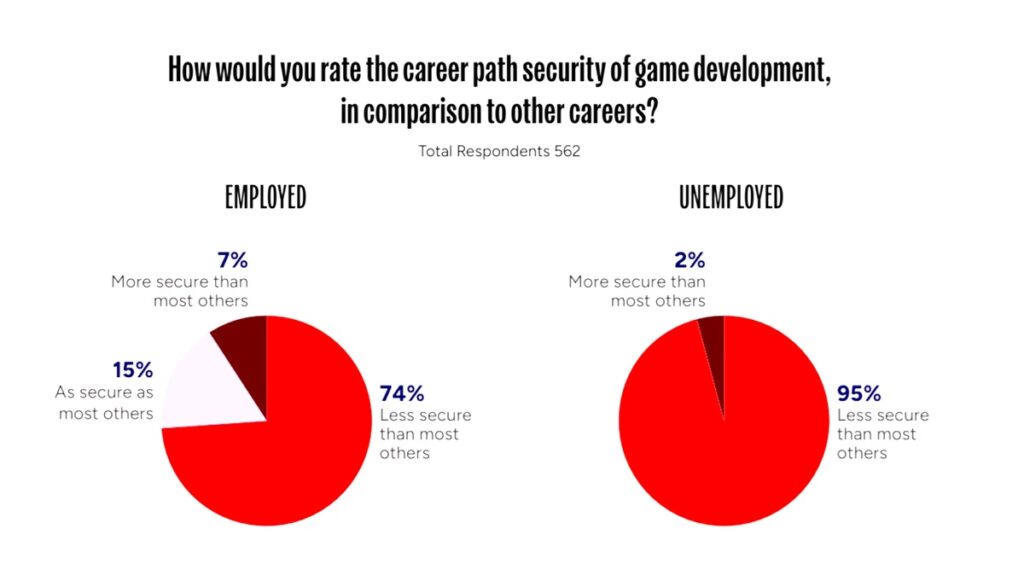
Less can be said about confidence in the game industry as a whole. When asked to rate the stability of game development in comparison to other careers, 80% said it was a “less secure” profession.
That’s not stopping them from continuing to do what they love: 82% of respondents said they are somewhat or very likely to stay in the game development industry for the next five years (11% said they were unlikely to stay and 7% were unsure).
The story is a little less hopeful for those who are unemployed. A whopping 98% of them rate the game industry as less secure than others, and 29% of them said they are unlikely to stay (21% were unsure).
Pay equity remains a complicated issue: 33% of employed respondents said their companies are working to close existing pay gaps for women and employees of color, while one-tenth said no efforts are being made (about 38% of respondents said they didn’t know). However, 15% said there was “no need” to establish salary parity based on race or ethnicity, and 17% said their companies didn’t have a gender pay gap (including 21% of men).
The numbers tell a different story.
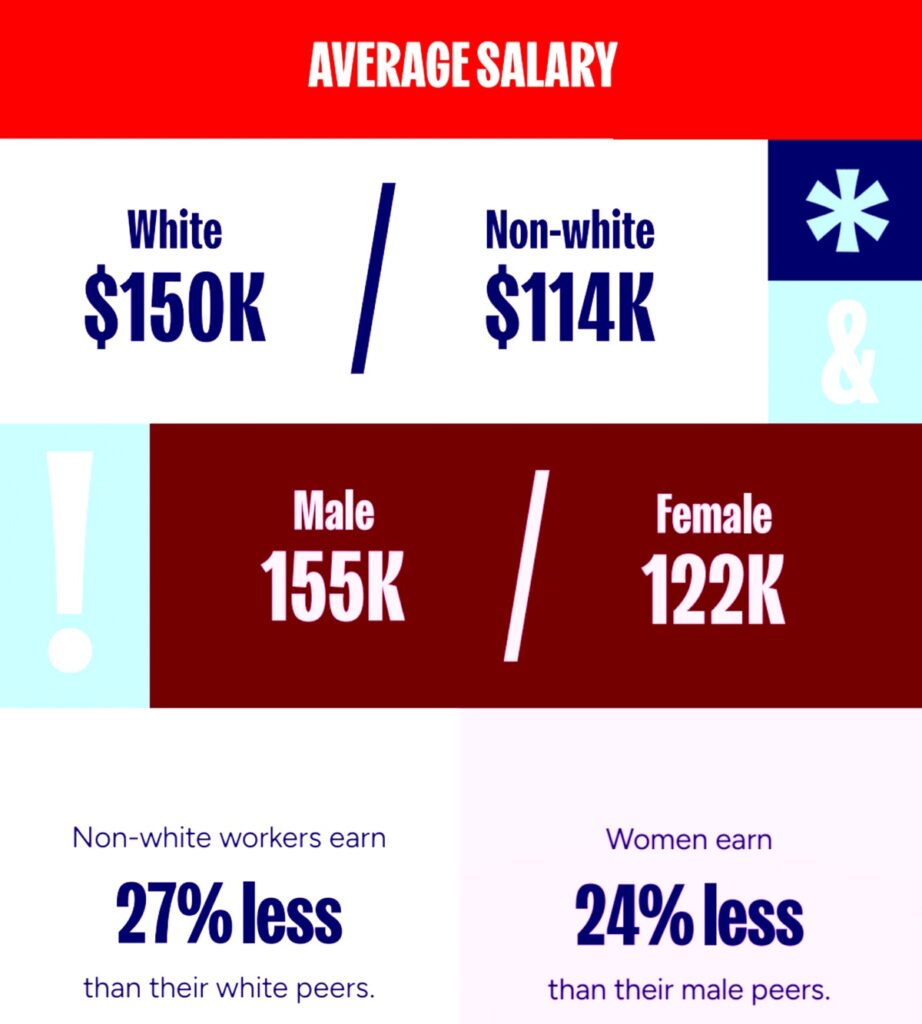
According to the respondents, non-white workers on average receive 27% less than their white peers. Women earn 24% less than their male counterparts. For context, the current gender pay gap in the United States sits around 15%.
To test this further, GDC compared the salaries for one specific group that had statistically similar representation to the core survey: currently employed game designers with at least six years of experience (75 respondents in total). Within this subset, two-thirds of men (68%) received at least $125K per year, compared to 38% of women and non-binary respondents. In addition, 62% of white respondents made at least $125K per year, compared to 45% of non-white game industry professionals.
Lack of pay transparency
Pay transparency is a complex issue in the United States. There are no federal laws regarding the practice, but several cities and states have passed their own regulations that require employers to post expected salary ranges for new positions or promotion opportunities. According to the survey, about 29% of respondents work at companies with some level of open pay transparency.
Informally, people working in the United States have a protected right through the National Labor Relations Act (NLRA) to discuss their wages—even if their company is based outside the US. However, almost one-fifth (18%) of respondents said there’s “no transparency or discussion allowed” at their places of work. Those working in visual arts (29%) were most likely to say that no pay discussions are allowed.
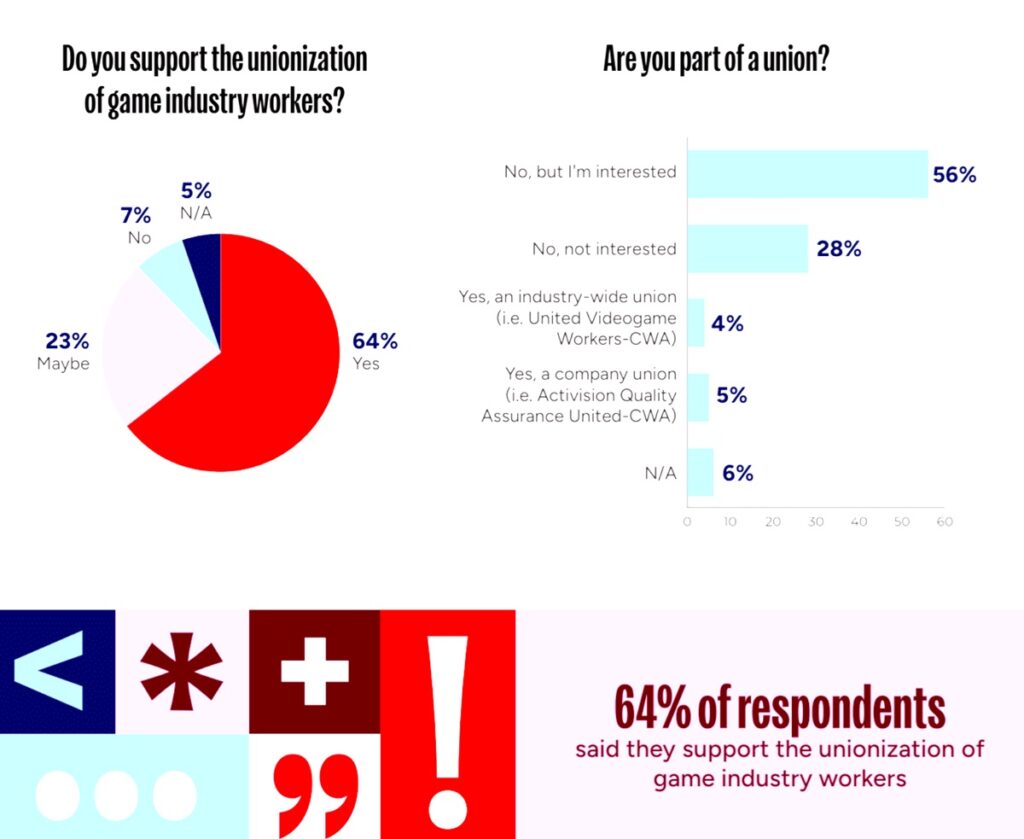
Almost two-thirds (64%) of respondents said they support the unionization of game industry workers, with union support higher among younger workers, people who are currently unemployed, and those making less than $100K per year. One-tenth (9%) of respondents say they are currently part of a union.