
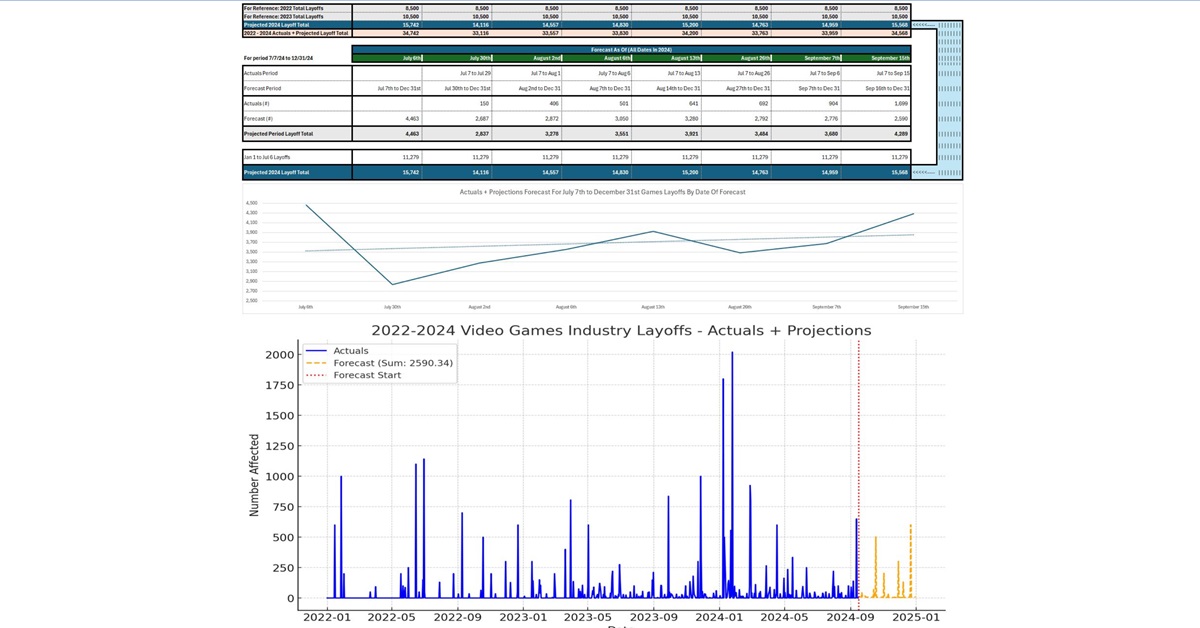
Game hiring was starting to look like it was getting better in the second half of the year. But Amir Satvat, the job resource aggregator who knows this space, said that it looks like hiring has slowed.
In a post on LinkedIn, Satvat said that the number of available roles has declined more than anticipated, dropping from 14,691 to 12,666 over the last three months. While some of this is due to roles being filled, Satvat’s estimates indicate that a significant portion is also due to a slowdown in hiring.
Part of the shift has been clear. Last week, Microsoft announced it would lay off another 650 employees across the Xbox division. That comes after the company laid off 1,900 people earlier in the year. Other recent job cuts (on Game Industry Layoff Tracker) include six at Evening Star, 25 at Annapurna Interactive, 139 at Lost Boys Interactive, and 90 at Tilting Point — all since the start of September.
“Due to this shift, I’ve had to adjust my estimate for when the trailing 60-day hiring will exceed the 60-day cuts, moving the breakeven point from the end of October 2024 to the end of December 2024,” Satvat said. “If there’s further deterioration in available jobs or additional large-scale cuts, this could push the turnaround from Q4 2024 to Q1 2025. However, for now, I remain hopeful for the very end of Q4 2024.”
Earlier in the year, the data looked like the crossover would happen in September 2024. Overall, the worldwide game job numbers are fuzzy, but Satvat believes it is around 300,000 or so. He is trying to come up with the most accurate data on the worldwide game job market.
In the meantime, Satvat has updated his list of resources to help people get jobs via AmirSatvat.com. Satvat keeps a list of all available games in the industry, with information updated for thousands of game companies.
In his most recent revision, Satvat said he undertook an extensive review to remove organizations without active career links, those with dead links, or those that hadn’t posted a role in over a year. As a result of these changes, the number of games companies listed has decreased from 3,713 to 3,137. Out of these 3,137 companies, 1,024 are currently hiring.
Satvat will help us sort through the game job market on a panel at GamesBeat Next, our next game business event happening on October 28-29 in San Francisco. Satvat has given out free codes for the event. And you can use this code for a 25% discount: gbn24dean.
Update: September 22, 3:18 p.m. Satvat added the following analysis on 9/20/24:
Key Insights for Games Job Seekers From the Last 6 Months
Amir Satvat
The chances of landing a job in games after 1 year of searching have increased from 6% to 7% over the last 6 months.
However, some of the sub-splits are even more revealing. For those with experience, the odds have roughly improved from 25% to 30%. But for those with less than 3 years of experience and no prior work in games, the odds have dropped from about 2% to 1.8% (though this cohort had previously enjoyed a rebound from a low of above 1% earlier in the past year).
These percentages reflect a complete openness to relocation. Depending on where you live – whether in a games hub like California or Quebec, or elsewhere – roles are highly concentrated globally. Living outside a major games hub, or only seeking remote positions (which now make up just 14% of opportunities), can reduce your overall chances by as much as 65%.
A third of the games industry’s jobs globally are in just 15 cities.
In North America, 75% of the games jobs are located in just a few states or regions:
– California (34%)
– Quebec (16%)
– Washington State (8%)
– British Columbia (7%)
– North Carolina (5%)
– Texas (4%)
Per above, nearly half of North America’s games jobs are in California and Quebec alone.
For active members of our community, those who have engaged with all available resources for 3+ months, I have extremely robust data from the past 2 years that continues to confirm that our members’ odds did double from 6 to 12% up to six months ago, as part of a retroactive study.
I have launched a new study to see whether, at this new placement rate of 7.3% for the last 6 months, our 2x impact similarly scales. These effects are highly significant but less pronounced for those who have already worked in games (already a 30% chance).
Many break into games after other industries. Our data continues to suggest a multiples higher chance of gamers finding jobs if they are open to all industries. I implore everyone who helps early-career individuals, especially those in games programs: you must be realistic about students’ chances.
The number of early career roles worldwide has not budged from 600-1,000 for 2 years.
1.8% is 1 in 56. The other 55 kids must get paid for something else for at least a year. This doesn’t mean giving up on dreams – I didn’t!
These overall gains in job placement rates are part of the reason why my job market “recovery” (defined as break-even 60 days trailing hires versus layoffs) is still projected for Dec 2024, pushed back from October 2024 due to heavier cuts in recent weeks.
I’m observing a complex balance between recent layoffs (higher than expected) and the hiring success rate (higher than expected). Net job openings across the games industry have decreased by 2,000 over the last 3 months (~14,000 to ~12,000), though much of this is due to roles filled and closed. Nonetheless, this remains an offsetting negative factor and I continue to study these variables.