
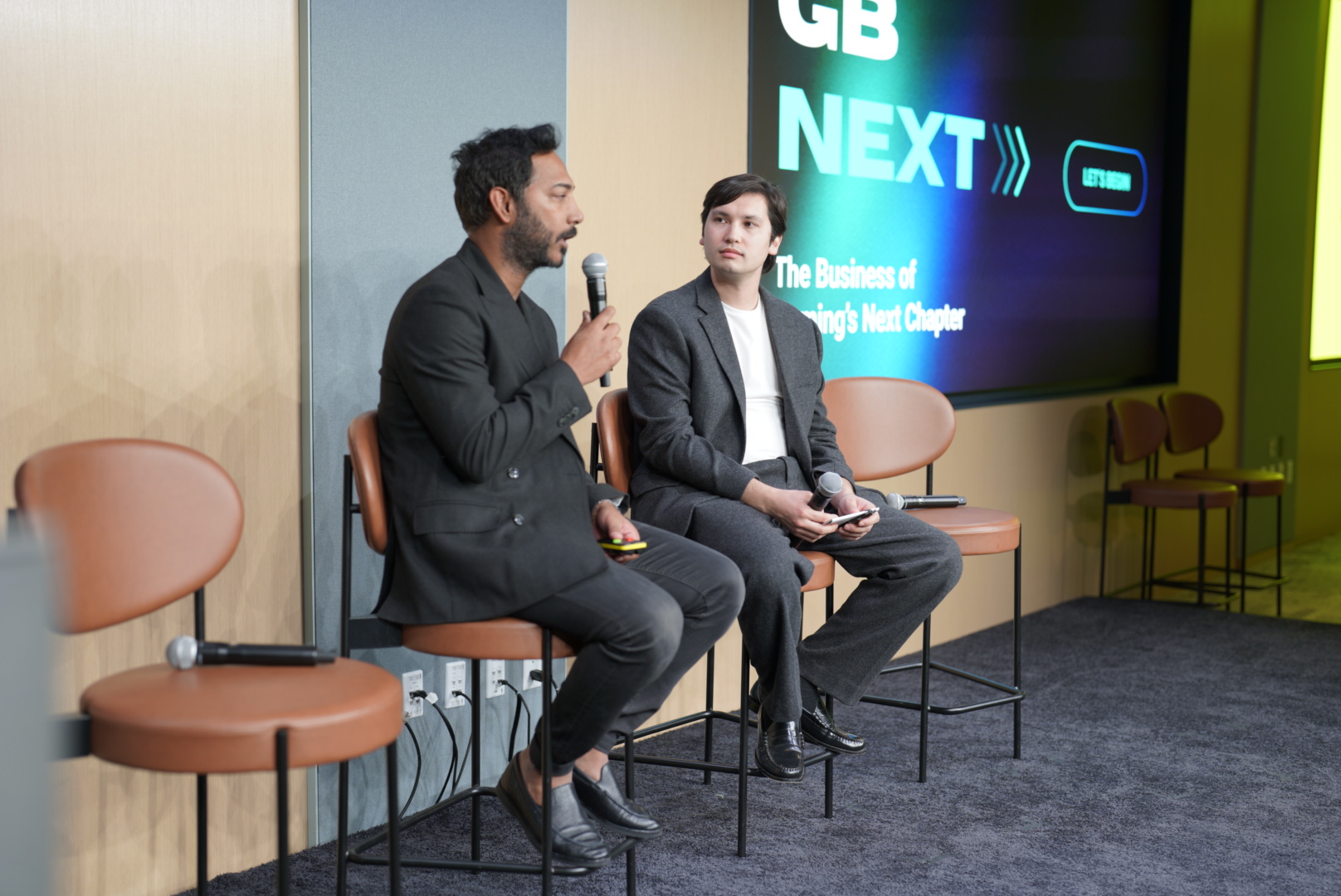
With video game players increasingly avoiding the “gamer” label, Livewire’s Indy Khabra sees the shift as an opportunity to build bridges between gaming and other forms of mainstream culture.
On day one of GamesBeat Next today, November 12, Khabra, the co-founder and global co-CEO of the gaming marketing tech company Livewire, sat down with GamesBeat lead news writer Alexander Lee — aka yours truly — to discuss the evolution of the “gamer” identity. The session pulled heavily from Livewire’s recent “Power in Play” study, published collaboratively with Publicis Media, which showed that 64 percent of players who game at least once a week do not strongly identify with the gamer label.
In the main room at GamesBeat Next, there is a “hot take” whiteboard, on which any attendee can use a marker to write and share their spicy opinions about the future of the industry. One take prominently displayed on today’s board was an attendee’s opinion that “the ‘gamer’ label is holding us back.”
Khabra denied that he had written the anti-gamer-label statement, although it aligned well with the topic of his talk. Instead, he argued that the word “gamer” will likely continue to be used by players and marketers in the future, just modified more often with adjectives like “casual” or “competitive.”
“On the advertising and marketing side, I don’t believe the word ‘gamer’ is going to disappear. There’s a level of relevancy; I think how we use it is changing,” he said. “So, instead of calling X a ‘gamer,’ it’s going to be a ‘casual gamer,’ or a ‘gamer who likes X genre.’ This is an evolution, not only of how communities want to be seen and identified, but also how we describe the space as well.”
Instead of viewing gaming as a niche interest, Khabra said Livewire sees gaming as the “central gateway” through which younger audiences can connect with other forms of culture, including sports, music, entertainment and fashion. He cited his company’s recent partnerships with the NFL, for which Livewire is currently producing a docuseries, as well as Live Nation, whose Livewire-designed Roblox experience is slated to launch in January.
“Whether it’s MLB, whether it’s football, whether it’s cricket, every sporting code is looking to connect with that next generation of fans, and gaming is front and center as one of those ways to do that,” Khabra said.
As marketers look beyond the gamer label to reach video game players with more nuance, collecting and processing user data will be key for advertisers to better understand players’ preferences. Khabra flagged Livewire’s Gamer.ID tool, launched earlier this year, as one of the company’s offerings intended to address this problem, with the overarching goal of guiding brands’ investment, improving targeting and increasing the overall flow of advertising spend into gaming.
“In the United States, we have 135 million unique deterministic IDs — that is 88 percent of the adult gaming population in the United States,” Khabra said. “So, a very large data set, and we’re using that to understand the player base.”