
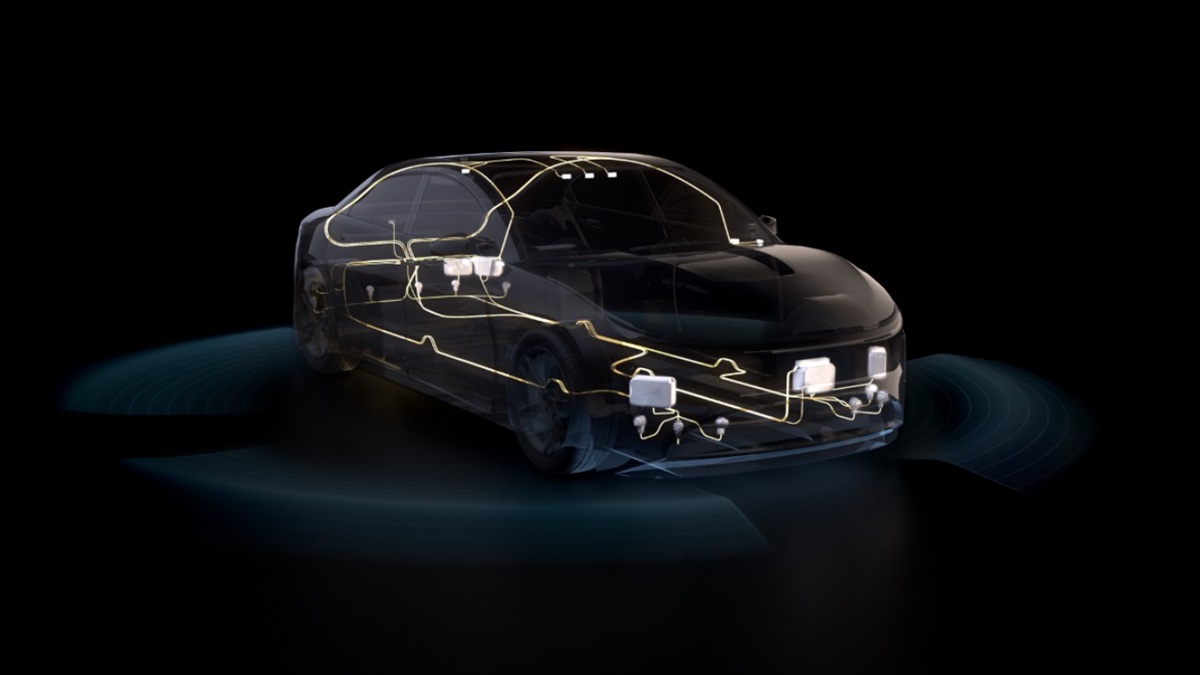
Nvidia said that Nvidia Drive Hyperion platform adoption is growing fast, including with global automakers BYD, Geely, Isuzu and Nissan.
Nvidia also said the car automation platform is also getting adoption from mobility providers — reflecting rapid momentum toward safe, scalable autonomous vehicle (AV) development. Nvidia said the partners are implementing Level 4 self-driving cars (out of a total of five levels) where a car can operate fully autonomously within specific conditions or geofenced areas — without requiring a human to take over.
Standardizing on Drive Hyperion — supported by the Nvidia Halos OS safety architecture
— enables these partners to accelerate validation cycles and streamline global deployment strategies. By using a standardized reference architecture that integrates compute, sensors, networking and safety systems, manufacturers and mobility leaders can achieve faster fleet learning and more efficient global scaling.
Nvidia announced the news during the GTC keynote by CEO Jensen Huang at the company’s GTC event on Monday in San Jose, California.
“The autonomous vehicle revolution is here — the first multitrillion-dollar robotics industry,” said Huang, in a statement. “Everything that moves will eventually be autonomous. The Nvidia Hyperion platform and our Alpamayo open reasoning models give vehicles the ability to perceive their surroundings, reason through complex situations and act safely — making scalable, level 4 autonomy possible.”
Drive Hyperion scales L4 vehicle programs and robotaxi platforms
Leading automakers BYD, Geely and Nissan (powered by Wayve software) are developing
next-generation level 4 AV programs built on Nvidia Drive Hyperion production-ready compute and sensor architecture.
Isuzu and Tier IV are also collaborating on L4 autonomous bus development using the
Nvidia Drive AGX Thor system-on-a-chip, part of Nvidia Drive Hyperion.
In addition, Nvidia is collaborating with Amazon to advance Alexa Custom Assistant with
multimodal edge AI capabilities on Nvidia Drive AGX accelerated compute, enabling automakers to deliver ambient in-cabin intelligence with privacy in mind and enhanced
performance.
Uber is building one of the world’s most expansive autonomous ride-hailing networks
powered by Nvidia drive Hyperion. Supported by a growing roster of automaker
platforms, Nvidia and Uber today announced an expanded partnership to launch a fleet of
autonomous vehicles entirely powered by the full-stack Nvidia Drive AV software across
28 cities and four continents by 2028. (I guess we’re going to see the gig economy evaporate in those cities).
The rollout will begin with Los Angeles and the San Francisco Bay Area in the first half of 2027.
This Drive Hyperion-powered fleet will tap into Nvidia Alpamayo open models and
the Nvidia Halos operating system to accelerate the development and deployment of
safe, scalable robotaxi services worldwide in 2027.
Other mobility leaders including Bolt, Grab and Lyft are also leveraging Nvidia Drive
Hyperion to accelerate autonomous mobility initiatives, signaling broader industry
momentum toward software-defined robotaxi fleets.
Advancing Level 4 hardware
Extending Nvidia Drive’s full-stack approach to software safety, Nvidia Halos OS delivers a universal safety foundation for production-ready, scalable autonomy on Drive Hyperion.
Built on ASIL D-certified DriveOS foundations, its unified, three-layer safety architecture integrates safety middleware and deployable safety applications — including an NCAP five-star active safety stack to provide the guardrails that enable reasoning-based AI systems to operate with verifiable, automotive-grade integrity at scale.
To continuously validate and support the rigorous AV safety ecosystem, AEye, Flex, Gatik, Hesai, Lucid, MIRA, PlusAI, Qt Group, Saphira and Valeo are joining the Nvidia Halos AI Systems Inspection Lab.
Nvidia Alpamayo 1.5: A Reasoning Engine and Steerable Driving Model
In addition, Nvidia today introduced Alpamayo 1.5, a major upgrade that expands Nvidia
Alpamayo — an open portfolio of AI models, simulation frameworks and physical AI
datasets for building safe, transparent, reasoning-based AVs — with an interactive,
steerable reasoning model.
Building on the Alpamayo 1 model, Alpamayo 1.5 takes driving video, ego-motion history,
navigation guidance and natural language prompts as inputs. Then, it outputs driving
trajectories with reasoning traces. This enables developers to steer behavior and specify
constraints directly through navigation and text prompts.
Alongside Alpamayo 1.5, the Alpamayo portfolio now includes post-training scripts to
enable model adaptation for researchers and developers. Since launching earlier this year,
Alpamayo has already been downloaded by more than 100,000 automotive developers
worldwide.
With Alpamayo 1.5, vehicles can more effectively learn from rare or unpredictable events
— such as unusual road hazards and complex human behavior — by replaying scenarios,
querying model decisions and applying updated behavioral guidance through prompts and navigation settings.
The model also adds flexible multi-camera support and configurable camera parameters,
simplifying reuse of the same AI driving stack across vehicle lines and sensor configurations while preserving compatibility with existing Alpamayo integrations.
Testing and validating reasoning-based AVs requires high-fidelity simulation that covers
the diversity of real-world driving. Nvidia Omniverse NuRec is a set of 3D Gaussian Splatting technologies that ingest real-world data to reconstruct and render interactive
simulation.
Now generally available on the Nvidia NGC catalog, NuRec helps AV developers stress-test
reasoning behaviors and simulate edge cases without the time and costs of manual
worldbuilding.
Leading AV toolchain providers such as 51World, dSPACE and Foretellix have integrated
NuRec into their simulation solutions. Voxel51 is using NuRec in its Physical AI Workbench
for customers such as Porsche Research, while Parallel Domain is using the NuRec Fixer
model to enhance its reconstruction pipeline. Mcity, an AV research facility run by the
University of Michigan, is using NuRec to build a Gaussian-based digital twin of its physical
test track for the AV industry and research community.