
The Entertainment Software Association (ESA), in partnership with video game trade associations in Australia, Canada, Europe and South Korea, released the 2025 Global Power of Play report.
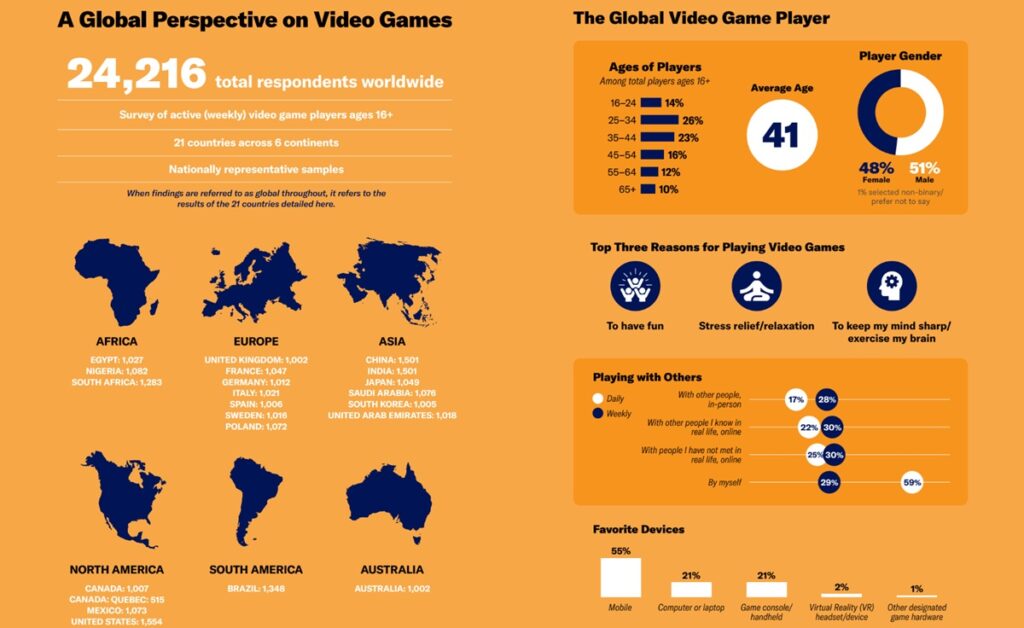
The report reveals the universal social and emotional benefits of video games, confirmed by both peer-reviewed academic research and a survey of 24,216 active (weekly) players (age 16+) in 21 countries: Australia, Brazil, Canada, China, Egypt, France, Germany, India, Italy, Japan, Mexico, Nigeria, Poland, Saudi Arabia, South Africa, South Korea, Spain, Sweden, the United Arab Emirates (UAE), the United Kingdom and the United States of America (U.S).
The ESA previously did a similar report in 2023, and we’ll talk about the differences.
“As one of the most popular forms of entertainment in the world, video games are a source of fun and entertainment for billions of players around the world. What the 2025 Global Power of Play report confirms, however, is that video games are much more than that,” said Stanley Pierre-Louis, president and CEO of the ESA. “Proven by both academic research and one of the largest consumer surveys ever conducted of video game players, games bring immense value to our lives, provide borderless avenues for connection and improve our mental and social wellbeing.”
“For this one, we went even broader. This was an effort in working with the other leading trade associations from around the world and conducting the largest and most globally inclusive study of its kind: 24,000 players, 21 countries, six continents, and in areas that we hadn’t looked at before, in areas in Africa and Middle East, some other additional countries,” Pierre-Louis said in an interview with GamesBeat.
He added, “We asked them the questions that we normally might ask here [in the U.S.] Why do you play? How do you play? What impact does play have on you? And we really want to understand the impact that games have on people, and just trying to test what that means in a universal way.”
The takeaway is the consistency of the impact games have. The report shows the top three reasons that people play, and you see this consistency, he said.
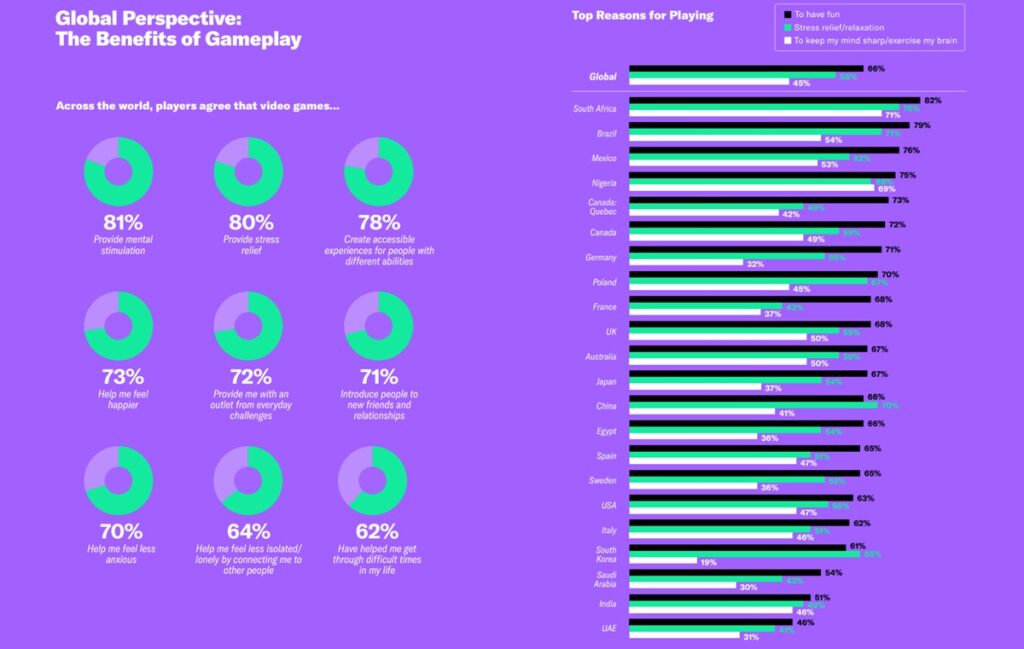
Globally, players agree on the positive social, emotional and mental benefits of game play: Having fun is the top reason people around the world say they play video games (66%), with stress relief (58%) and keeping minds sharp (45%) making up the top three reasons
for playing. In the U.S., the top three reasons Americans say they play video games are
to have fun (63%), for stress relief (56%) and to keep their mind sharp (47%).
Seventy-seven percent of players globally say video games help them feel less stressed,
70% report reduced anxiety and 64% credit video games with easing loneliness by connecting them to others. Americans feel similarly, reporting games helps them feel
less stressed (75%), less anxious (67%) and less lonely (58%).
Players worldwide agree that video games provide mental stimulation (81%), provide
stress relief (80%) and create accessible experiences for people with different abilities
(78%). American players track global sentiment, ranking mental stimulation (80%),
stress relief (80%) and creating experience for people with different abilities (77%)
highest.
“The percentages might change slightly, but the fact that people find that games have a positive social, emotional and mental benefit, irrespective of jurisdiction, is really powerful, and that was one of the key takes takeaways for us,” Pierre-Louis said. “The number one reason people play is to have fun. I’ve said that before, and it’s proven to be the case in every jurisdiction, and I think that makes a lot of sense. People also find that games make them feel less stressed and less lonely, which is another top reason people play. And they also find that games provide them with mental stimulation, and we’ve been reporting that for some time.”
These reasons for playing translate across borders. A lot of these findings were also backed by academic research.
Players around the world turn to games for broader skill development
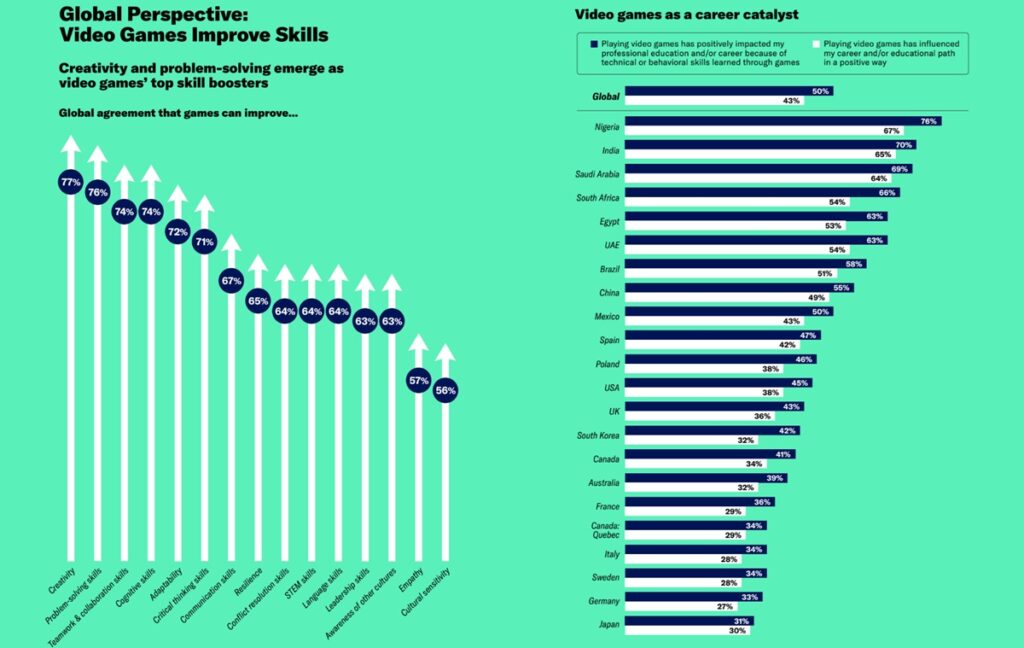
Players agree that video games help improve creativity (77%), problem-solving (76%)
and teamwork and collaboration skills (74%). Adaptability (72%), critical thinking (71%)
and communication skills (67%) also rank high. In the U.S., the top three skills players
believe are improved by playing video games are adaptability (77%), cultural sensitivity
(74%) and communication (73%).
Half of all players worldwide say playing video games has directly bolstered their
professional education through technical or behavioral skills, and 43% report that games
have influenced their career or educational path. In the U.S., 45% say video games have
positively impacted their careers.
Games like NBA 2K and EA Sports FC are a fun and accessible way to play and train in sports, and there are stories of professional athletes who use video games as another way to stay in mental shape before they get on the field, Pierre-Louis said.
Over half (54%) of global players feel that sports video games have sharpened their
real‐world abilities in that same sport; 44% of Americans agree.
“In addition to the social, emotional and other benefits that people feel, players also find that video gameplay develops skills that benefit their lives away from games and that can positively impact and influence their hobbies and professional pursuits,” Pierre-Louis said.
About half of players worldwide say video games have bolstered their professional education through technical or behavioral skills, and many say that it’s influenced their career or educational path.
“So it just shows that games aren’t just about entertainment, although they are there for entertainment, but they also teach important skills that people can use,” Pierre-Louis said. “About 77% of global players found that it helps improve their creativity and similar percentage around problem solving, adaptability, collaboration, critical thinking, communication, all of those things are high on their list.”
Within the U.S., adaptability was ranked at 77% as the top one. Cultural sensitivity was another at 74% and communication at 73% so it just shows that the U.S. is not necessarily different, but what we’re taking from it might slightly different than in other jurisdictions, he said.
Video games are not only a popular vehicle for lasting connections with children, family
members and friends, but also are an avenue to forge new relationships:
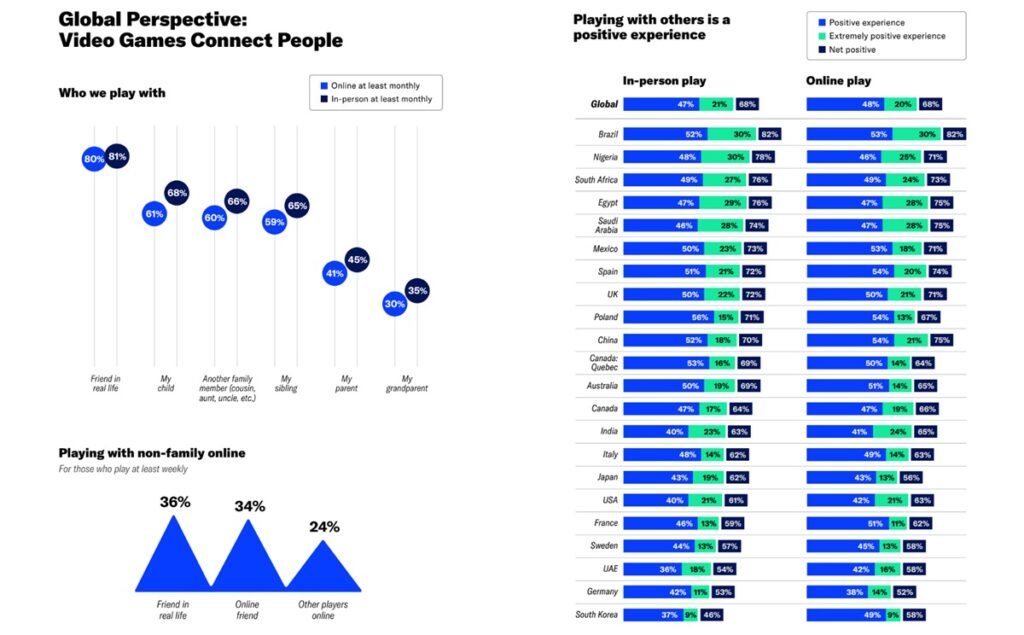
Nearly two-thirds (62%) of players worldwide agree that video games create spaces for
positive connections with others; 55% of Americans agree.
Across the world, younger players (ages 16-35) use games to make and build relationships, with 67% saying they have met a good friend, spouse or significant other through video games. Nearly three in four (73%) of that same age group say video games help them feel less isolated and lonely by connecting them to other people.
More than half of players globally (55%) say that video games positively impact their relationships with their children, and 68% play with their children in-person at least monthly. 47% of American players say games positively impact their relationship with
their children.
“Seeing that translate from our study now into a global study is gratifying and it also validates the fact that games are positively impacting their professional and academic pursuits,” Pierre-Louis said. “A study at University of Texas that found that students with video game experience outperform actual medical students in robotic surgery simulators just because their eye and coordination and fine motor skills are more developed.”
Profile of the global video game player (age 16+)
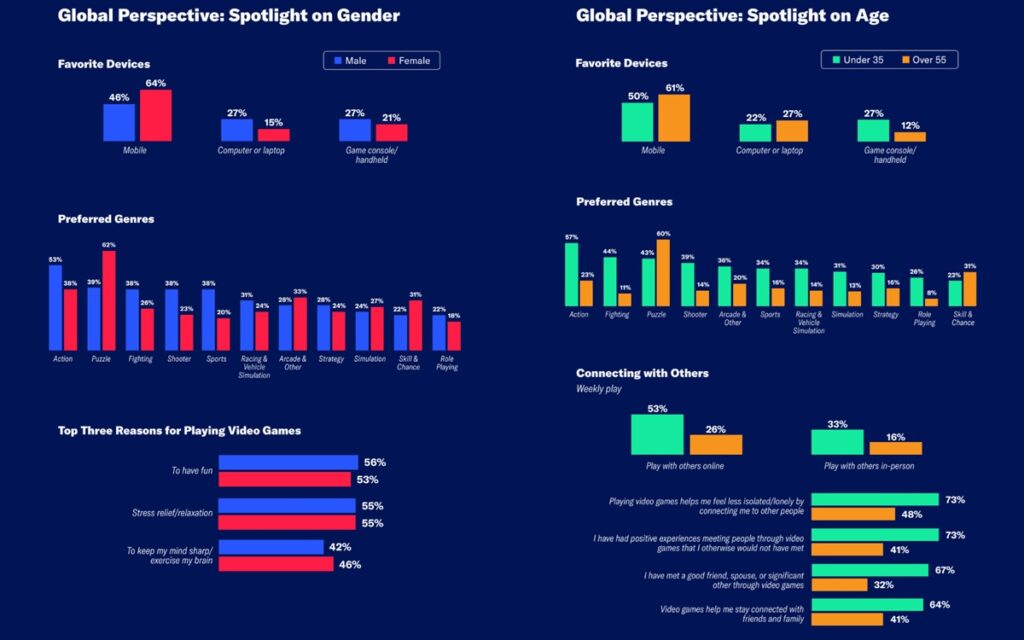
The global video game player is 41 years old on average and is about just as likely to be
male (51%) as female (48%). China is the country with the lowest average player age at
32; Italy has the highest at age 50.
There are several countries where significantly more women than men play video
games, including Brazil (57% to 43%) and South Africa (58% to 41%).
Globally, the majority (55%) of players play on mobile devices. Action and puzzle games
are the top two favored genres in 20 of the 21 countries surveyed.
Globally, the split between women and men playing is pretty even, with 51% of men playing and 48% of women playing globally. The average age varies by country. The average age in the U.S. was 41, while China was 32 and Italy was 50.
“Saudi Arabia, clearly, as everyone has seen, has been doing quite a bit of investment in the video game ecosystem. A country like Poland hasn’t, but Poland went from not having a game industry to localizing games to then creating games, and now has some of the most popular IPs in the world in a span of 25 years, and that didn’t come from government funding,” Pierre-Louis said. “That just came through the business cycle of games, and also a very rich history in math. It’s a country that stressed STEM in a very deep way for both boys and girls from the earliest of ages.”
In other words, Poland clearly moved up the food chain on the strength of its passion for games, not from government subsidies. Games also open people up to learning more and understanding other cultures and systems and other ways of thinking, Pierre-Louis said.
This year’s report ensured there was representation across all the populated continents. The six major continents are reflected in the report.
Access the complete 2025 Global Power of Play report at www.theesa.com/powerofplay.