
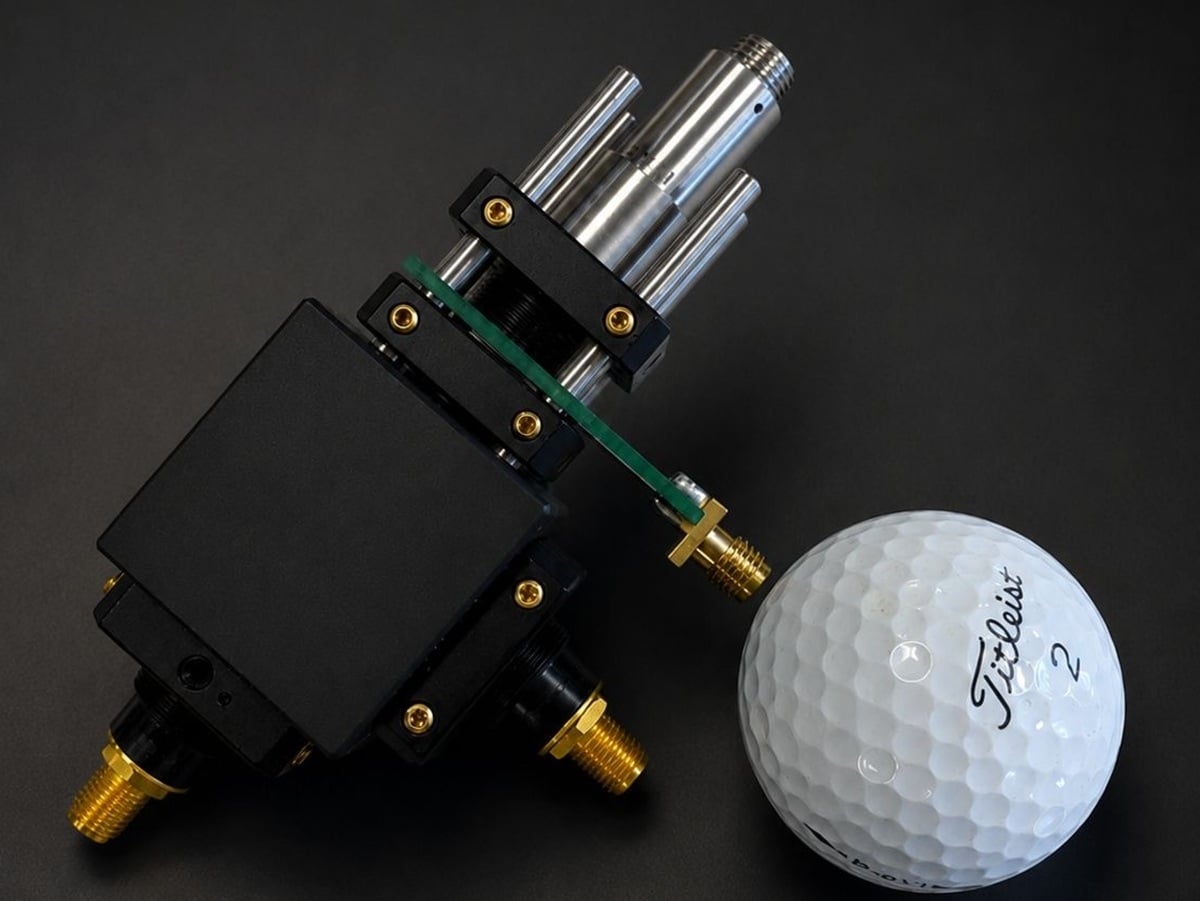
Dirac Labs is building a quantum universal positioning system designed to work underwater, underground and in environments where GPS won’t work.
The Madison, Wisconsin-based quantum-enabled navigation company, announced that it has joined the Wisconsin Security Research Consortium (WSRC) as an industry affiliate, providing resilient navigation alternatives to enable autonomous maritime missions.
WSRC, led by the Wisconsin Technology Council, connects Wisconsin’s universities, technology manufacturers and government partners to advance defense research and economic development opportunities in the state.
Dirac Labs’ affiliation builds on the Autonomous Heartland effort to position Wisconsin — with its shipyards, airspace, industrial base, workforce, and research anchors — at the center of America’s autonomous and maritime future. Along with the Sagamore Institute, the Midwest Defense Accelerator and TitletownTech, WSRC supports the growing Area 52 initiative.
Area 52 was originally proposed by retired U.S. Navy captain Jerry Hendrix to serve as the Navy’s equivalent to the Air Force’s Area 51. Hendrix argued that the Navy needed a secure area to develop and test autonomous and unmanned platforms away from the adversary surveillance possible in international waters.
Lake Michigan is a uniquely suitable option, as it is the only Great Lake entirely within U.S. territory that is large and deep enough for both surface and subsurface testing, and it has existing FAA-designated restricted military airspace overhead connected to assets like Volk Field.
The company’s diamond-based sensors measure Earth’s magnetic field with extreme precision, and its AI models perform real-time signal processing to turn those magnetic measurements into a perpetually reliable position unaffected by drift. Because the magnetic field is present everywhere, including where GPS signals cannot reach, the approach offers a passive, resilient alternative that cannot be jammed or spoofed the way satellite signals can.

Assured positioning, navigation and timing (PNT) has become a top priority across the Department of Defense, as GPS jamming and spoofing grow more common in modern conflict and gray-zone operations. The absence of GPS also impacts commercial users in fields like mining, subsurface exploration, ocean science, agriculture and autonomous infrastructure monitoring, where the environmental conditions interfere with GPS signals.
“Assured PNT is no longer a niche requirement. It’s a prerequisite for operating in contested environments, from the seabed to the space,” said Dorota Grejner-Brzezińska, Vice Chancellor for Research at the University of Wisconsin–Madison, and a lifelong GPS researcher, in a statement. “Dirac Labs is rooted in UW–Madison research, focused on a hard national security problem, and building technology designed to be manufactured at scale. As the Great Lakes become a proving ground for autonomous maritime systems, having GPS-independent navigation developed right here in Madison is a real win for Wisconsin and for the nation.”
“Area 52 is more than a test range concept; it’s an economic development strategy for the state,” said Maggie Brickerman, president of the Wisconsin Technology Council, which leads WSRC, in a statement. “When a quantum navigation company spun out of UW–Madison chooses to grow in Wisconsin and contribute to that effort, it validates what we’ve been telling federal partners: the research, the talent, and the industrial base are already here. Our job is to keep connecting them.”
The Dirac Labs quantum platform is built to connect through the existing GPS ports on aircraft, submarines, and other vehicles, avoiding costly platform re-engineering. Dirac Labs is also designing its sensors to be produced using existing semiconductor foundry infrastructure, an approach aimed at the size, cost and scalability barriers that have long kept quantum sensing confined to the laboratory.
“The platforms that need precise navigation the most — submarines, subsurface systems, and uncrewed vehicles operating under jamming — are exactly the ones GPS can’t serve,” said Sanket Deshpande, CEO of Dirac Labs, in a statement. “Dirac Labs was born in a UW–Madison lab, and joining WSRC connects us to the researchers, federal sponsors, and mission owners who understand that problem firsthand. It gives us a direct path to move our sensors from prototypes to the field, with Wisconsin partners alongside us.”
To learn more about Dirac Labs, please visit diraclabs.com. More information about Wisconsin’s role in Area 52 can be found at wisecurity.org/autonomy.