

Ambiq Micro hit its financial targets for the second quarter of 2025 in its first quarterly report since going public in July.
The company reported an $8.5 million loss on $17.9 million in revenue (up 13.6%) as it ramped up sales of its ultra-low-power AI chips at the edge of the network.
Scott Hanson, CTO of Austin, Texas-based Ambiq, said in an interview with GamesBeat that the company, which raised $97.2 million in proceeds from its initial public offering (IPO), that the company was investing in hiring AI chip engineers and other staff.
“We’re investing in R&D. We’re hiring. We’re using the proceeds of the IPO to go out and hire people in support of some of the new product development. So this is all within plan right now,” Hanson said. “Everything that’s going on is within plan.”
During the quarter, the company expanded its Apollo5 System-on-Chip (SoC) family with introduction of the Apollo510B wireless SoC for power-constrained edge AI applications. But Hanson said he is very focused on Atomic, a new family of AI-focused, low-power chips that are in development.
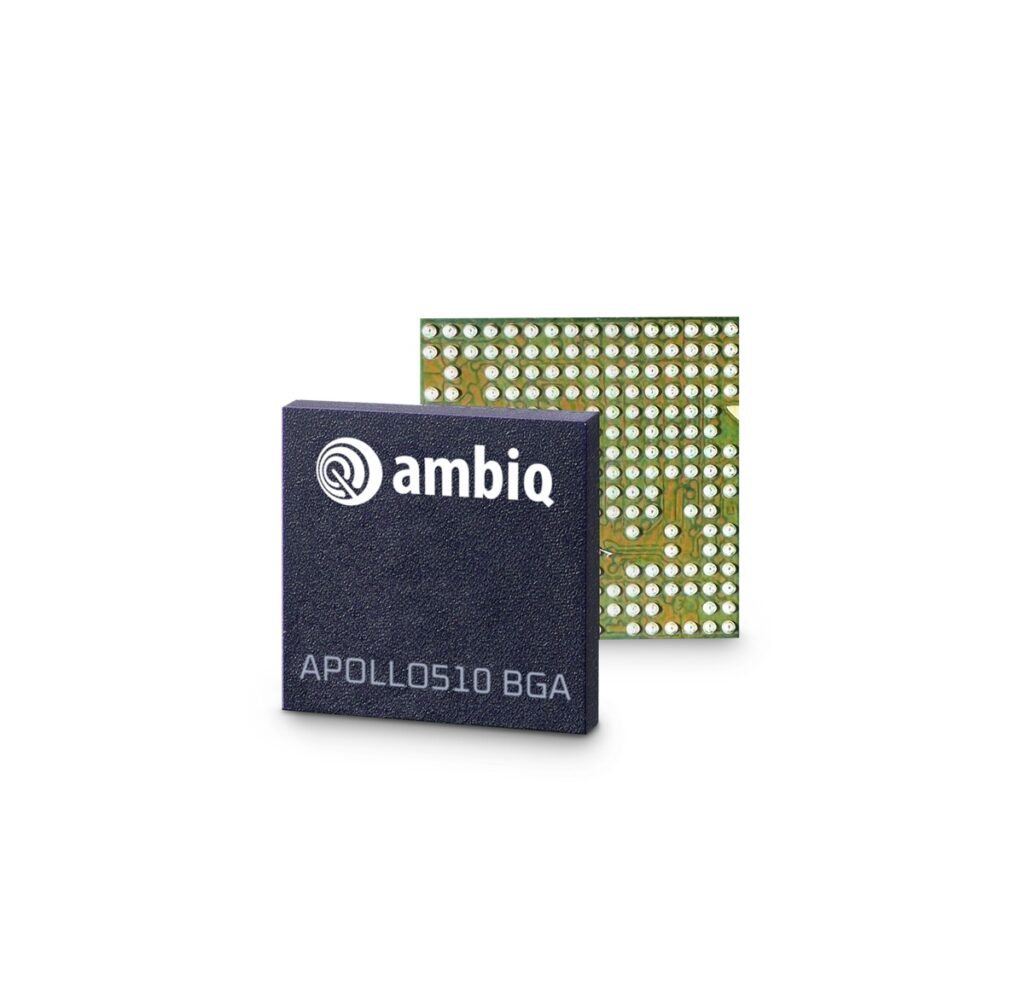
“Our recently completed IPO represents the next chapter of Ambiq’s journey leading the edge AI revolution and bringing intelligence to edge devices,” said Fumihide Esaka, CEO of Ambiq, in a statement. “Second quarter net sales increased 13.6% sequentially, reflecting solid customer demand for our highly differentiated technology platform. Ambiq’s ultra-low power solutions have been incorporated into more than 280 million edge devices to-date, and we are well positioned to capitalize on the rapid growth of edge AI applications.”
Esaka added, “One of our top priorities is the continued expansion of our technical innovation and product development roadmap. As evidence of our progress, we recently announced the expansion of our successful Apollo5 product family with the introduction of the Apollo510B wireless SoC. This solution integrates a low-power Bluetooth radio, making it an ideal solution for always-on, connected edge devices.”
Mr. Esaka concluded by stating, “Looking ahead, our well-received IPO provides us with the additional capital necessary to accelerate our strategic initiatives that include broadening our customer base as well as penetrating new end markets and geographies in support of driving long-term profitable growth.”
Second quarter results
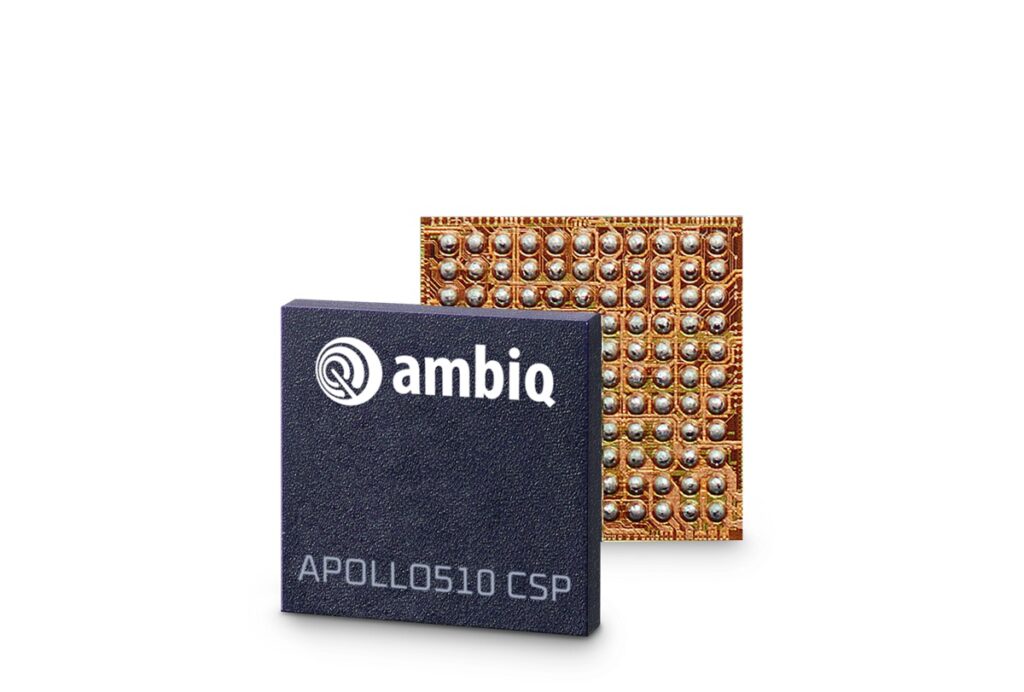
Total net sales for the second quarter of 2025 was $17.9 million, compared to $15.7 million in the first quarter of 2025 and $20.3 million in the second quarter of 2024. The sequential increase in second quarter revenue was driven by increased customer demand and favorable product mix.
Net loss for the second quarter of 2025 was $8.5 million, or ($18.89) per share, based on 449,785 weighted-average shares outstanding. This compares to a net loss of $8.3 million, or ($18.96) per share, in the first quarter of 2025, and net loss of $10.6 million, or ($34.59) per share, in the second quarter of 2024.
The year-over-year decrease in net sales reflected Ambiq’s strategic decision to diversify revenue toward higher-value opportunities in geographies outside of China, where geopolitical tension has been high. In the second quarter of 2025, net sales to end customers in Mainland China were 11.5%, as compared to 42.0% in the second quarter of 2024. Hanson noted that transition is one reason why there are challenges.
I noted that geopolitical challenges like trade restrictions and tariffs are high around the world. Hanson acknowledged that but also noted that there are opportunities related to providing products for government-related projects and defense. That’s not the kind of remark that we have heard in recent decades in Silicon Valley, but it rings true.
For the third quarter, Ambiq anticipates revenue of $17.5 million to $18 million as well as a lower non-GAAP loss per share of 35 cents to 28 cents.
Hanson noted the overall performance was in line with expectations based on guidance the company gave more than a month ago in advance of the IPO.
“Our value proposition is intelligence everywhere,” he said. “If version 1.0 of the company was about extending battery life, version 2.0 is about adding intelligence without compromising battery life. And that latter value proposition is better. It’s going to come in with higher gross margins in the long term. We’ve executed a transition in terms of our focus.”

The company has about 200 people now. I asked what he thought of some AI engineers getting $100 million salaries (at Meta) on the one hand and others getting laid off because of AI on the other.
Hanson said, “‘There is, of course, some noise from the world about these
eye-watering salary levels. But I would say that the majority of the market is quite a bit more sober and more manageable. There is certainly a lot of interest among the hardware community in building chips for this. And so we’re getting good resume flow.”
In general, Hanson said he is encouraged to see a healthy market, as he aims to see growth and diversification of the customer base. Many of the wearables that he had like a smartwatch and a smart ring can use the kind of low-power chips that Ambiq makes.
“We are seeing traction in the AR glasses space, so that’s another exciting area with very high volume potential and where we have some interesting wins,” he said.
There are devices like ear protection or safety monitors for workers that can use Ambiq devices, as well as machine health monitors that measure the sound signatures and vibrations of machines.
Asked what he thinks will be good to see at CES 2026 in January, Hanson said he thinks AR glasses will have a lot of interesting announcements and use cases, such as translation or identification of landmarks.
“We’re just going to see an increase in the types of places where AI is popping up,” he said. “We’ve heard about edge AI use cases from our customers in wearables. Those are the earliest use cases, from five years ago, doing heart rate monitoring with an AI model,
sleep monitoring with an AI model, and that’s become almost standard these days.”
“What’s exciting to me is just the diversity of customers we’re talking with that are in all kinds of disparate spaces. And my hope would be that a lot of those start to pop up at CES,” he said. “It’s not just the big companies talking about phones and wearables and the standard stuff, but it’s going to be companies talking about security systems that are AI-enabled, machine health monitors that are AI-enabled, medical devices that are AI-enabled.”