
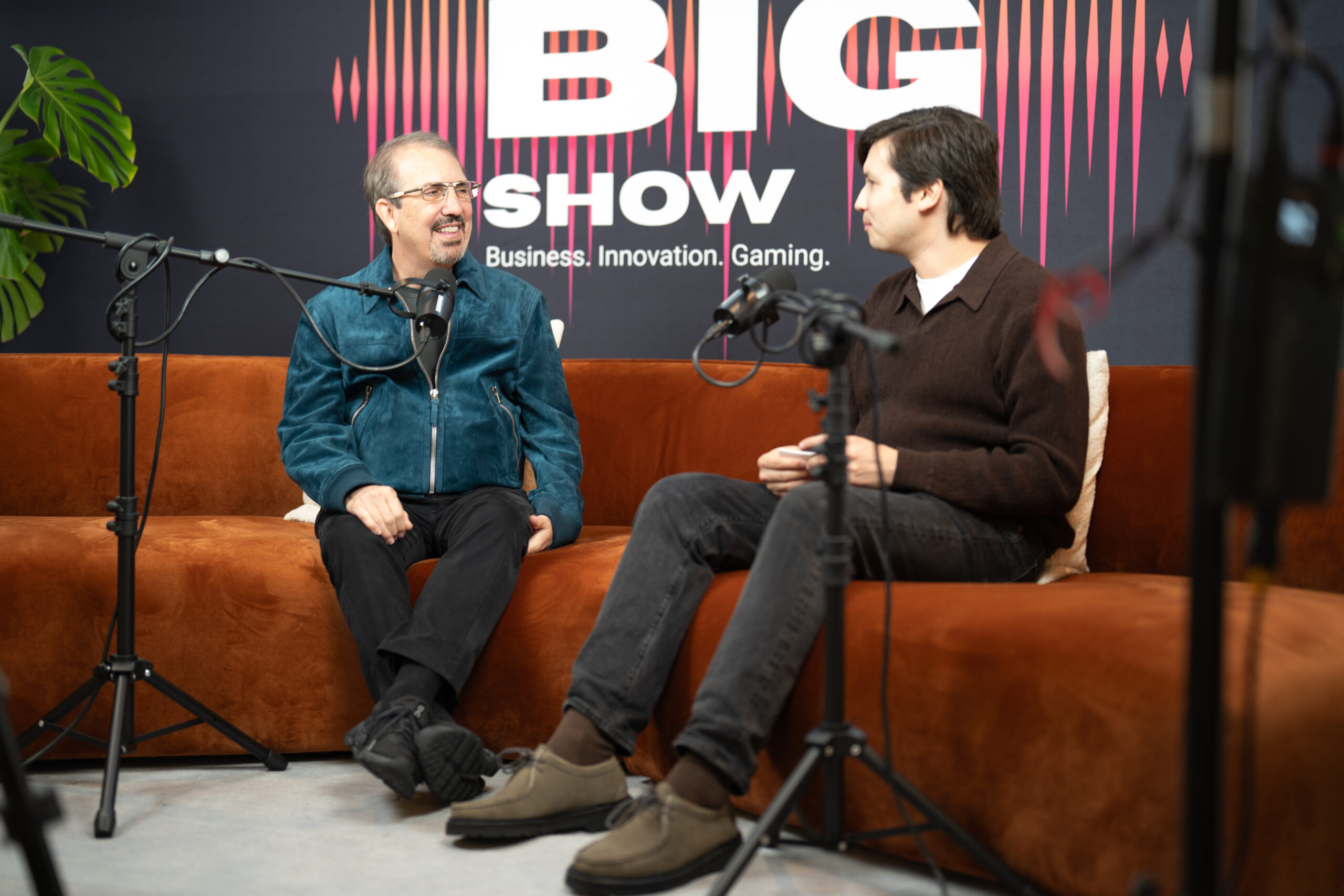
One year after stepping in as president of Wizards of the Coast, John Hight is celebrating his wins — and looking toward the future.
It’s been just about 15 months since Hight — a gaming industry veteran whose portfolio includes legendary titles like “God of War III” and “World of Warcraft” — picked up the reins at Wizards of the Coast. On day two of GamesBeat Next yesterday, November 13, Hight sat down with GamesBeat’s Alexander Lee (that’s me!) for a fireside chat about Wizards of the Coast’s evolving digital games strategy — and how he has consciously restructured the company over the past year and change.
The franchise structure
One key change that Hight implemented after joining Wizards last year was to restructure the company so that all of its tentpole properties — from Dungeons & Dragons to Magic: The Gathering — are guided by unified leadership whose authority extends across both digital and tabletop gaming products. Hight specifically cited Wizards senior vice presidents Ken Troop and Dan Ayoub as the leaders of the Magic and Dungeons & Dragons franchises, respectively.
“Whether it’s video games, or whether it’s the books that we do, or even the relationship that we have with the community, it’s important for me to have a franchise leader that not only loved D&D and understood it as a player, but was going to be accountable,” Hight said during the fireside chat. “I wanted somebody to say, ‘You know what? I want to make sure that everything that happens in the D&D universe is going to make sense to players and people who love D&D.”
The philosophy behind Hight’s push to reorganize Wizards of the Coast’s internal structure is driven by his dislike for the term “intellectual property” — at least as a descriptor of Wizards’ gaming ecosystems.
“These are worlds; these are characters. These are memories that we have, and we are the caretakers of those things,” Hight said. “This is not some commodity to be traded and exploited — it is something to be cared for and nurtured, and that company, that team, has done that for decades.”
Wizards’ science-fiction bet
In addition to Magic: The Gathering and Dungeons & Dragons, Hight flagged Wizards of the Coast’s new IP development arm, which is currently developing the science-fiction game “Exodus,” as a third major division under his reorganized company structure.
If Magic and D&D represent the past and present of Wizards, “Exodus” could very well represent the company’s future — and as a newer project that spun up under Hight’s leadership, it is arguably the clearest expression of his world-first philosophy. The entire ecosystem will be built around a science-fiction universe devised by the author Peter Hamilton, whose book “Exodus: The Archimedes Engine” acts as a prequel to the main game.
“He’s written just a wonderful series for us, that we’re going to be able to mine for future games probably longer than I’ll be on this planet, if we so desire,” Hight said. “As you might imagine as a company that also has a full consumer products arm, we can back up a lot of the world-building and games with consumer products.”
Wizards’ significant investment in “Exodus” — and Hight’s obvious passion and enthusiasm for the project — show that the company is not resting on the laurels of Magic and D&D as the company reorganizes to unify its digital and tabletop gaming ecosystems.
In an industry grappling with AI, waves of layoffs and shifting business models, Hight’s approach is almost counter-cultural — prioritizing deeper worlds and long-term continuity between products over short-term wins. If Wizards can successfully execute on this vision, it could create a more sustainable playbook for other gaming companies to emulate.
“We’re going to prevail. It’s just natural — everybody loves games. We are ubiquitous, and we are constantly leveraging technology to figure out how to make entertainment even more fun and innovative and engaging,” Hight said. “And we bring people together, right? We bring them together and have fun with each other, whether it’s in video games or tabletop games. So we’re going to win — just hang in there.”