
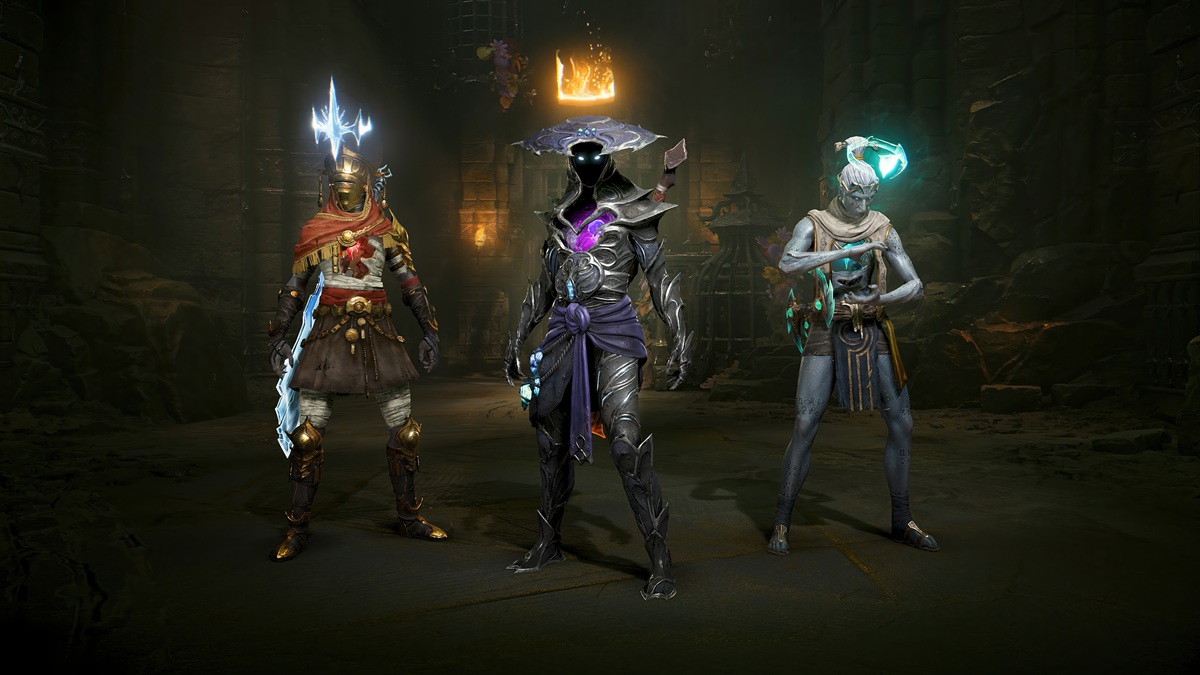
You could think of Arkheron, the upcoming fantasy multiplayer game from Bonfire Studios, as Diablo meets battle royale. You might think it’s a Diablo clone.
But that would be short-changing you on a real description of the game, which is an original intellectual property that has been in the works since ex-Blizzard leader Rob Pardo started the company with Min Kim in 2016.
The game went through a long process of creation which Pardo described in a press briefing as well as an interview with me.
Now the game is being revealed for the first time since the company started almost nine years ago and development began seven years ago. The team showed off the gameplay and talked about the major decisions they made along the way.
Bonfire Studios isn’t talking about the release date yet. The game will be rated T for teen in the U.S., and it will debut on the PC, Xbox Series X/S and Playstation 5. The price is also TBD. But now we’re getting our first look under the hood.
The game in a nutshell
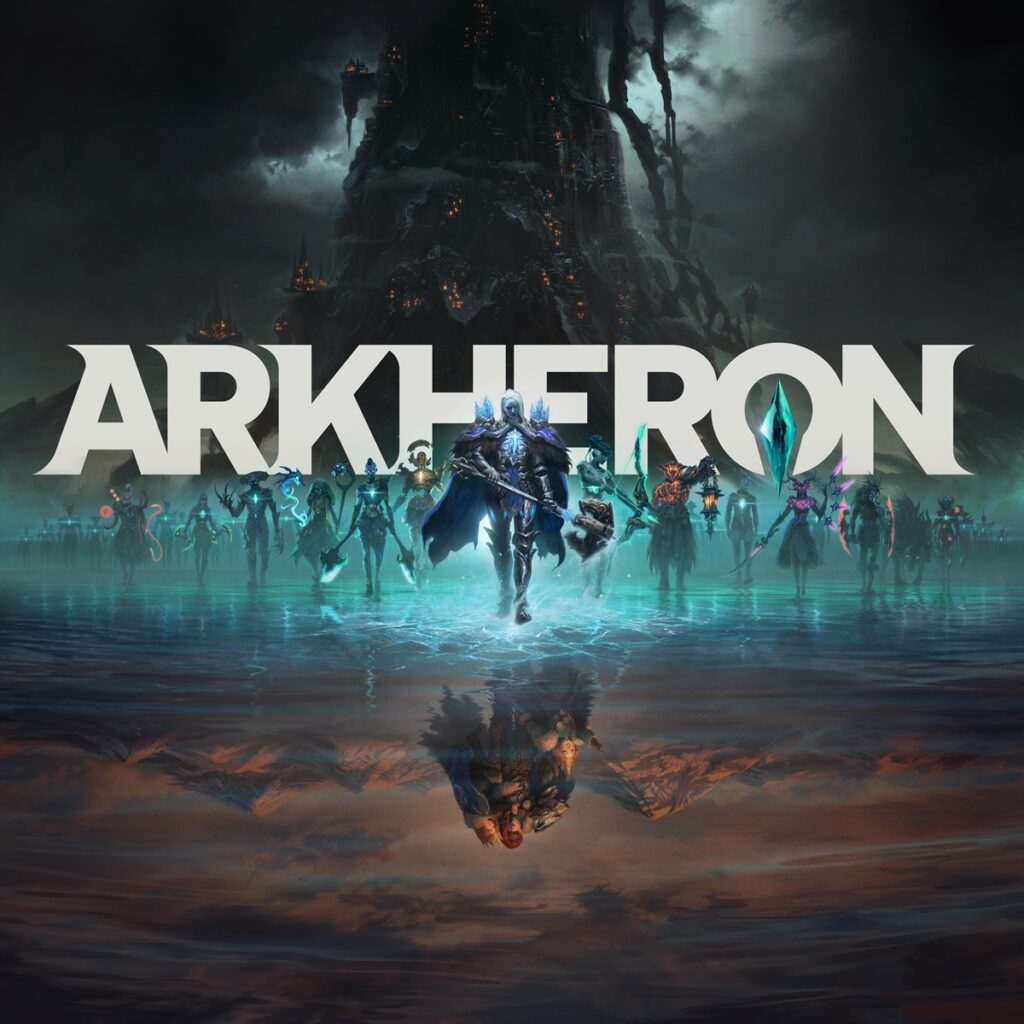
Arkheron is a dark, surreal dimension constructed from emotionally-charged memories of the living world. Those in the world are anchored to the Tower by the grip of a past they can’t quite remember; driven to do whatever it takes to find answers and escape the destructive Abyss. The dark look is intentional. The game is a kind of Gothic fantasy, and that’s why it’s dark. The details in the character images are pretty sharp and very colorful.
In this fast-paced, dynamic player-vs-player (PvP) game from Bonfire Studios, teams of three battle to ascend a mysterious Tower built from fragments of their life before. Here, items are the heroes — each one imbued with powerful abilities that shape how you fight, adapt, and outplay other teams. Your team will have to combine items, chain abilities and create unique goals. You can do things to lock a team inside a room or lock them out.
You can build your strategy and identity on the fly by looting and combining items in real time, creating unique builds throughout every match. What you choose to carry defines not only what you can do, but who you can become.
Ascension royale?
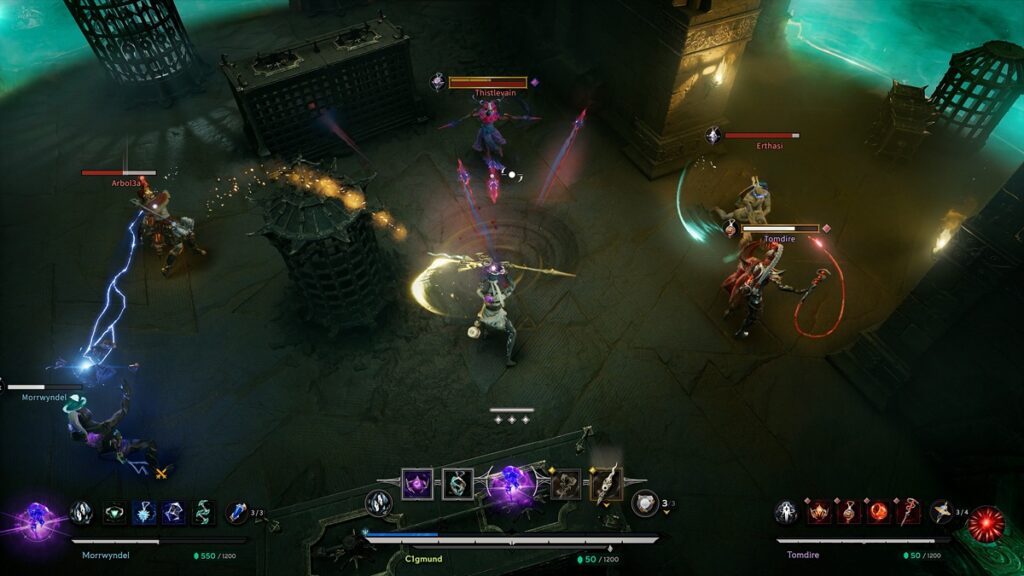
In this game, you have to go up the Tower to survive. You fight your way up the Tower in a series of one-team-takes-all showdowns in Ascension mode.
Battle monsters, challenge rival teams and seize control of beacons floor by floor to ascend before time runs out. With each successful Ascension, the player pool shrinks, culminating in a final 3v3 showdown at the summit where one team will claim victory before the Tower resets and a new cycle begins.
“It’s your play style and how you adapt. And this means that every match is different. You’re building a new character. Every player has a chance to show their skill. And then our primary mode, we’ve been calling an Ascension Royale, is our innovation on the shooter battle royale format,” Pardo said.
What You Carry Defines You: In the Tower, memories take shape as powerful weapons and abilities called Relics. Every Relic you pick up has the potential to shift how you play, letting you adapt your strategy on the fly. You can chase a full set of four matching Relics to transform into an Eternal and unlock a game-changing fifth ability. Or, discover your own playstyle: Mix and match Relics from different sets, swap them out as you find new ones and create a “shattered” build that’s uniquely yours, gaining set bonuses and custom synergies along the way. The choice is always yours – and it can change at any moment.
High Stakes, Close Quarters Combat: Arkheron’s free-aim isometric action keeps you locked into the fight; swiveling the camera to line up kill shots while dodging and striking at close range. The tight view makes combat strategic, fast-paced and intimate. Immersive audio heightens the pulse-pounding tension; you hear the danger before you see it, turning subtle sounds and music cues into vital keys for survival.
Bonfire Studios background

Rob Pardo worked on games like StarCraft, StarCraft: Brood War, Warcraft III: Reign of Chaos, World of Warcraft, Diablo III and the ill-fated Titan MMO, which eventually led to Overwatch. After 17 years at Blizzard, Pardo resigned in 2014.
He traveled around and took a mid-career sabbatical. He saw that time as a chance to reset and recover from burnout. He realized he missed game development, but not leading a large company or having a fancy C-suite studio, he said.
“What I missed the most was being a part of a team again and really being able to work side by side in a passionate, collaborative environment, selfishly to benefit from that growth myself and slowly, I began to realize maybe the way to find that again was to start a new game company,” Pardo said.
He joined forces with Min Kim, a former Nexon executive, and others. The team grew to more than 70 people over the years.
“Once I joined forces with my early cofounders, we thought long and hard about what to carry forward from our past experiences,” Pardo said. “We asked ourselves, ‘What kind of place do we want this to be? Fundamentally, we believe that we built a great development team that could develop the games they loved in a similar player-first inverted way, we could be really successful, but also we had a love for games that were social and where players could enjoy feeling connected and knowing that they belong.”
That’s where the name Bonfire Studios came from, as a metaphor for the “experiences we wanted to create surrounding the fire, the players enjoying the game and telling stories of their recent exploits together,” he said.
In the first couple of years, a lot of the work was building the team.
“We didn’t really feel like we could truly start game development until we had a core nucleus of teams,” Pardo said. “We are passionate about the game that we chose, but we did start generating some ideas.”
Early development

Pardo said that the team encouraged everyone to pitch ideas. They called them seeds, because they’re really just simple, five-slide pitches, often using shorthand like this genre meets that one.
After the team grew more, it had 35 seeds. Pardo gave everyone five post-it notes and told people they could vote for five ideas they were the most passionate about. About seven seeds survived this process and they were extended with longer pitch decks.
“These were pitches we could have pitched a publisher, but we had the rare opportunity of not doing that,” Pardo said. “Instead, these were things we weree going to pitch to ourselves. Ultimately, the team focused on an idea that had universal approval. It was code-named Project Torch. It hearkened back to the Diablo franchise and Dark Souls. There were artists who loved the monsters in the world.
“But the thing that I definitely learned about making games over the time period is once you go on the game development journey, one thing is always certain,” he said.
The team started prototyping in 2018 and the goal was to make a “minimum lovable” product.
That meant getting the game to a place where the whole team could sit down play it and feel the core loop, he said.
“If you don’t get that right, everything you make afterwards is resting on a faulty foundation, and I think a lot of teams sometimes convince themselves that they can do this work in parallel with building out the rest of the game,” Pardo said. “I actually made that mistake myself back at Blizzard on a project called Titan. We had scaled too fast before we found the fun. By the time we faced the hard decisions, it was much too late, and the project collapsed under its own weight.”
The silver lining to that Titan eventually morphed into Overwatch.
Arkheron’s hardest challenge
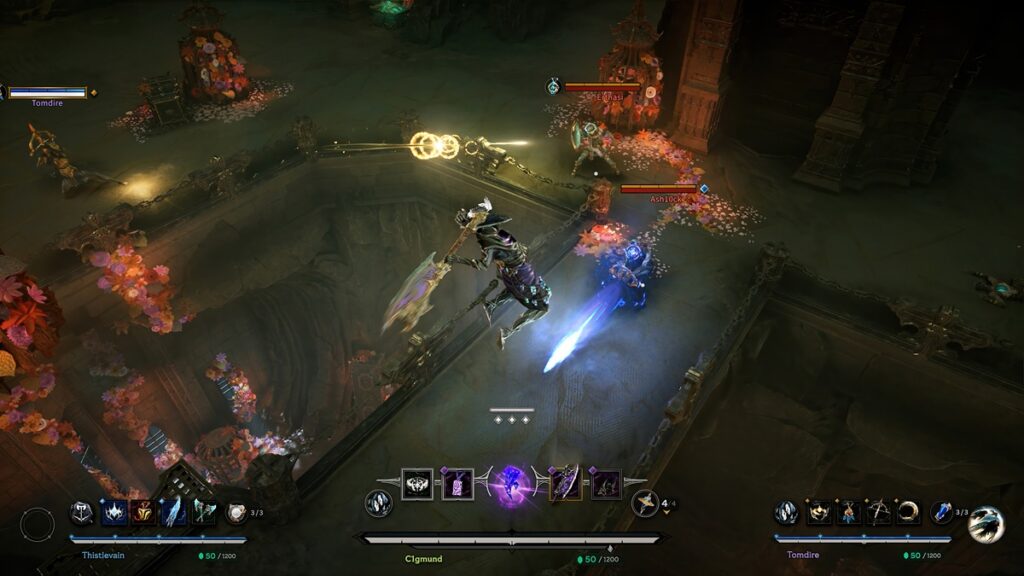
The hardest problem was actually combat.
“We tried the obvious models based on our sapling, but none of them worked. Then we tried two more. Neither of those worked, either, but we stayed persistent, kept the team small, and tried more,” he said. “This time we found it. We knew this was the model that was going to be for this game.”
While most of the developers were celebrating, the engineers were getting worried they had been building the network layer for previous combat models. If the team wanted to go down this path, the engineers would have to rebuild the networking layer from scratch, and that would take close to a year.
Regarding the networking reset, Pardo said that “game development can be messy.” There are things that you cannot start testing like matchmaking until you have real players playing the game.
The team decided it had found the soul of Arkheron, and it didn’t want to take any half measures. Fortunately, the company had the funding for the engineers to undertake that restart. The team started with playtests in the mornings and had feedback sessions immediately after so developers could make changes in the afternoon build and then they could play a better experience the next morning.
“We’ve always believed that iteration and more iteration in development really gives you the best opportunity to make a great game,” Pardo said.
During the pandemic, the game was really what connected the team during that time. The team maintained the discipline to grow slowly and methodically when the game needed it. It was becoming a socially competitive game, where the challenge would be to build the depth necessary to maintain the integrity of highly skilled players who would want to play thousands of hours.
“In a competitive game, depth is really what separates something that lasts for months from something that can last for decades,” Pardo said. “Some people think depth only matters for the competitive players, but the truth is every player really wants a game that encourages mastery. And then the counterintuitive part of building a game with deep mastery is you have to focus on it first, really, before you go deeply into the approach.”
He said the reason you build the depth first is because it takes the longest to develop, and most teams don’t spend enough time there, or they try to do it last.
“But validating if you’re successful is another challenge. One of Blizzard’s lesser-known development philosophies is to do this with actual players. As our games became more playable, we would expand the play testing circle wider and wider, first to other game developers and eventually to those outside the company,” Pardo said. “For example, I believe one of the secrets of World of Warcraft success was that we ran a live alpha for over a year before release.”
Soon, Arkheron will open up to thousands of new players in a playtesting community. Pardo said the game is stil far from finished.
How to play
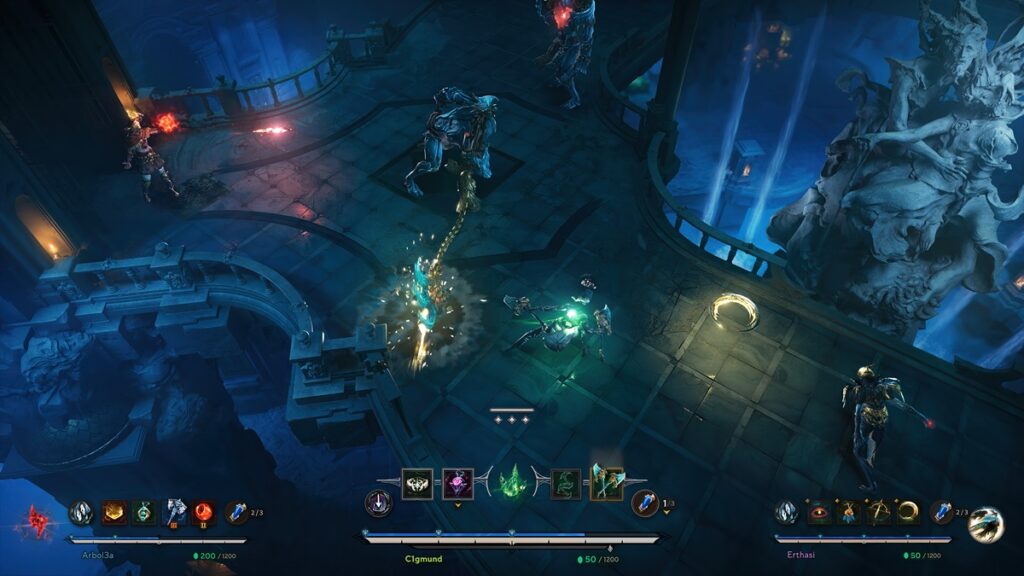
At the outset, 15 teams of three will enter the Tower. On each floor, you fight monsters, loot items and clash with other teams. After a few minutes, players have to find their way to the next level. On the fourth and final level, only two teams will be left.
The Tower itself is a metaphysical construct made of memory. It’s both dark and beautiful, a place that seems familiar and alien all at once. But the name Arkheron is not about the outside of the tower. It’s actually the world that is on the inside, which is a surreal dimension built from the memories of the dead, Pardo said.
“Each soul bound here is haunted by unfinished business, and their people, places and moments from their living world are pulled into the tower,” Pardo said. “Many things inside the tower serve the same function as they did in living. A chest will contain treasure. A key will open a locked chamber. But not everything inside the tower is what it seems. A cracked door might reveal a lightless prison overrun with bright blooms of flowers. An underground catacomb can lead to a Pompeii-like island city buried in ash.”
The world is always shifting, reshaped by memory. The past is never stable. So the world of the Tower is never fixed. Every cycle brings change. And the end of every cycle, the Tower is destroyed by a great storm of unmaking. You play as an echo, the soul who died with unfinished business which continues to haunt them. Even after their death, they are tethered to this world through the anchor in their chest. It is the memory that they carry with them. And it’s these anchors that recreate the Tower.
At first, the team had isometric viewpoints for its combat model. But the point and click game wasn’t really clicking for a team-based competitive game.
“We tried more of a battle royale model, but it didn’t land either. We even kind of played around with more of a Dark Souls [style] that felt really off as well. And then finally, someone just kind of hacked the camera to be a little more top down, and started spinning the camera on its axis, and we immediately found fun,” Pardo said.
You can swivel the camera and that speeds up the action. But you can’t see the whole playfield at once.
This kind of viewpoint put both melee and ranged weapons on an equal footing. If the view was pulled back further, melee players would never be able to close the gap. You have to use audio cues of the sound of a team approaching.
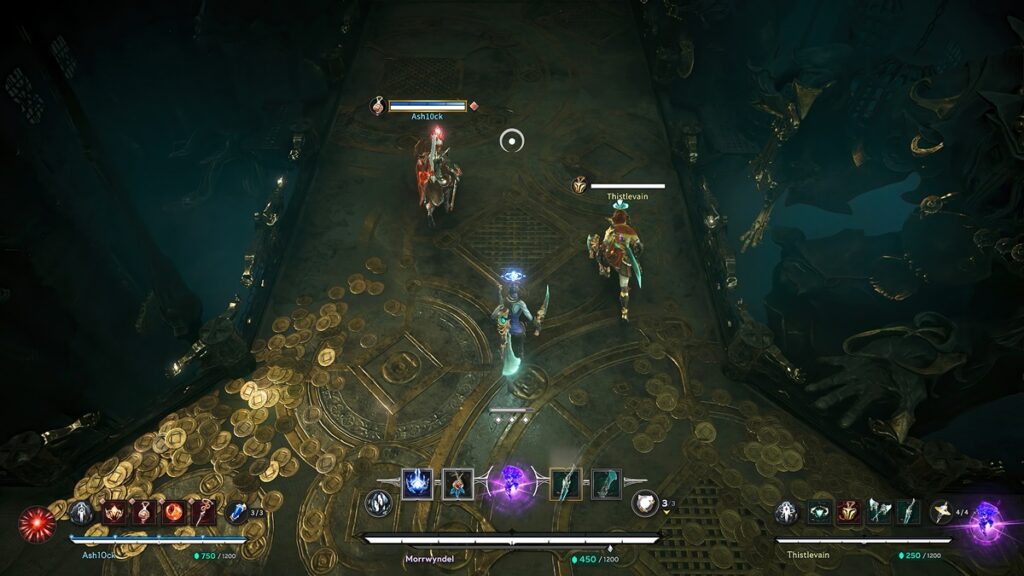
You can use a mouse and keyboard, moving around wht the WASD keys. The inventory is simple, with just four slots. There’s a crown, an amulet and two weapons. You have to choose which things you’re going to carry. One special ability is a leaping attack that lets you jump over walls and crush your enemies. The amulet can give you abilities like setting up a barrier that stops enemy projectiles. Another might be a kind of bomb that can steal life from your enemies. You can learn all the details of the various relics in the game. Some will let you regenerate armor. If you get four relics of the same type, you can gain advantages. These Eternals can be used to build narrative into the game world.
The starting lineup has 10 Eternals with a total of 40 items. Ultimately, thousands of combinations can be made.
Once players go into the battle royale mode, 15 teams of three enter the map on the first floor, picking a drop zone. The floors take five minutes to eight minutes to resolve, and the match itself will take about 25 minutes.
The team has a lot of post-launch content, and Pardo expects to be running a live service before the launch happens.
We’ll find out soon if players like what they see. But one thing is for sure. Arkheron has a very unique gestation coming from a unique team that wanted to build an original title. They have succeeded in getting this far, and the end goal is coming up soon.
One of the characters has shame and unfinished business takes the form of the City of Bells, where she is doomed to walk in the shame-petrified city forever.
“As a player, you’ll get to experience how her memories and emotions built the moments just before, during and after the event,” he said.
There are both environmental storytelling quests to immerse players. Monsters will spawn that players can fight or flee from. Players can rise up from one floor to another if they find a beacon. They can then fend off others who want the same beacon or take one from others. There aren’t enough beacons for all teams to make it upward.
Pardo said the final showdown creates action that teammates will be talking about for days to come.
“That’s one of the best things about Arkheron. It’s really an engine for player stories, so that no two games are ever the same,” Pardo said.