
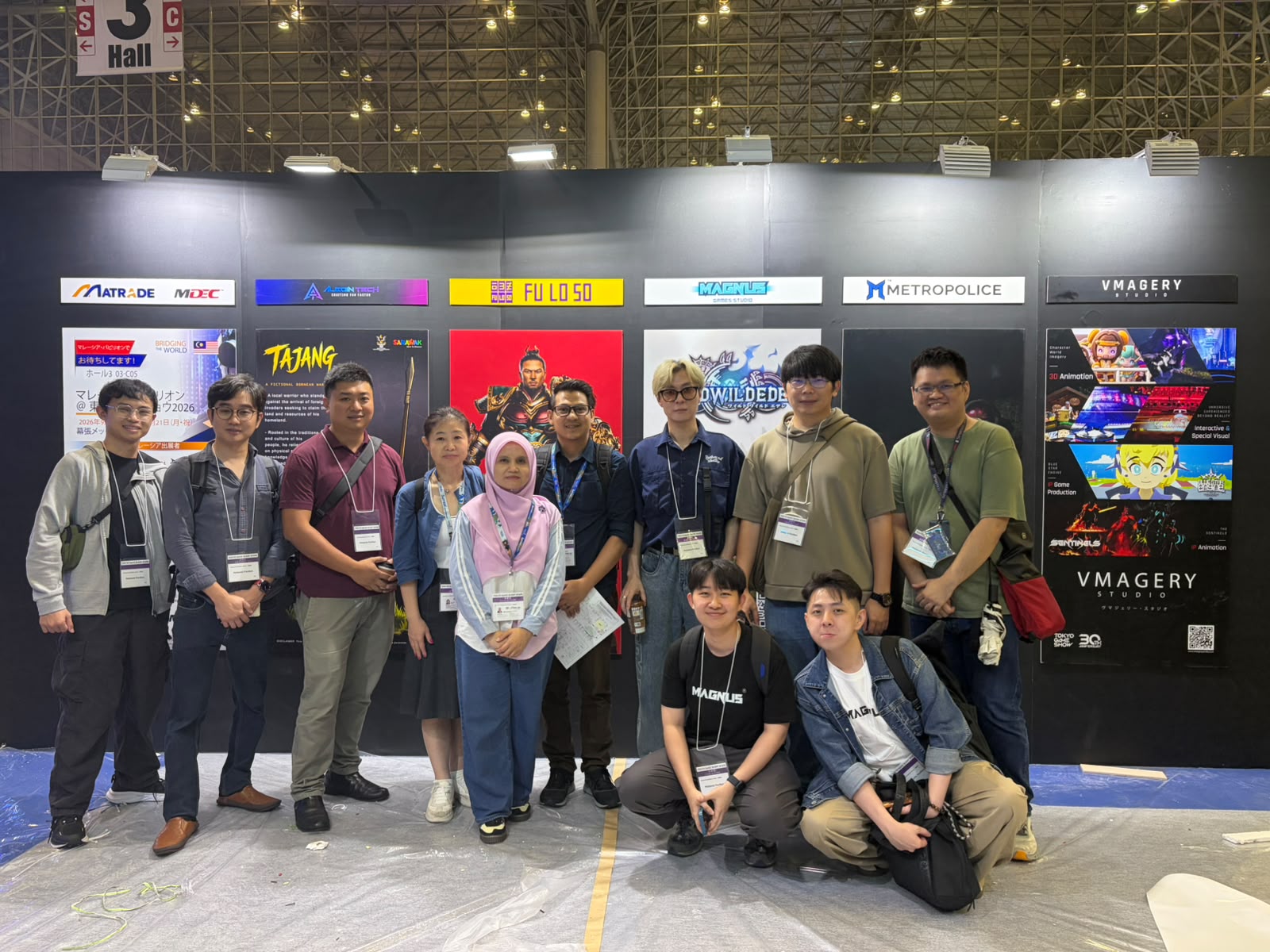
Tokyo Game Show 2026 put a spotlight on the Asian game industry with a range of regional pavilions representing markets across the region.
This year marked the Malaysian game industry’s tenth year with an official presence at Tokyo Game Show 2026 — a joint effort of the Malaysia External Trade Development Corporation (MATRADE), the country’s government office focused on promoting Malaysian trade overseas, and Malaysia Digital Economy Corporation (MDEC), the Malaysian government’s dedicated organization for digital software companies in the country.
Malaysia was not the only Southeast Asian company to show up in an official capacity at Tokyo Game Show. Regional authorities from Thailand and Korea also showed up in force.
During last year’s edition of Tokyo Game Show, the majority of the event’s regional pavilions were located inside Halls 4 and 5 — the centrally-located largest halls inside the Makuhari Messe convention center. This year, these central halls were dominated by massive booths featuring prominent exhibitors like Sega, pushing the smaller international pavilions into other halls. Although some of the international exhibitors who spoke to GamesBeat expressed initial misgivings over their new location, all of them reported that they were satisfied with the amount of foot traffic they’d experienced over the weekend.
“Personally, Hall 4 is much better than this area, because there’s lots more big game companies and more of a focus,” said Ingeol Jang, the senior manager of the Korea Creative Content Agency, which administered the official Korea Pavilion at TGS 2026, in an interview with GamesBeat. “When Tokyo Game Show opens, everyone runs to Halls 4, 5, and 6.”
The Korean Pavilion at Tokyo Game Show provided a showcase of the creativity behind some of the recent and upcoming releases coming out of the country’s game industry, from the social-media-inspired mystery solving game FakeBook, which launched its Japanese-localized version at TGS 2026, to Backrooms Cleaners, which combined shooter gameplay with roguelike mechanics and a truly spooky, Backrooms-inspired aesthetic.
The presence of dedicated pavilions for the game industries in Asian countries outside Japan highlighting the absence of many Chinese gaming companies from the event. Very few Chinese gaming companies attended TGS 2026, with Chinese attendance at the event dropping by 40 percent amid growing geopolitical tensions between Japan and China.
Although Tokyo Game Show’s public days offered an important promotional opportunity for international developers at the conference, the developers at the Asian regional pavilions were largely focused on the event’s business days and the networking that came with them. For this reason, they were not particularly distraught over the cancellation of the event’s third and final public day, although developers across the pavilions lamented the extra opportunity to share their games with the masses.
“I’ve gone to TGS before, just individually, on the normal B2B pass. In the past, that was like hard mode. Trying to get meetings with people is quite difficult,” said Richmond Lee, the chief executive officer of the Thai independent game studio Bit Egg, in an interview with GamesBeat. “But having a booth is a game changer, because not only do you have an easy and consistent place to meet people, but you get so many people just coming by randomly — just a lot of serendipitous meetings.”