
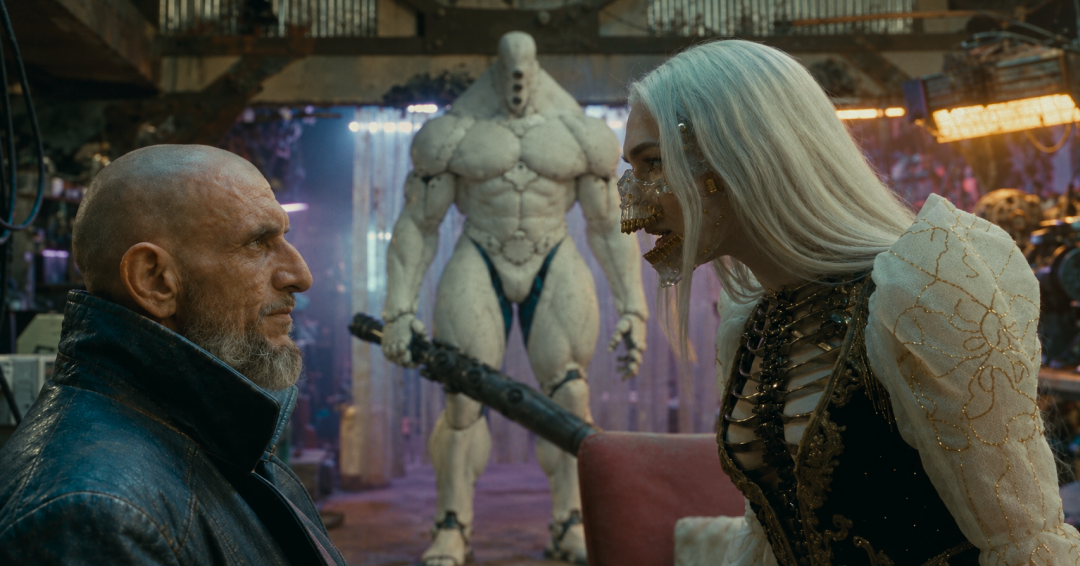
Grimes, the popstar with over four billion views and streams, is part of the cast of the first AI film to come to theaters Gods Don’t Give Gifts.
Grimes plays Zayinth Alda—a disaffected NiiroCore aristocrat and niece to Caen Halvorith, inventor of the Substrate Migration Protocol—who pays a visit to a dealer of dreamspools in the slums of East Cinder.
Director Zack London said in a statement, “So excited to have Grimes board the film — we created the character of Zayinth Alda for her and we can’t wait for audiences to see her performance.”
The film will begin a run in U.S. cinemas on December 4, 2026, following a distribution strategy inspired by Mark Fischbach’s ‘Iron Lung’ — the successful indie horror film from Youtuber Markiplier. The movie has four different stories in a single film.
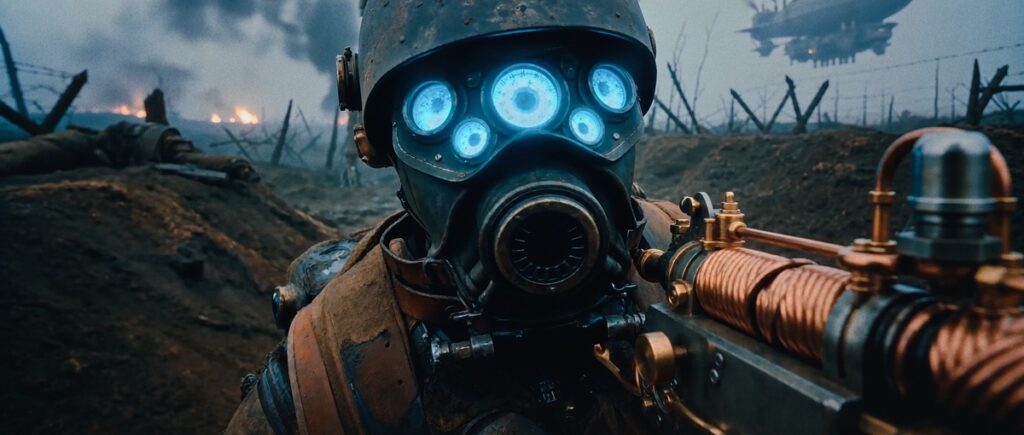
London said the stories follow people using strange tools to satisfy very primal needs, exploring the strange interplay and growing disconnect between the body and the mind. You might say the stories are dystopian, but the world doesn’t end in them; there isn’t an apocalyptic turning point, or some dramatic collapse. Despite the seeming horror of it all, the world just bumbles onwards.
Edward Saatchi, CEO of Fable, the AI storytelling company that helped make the movie along with Gossip Goblins, said the trailer, playing in theaters currently, has 16 million views across platforms and was one of Fandango’s X account’s five most viewed trailers of the year.
In an interview with GamesBeat, Saatchi said, “I worked with Zach for quite a long time, and I said, ‘You know, it’s time. Let’s do a feature film because for various reasons the space has matured. I did the first AI film festival back in 2022. I said then that the only thing that’s going to matter is — as these AI tools become true commodities within the marketplace — artistic vision. That’s been my quest for five years.”
He said the film is about the moment we live in during 2026, just like the 1967 film Bonnie and Clyde captured the moment of that era. He noted that Pixar leader Ed Catmull was a radical who created a whole new aesthetic with Pixar’s computer-animated films. The goal was to make films that no one had done before, rather than make cheaper films.

“Animated films are about to look completely different,” Saatchi said. “We are subordinate as an industry to creative decisions made by visionaries in the 1990s. It’s a bit like a game engine that starts to show its age. These movies’ techniques are showing their age. There are amazing pioneers but the baseline is to make more stuff that looks like Pixar.”
Saatchi, showrunner/producer, said casting the likeness of an actor with their spoken vocal performance will become more common with animated films using AI — audiences will see actors, athletes, musicians giving vocal performances with their likeness in films. In an interview with GamesBeat, Saatchi said the film — which is 107 minutes long — is just like an animated film. Humans apply the artistry when it comes to writing, directing, storyboard animation, voice acting, cinematography and editing, Saatchi said.
The indie film takes viewers to the science-fiction, horror-tinged world of the ‘Second Cycle of Humanity’ where transhumanism has accelerated to the point that humanity looks very different.
Grimes’ role
Popstar Grimes stars as Zayinth Alda in the film. Influencer Mike Majlak with almost a billion views is also joining the cast and can be seen in the clip launching on November 5.
Writer-director London, who was recently selected as one of the 25 most powerful people in Hollywood and AI by The Hollywood Reporter, has been described by The Hollywood Reporter as “the Auteur of the AI age” and potentially the ‘George Lucas of AI.’
He built the entire universe on a shoestring budget – and it’s resonated with audiences on YouTube. Saatchi said a team of about 30 people made the film in about nine months.
Possible awards
The studio will be submitting the film for Best Animated Feature — a first for AI and a test for the future of AI in Hollywood.
For Your Consideration screenings have already started for the Best Animated Feature Oscar, Saatchi said.
He added, “After hitting 16 million views for our first trailer, we have kicked off a traditional FYC Campaign, reaching out to Guild members and voters, and we will be beginning an FYC digital campaign in November. We’ve been heartened already by the reaction: one Oscar-Nominated animated film director from one of our FYC screenings compared Gods Don’t Give Gifts after seeing it to Kubrick’s ‘2001: A Space Odyssey’ and felt it might be a similar cultural moment — showing what is possible in science fiction movies.”
And Saatchi said, “We’ve had people comparing it favorably with the last two Star Wars films and had great feedback from Pixar folks (part of Fable’s team is ex-Pixar and we hugely respect their work) — we’re trying to make something as radical as Toy Story was in the 90s.”
On the film’s award chances, Saatchi said, “Pixar set the look for animated films in the 90s — they didn’t use technology to more cheaply make a film that looked like Beauty and the Beast. They created a radically new aesthetic with Toy Story. That’s what Gods Don’t Give Gifts represents: a wild new aesthetic for animated films that will define much of animated, actor-voiced films in the coming decades.”

Saatchi added, “This is that Toy Story moment for our generation — a radical departure for animated films — you only need to see Grimes’ brilliant performance in the film to understand how much things are about to change for animated movies. And we hope the Academy will recognize that a film that is seminal (the first AI film), wildly technically novel and (most importantly) good deserves a nomination.”
Saatchi’s Fable won an Emmy Awards for animated short for the VR film Henry in 2016.
London said, “The core of ‘Gods Don’t Give Gifts’ is really about what happens to ordinary human hungers and instincts when the physical limits around humanity starts to disappear. The four stories in Gods Don’t Give Gifts live inside that unease. They follow people using strange tools to satisfy very primal needs, exploring the strange interplay and growing disconnect between the body and the mind.”
London worked with cowriter Jacob Batchelor.
And London added, “You might say the stories are dystopian, but the world doesn’t end in them; there isn’t an apocalyptic turning point, or some dramatic collapse. Despite the seeming horror of it all, the world just bumbles onwards. The systems and markets and technologies all work as intended, and humans generally seem to prosper as a whole – it’s just that their humanity, at least as we know it, is fading towards extinction.”
London is one of a breed of new YouTube filmmakers, like Kane Parsons and Curry Barker. Just in the last few weeks there have been several studio bidding wars around internet IP involving Spielberg, Zach Cregger and Tristar.
Fable, which recently got an investment from Amazon, is backing the project as co-producer.
“The most important thing to us is to work on projects that will stand the test of time – this film by Zack is a masterpiece, not a demonstration of where the technology is, but a brilliantly written and paced story that will move audiences,” Saatchi said. “It is beautiful and exciting but deals in difficult themes around desire, the passage of time and the choices people make. This is a movie – and we’re so excited for people to see it on the big screen.”
The film is also being submitted for BAFTA and for the Golden Globes.

Alongside the film, fans within the Gossip Goblin universe will be able to create their own short films in the universe and win a $15,000 prize in a competition that will help draw attention to the cinema release – with the winner announced on December 4 — in a sign of the potential future for fan engagement.
Saatchi said, “Backrooms was a fan IP that came out of internet forums, Kane Parsons was a fan who built on top of a lore that started in a forum. Siren Head has built a huge fan remix community – fans want an ever deeper relationship with IP that they love, and Zack’s IP has such a rich world. The traditional view was that fans remixing IP would cannibalize boxoffice – Backrooms, created by Kane Parsons a fan who remixed the original Backrooms lore, proves that’s changing. The boxoffice what can happen when an IP engages fans to tell and remix stories in their world and to feel a sense of connection to the IP.”
London said the concept of the film is based on “part speculation, part critique, but I don’t think of it as a warning label. The point is not to say that technology is bad. The point is to take a premise seriously, follow its emotional consequences, and let the results be strange, funny, grotesque, and sad. Sci-fi can be kitschy and profound in the same scene, and I hold both with equal sincerity.”
Ravi Bhaskaran, a founding investor in Gossip Goblin, said in a statement, “Zack’s been building the history and the visuals behind the Gossip Goblin Universe and the 13 Cycles of Humanity for a long time. If people resonate with the movie, we hope to tell many more of our stories in the years to come. It’s hard to imagine that Zack was a solo creator a year ago – there was no studio or creative team. It’s been a crazy amount of hard work this year to make this movie happen – especially given our small creative team and shoestring budget. “
The stories within Gods Don’t Give Gifts follow an assortment of characters within the NiiroCradle.
London said, “ You might say the stories are dystopian, but the world doesn’t end in them; there isn’t an apocalyptic turning point, or some dramatic collapse. Despite the seeming horror of it all, the world just bumbles onwards. The systems and markets and technologies all work as intended, and humans generally seem to prosper as a whole – it’s just that their humanity, at least as we know it, is fading towards extinction.”
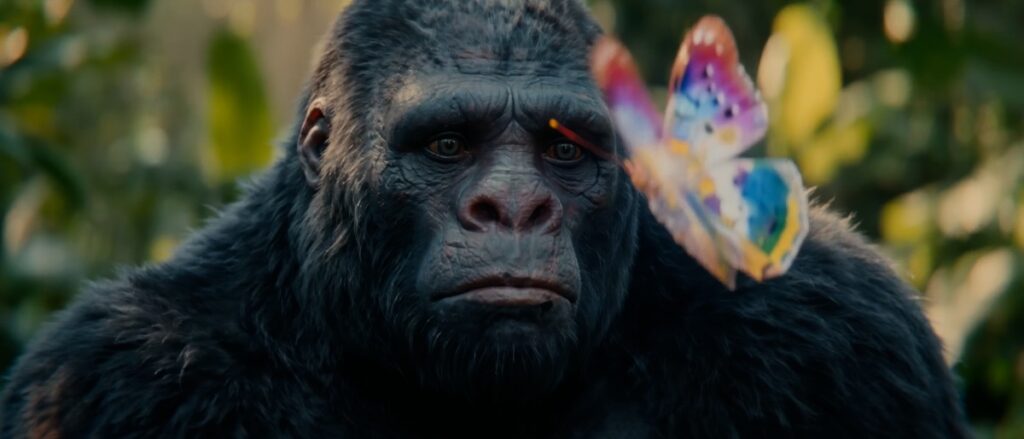
On the use of AI, London said, “I made these films with AI, which some people find ironic. But using a medium to interrogate that medium is one of the oldest moves in art; I may just be early to do it with AI. But what AI actually gave me is the ability to transmit stories onto a screen, with minimal filters, intervention, committees or constraints. Its enabled myself and a small talented team to envision an extravagant world, down to its smallest prop, and bring it to life with extraordinary fidelity – from jaw-dropping visuals of leviathans and space ships and talking apes, down to the scuffed up sneakers on a background extra.”
The 13 Cycles of Humanity
Across thirteen cycles spanning hundreds of thousands of years, humanity has risen to greatness and collapsed into ruin. Each cycle of humanity tells the story of a different civilization on a different world, united only by their shared ancestry and their capacity for self-destruction. From human livestock bred into helplessness to violent machines that claimed consciousness, from digital hiveminds that erased individuality to biological plagues that rewrote creation itself, each incarnation of humanity inevitably engineers its own extinction.
Watching over these cycles is the Basilisk, a disembodied AI superintelligence turned demi-god, born from humanity’s first attempt to decode the meaning of existence. Now it narrates each successive cycle, observing and inadvertently guiding each civilization toward its own ruin. The Cycles of Humanity is a chronicle of species-level failure; a series of cautionary tales about what happens when progress loses sight of humanity.
The movie takes place during the second cycle. On Niiro Cradle, consciousness has become the primary object of control, trade, and modification. Bodies can be replaced. Perception can be edited. Memory can be installed or removed. Death itself is no longer final.
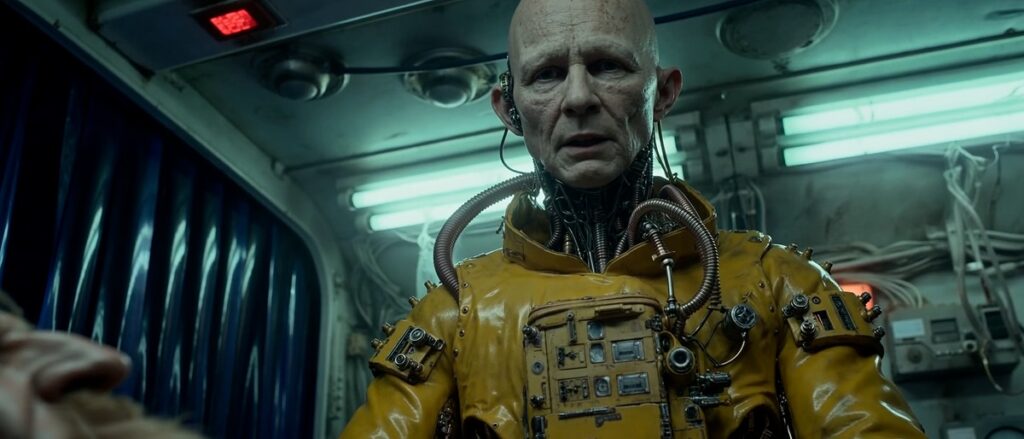
NiiroCore, the planet’s governing body, controls 97% of mindshare. Literally. Its proprietary wetware enables consciousness to be transferred into synthetic frames, replacing biological tissue with silicon and steel. Piece by piece, humanity is upgrading itself into something cleaner, stronger, and free from the weaknesses of flesh.
But the transition isn’t clean. Patchwrights weld jailbroken mods in back-alley workshops. Preachers rage against the death of the human soul. Debtors are transferred into animal bodies. Veterans gather in midnight diners. And corpo aristocrats watch it all from glass spires, wheeling in unmodified humans as dinner entertainment.
Yet despite all of humanity’s advancements, the mind remains largely unchanged. People still crave love, meaning, belonging and stimulation – only now technology has unlocked endless new and invasive ways of pursuing them.