
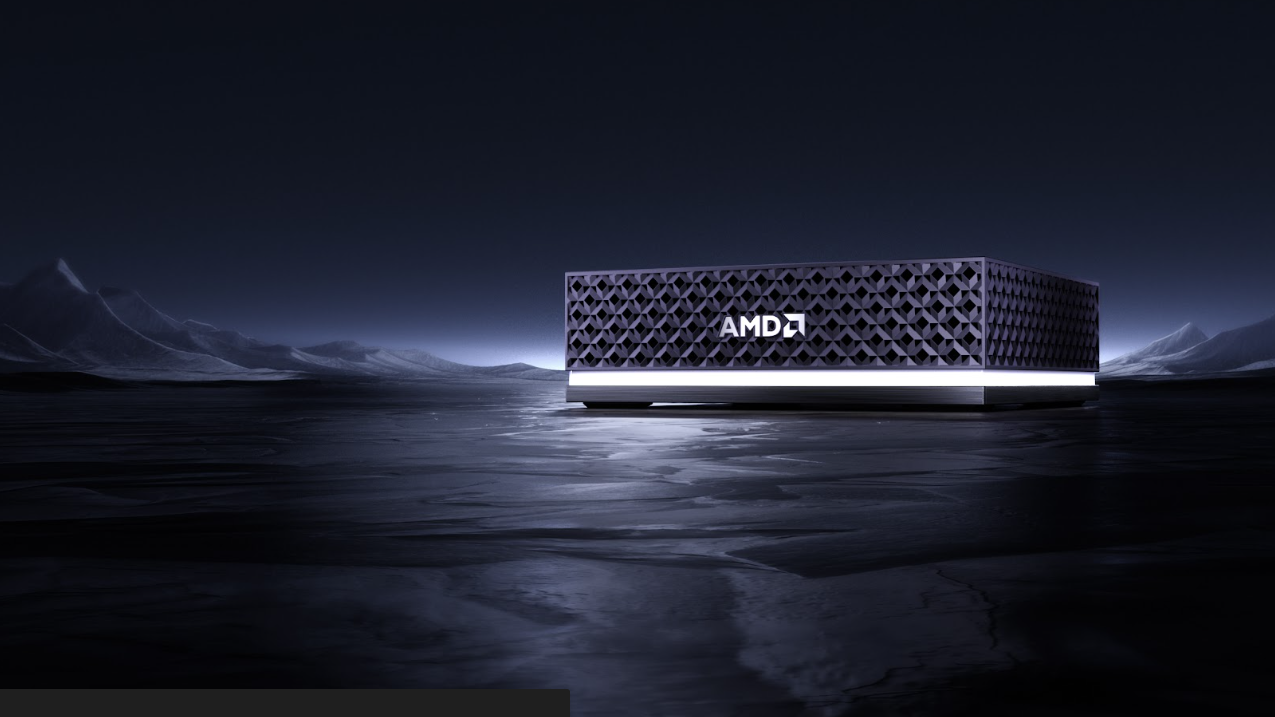
AMD announced the on-shelf availability of the AMD Ryzen AI Halo developer platform, powered by Ryzen AI Max 300 Series processors.
AMD also announced the new Ryzen AI Max PRO 400 Series processor lineup, which will power the next generation AMD Ryzen Halo developer platform later this year.
These updates enable developers and businesses to build and deploy local AI at scale and are designed to support agent computing with ease.
Ryan Shrout, an analyst at Shrout Research, said in a message to GamesBeat that AMD isn’t just dipping a toe into local AI. It’s finally shipping this first-party platform to compete head-on for the AI developer’s desktop. The market for local AI development and small-scale inference is only just forming, which is exactly why a second credible vendor matters now rather than later, he said. And supporting both Windows and Linux with full ROCm is a smarter early-market bet than it looks: in a space where every developer’s workflow is different, meeting them where they already work is a real advantage, Shrout said.
“On paper, Ryzen AI Halo and DGX Spark are closely matched, and AMD’s early performance numbers against Nvidia’s Spark look strong, but those are vendor claims on a short list of models, and they need independent validation before anyone treats them as settled. Winning a benchmark is the easy part,” Shrout said. “The real test is performance across a wide and constantly shifting range of models, and staying current as new models, workflows, and inference stacks land almost every week. That ongoing support is where Nvidia’s CUDA ecosystem has a long head start, and it’s the bar AMD has to clear.”
Shrout explained that agents fundamentally change the math on AI infrastructure. Autonomous agents will run continuously and consume orders of magnitude more tokens than chat. Shrout’s Signal65 research puts it at roughly four to 15 times more, and trending well beyond that. When consumption scales like that, per-token cloud pricing becomes a real line item, and owning local inference capacity stops being a hobbyist choice and starts being an economic one.
“That’s why I expect platforms like Ryzen AI Halo to become far more relevant through 2026,” Shrout said.
He added, “With the Ryzen AI Max 400, the ‘Gorgon Halo’ follow-on, the CPU and GPU are a small step, but memory is the real one. Moving up to 192GB of unified memory is the spec that matters most, because memory capacity is what decides which models you can actually fit and run locally, and that’s a meaningful jump over the 128GB ceiling on both today’s Halo and DGX Spark. The open questions are price and availability, and in this memory market, those are what will decide how this lands.”
Key Announcements:
- AMD Ryzen AI Halo powered by Ryzen AI Max+ 395 will be available for pre-orders starting in June 2026.
- The next-Generation Ryzen AI Halo platform will feature Ryzen AI Max PRO 400 series processors, launching in Q3 2026.
- AMD Ryzen AI Max PRO 400 Series introduces three new SKUs designed to accelerate local AI and agent computing. Ryzen AI Max PRO 400 Series processors will be available starting Q3 2026 from leading OEM partners.
AMD Ryzen AI Halo
The AMD Ryzen AI Halo developer platform is designed for developers building and deploying local generative and agentic AI applications, combining high-performance graphics, AI and compute capabilities with AMD ROCm software to streamline AI development workflows.
Availability:
- Ryzen AI Halo, powered by Ryzen AI Max+ 395, will be available for pre-orders starting in June 2026 starting at $3,999.
Key details:
- Enables developers to run larger local AI models with up to 128GB of unified memory.
- Accelerates on-device inference and agentic AI workloads with up to 50 TOPS of XDNA 2 AI performance.
- Streamlines AI development workflows with support for AMD ROCm software and widely used AI frameworks and tools.
- Reduces reliance on cloud resources for AI testing, fine-tuning and deployment workflows.
Next-Gen Ryzen AI Halo powered by Ryzen AI Max PRO 400 Series: The next-gen Ryzen AI Halo platform, powered by Ryzen AI Max PRO 400 Series, offers developers expanded local AI performance with 192GB memory (up to 160GB VRAM), 55 NPU TOPS, and higher clock speeds to accelerate complex AI models and agent workflows directly on the PC.
Key details:
- The Ryzen AI Max PRO 400 developer platform will be available in Q3, 2026.
Commercial AI PCs
AMD Ryzen AI Max PRO 400 Series: Built on AMD “Zen 5” architecture, the Ryzen AI Max PRO 400 Series combines AMD RDNA 3.5 graphics and AMD XDNA 2 NPUs to enable AI, graphics, and professional workloads on a single system — purpose-built for commercial AI PCs, mobile workstations, and small form-factor desktops.
Availability:
- Systems powered by Ryzen AI Max PRO 400 Series processors will be available from major OEM partners including ASUS, HP, and Lenovo starting Q3 2026.
Key details:
- Enables developers and creators to run large local AI models, including 300B+ parameter LLMs, on an x86 client processor.
- Supports concurrent agentic AI workflows with up to 192GB of unified memory for multiple local AI agents.
- Combines AI acceleration, graphics and compute performance in a single platform for professional AI and creative workloads.
- Delivers workstation-class performance for design, rendering, simulation and engineering applications.
Ryzen AI Max PRO 400 Series Specs
Ryzen AI Max+ PRO 495
16 C / 32T
Up to 5.2 GHz / 3.1 GHz
80 MB
AMD Radeon 8065S
45- 120W
Up to 55 TOPS
40 Graphics CUs
192 GB
Ryzen AI Max PRO 490
12 C / 24 T
Up to 5.0 GHz / 3.2 GHz
76 MB
AMD Radeon 8050S
45- 120W
Up to 50 TOPS
32 Graphics CUs
192 GB
Ryzen AI Max PRO 485
8 C / 16 T
Up to 5.0 GHz / 3.6 GHz
40 MB
AMD Radeon 8050S
45- 120W
Up to 50 TOPS
32 Graphics CUs
192 GB