
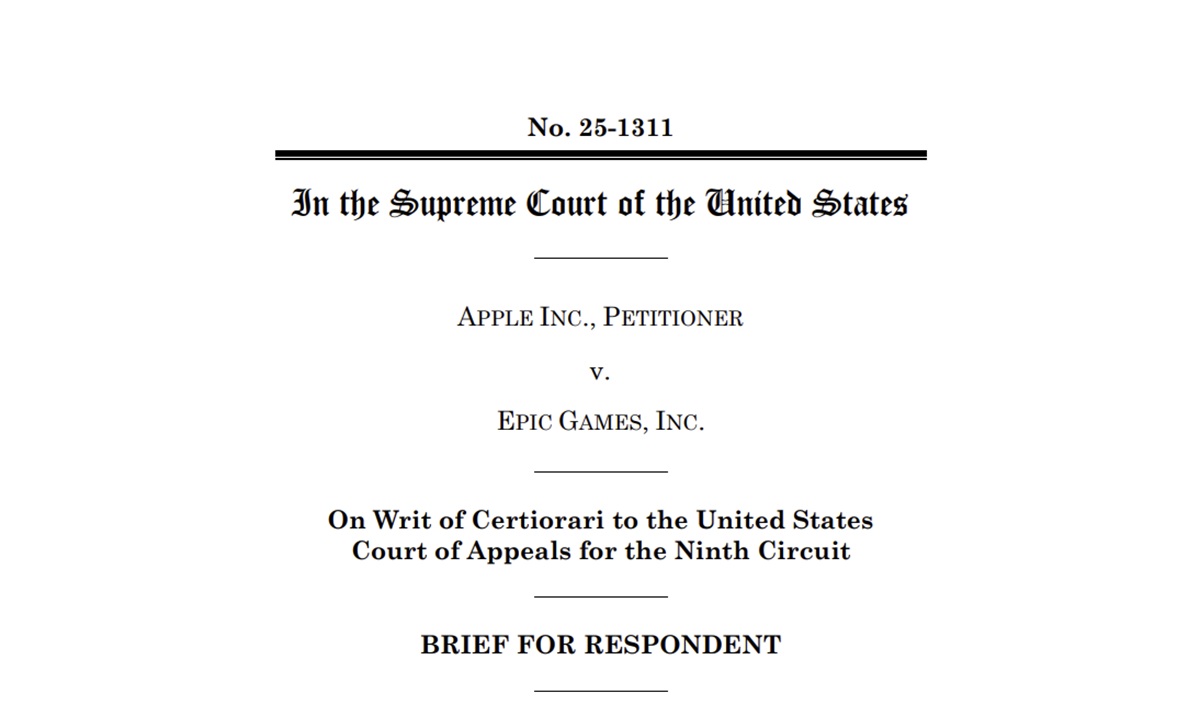
Epic Games filed a brief with the U.S. Supreme Court explaining why Apple was correctly held in contempt of court.
Rather than complying with the district court’s order, Apple started charging a “27% junk fee” on purchases made on the open web, Epic Games said. Then it said that Apple then made it nearly impossible for customers to link out to make those purchases. (See our latest interview with Epic Games CEO Tim Sweeney here).
“Contempt is for companies that knowingly violate court orders. That is exactly what Apple did,” the Epic Games brief said.
In the brief, Epic said Apple knew exactly what it was doing. For years, Apple blocked price competition on purchases of digital content—such as books, movies, and music subscriptions—made through iPhone apps, Epic argued.
“It did so by requiring that all such purchases be made through Apple’s own payment system, where it charged a lucrative 30% commission. And it prohibited app developers from linking consumers to other payment systems on the web, or even telling consumers that they could make the same purchases elsewhere at lower cost,” Epic said.
Epic lost on most of its antitrust allegations in a U.S. District Court case, but Apple lost an important part of that litigation. The district court enjoined Apple’s anti-steering practices: Apple could not prohibit developers from linking users to other payment systems, or from telling users that those options exist.
“The injunction’s goal was clear: to permit linked-out purchases from apps, which would allow price competition and provide meaningful consumer choice,” Epic alleged. “Apple’s response was to adopt new restrictions designed to have the exact same purpose and effect as the old ones.”
Epic said Apple imposed a commission on linkedout purchases, at a rate so high that app developers would lose money if consumers used any payment system other than Apple’s payment system.
“Significantly, this was the first time that Apple ever sought to tax transactions on the open web, as opposed to on its own platform. Second, Apple imposed design restrictions that made those links to external payment systems nearly impossible to find and painful to use,” Epic said.
And Epic said, “As soon as the injunction was entered, Apple began developing a plan to evade it. Apple’s internal documents show a methodical scheme, conceived and approved at the highest levels of the company, to nullify the injunction while maintaining the appearance of compliance.”
As the district court found, Apple executives consistently picked “the most anticompetitive option” despite internal warnings that doing so could run afoul of the injunction, Epic said. We asked Apple for comment.
The goal was to “limit the [district court’s] ruling” as much as possible. Apple adopted two types of new restrictions: a commission so high that no developer would find it worthwhile to offer links to external payment systems, and design restrictions so onerous that no user would ever leave the app to complete a purchase.
Epic moved to enforce the injunction, and the district court held an evidentiary hearing.
As the hearing unfolded, the court “became increasingly concerned” that Apple was “withholding critical information about its business decision[s]” and providing “sham” evidence to the court, Epic said.
“The court ultimately found that Apple engaged in a bad-faith cover-up to try to hide its knowing noncompliance with the injunction in three ways. First, Apple made baseless claims of privilege to try to prevent the court from seeing its true motivations in adopting the new restrictions,” Epic said.
And it said Apple presented the “sham” report to the court to try to justify its new 27% commission.
Epic also said Apple presented false and misleading testimony in court, saying one Apple executive “attempted to mislead the court” by claiming that executives had relied on the “sham” report when they had not, id.
The district court held Apple in contempt. It found that Apple’s new restrictions were not a good-faith effort to comply with the injunction, but a calculated scheme to evade it, methodically planned and executed by Apple’s top management, Epic said. Apple’s own documents and evidence showed that, and now the matter has gone to the high court.
The court of appeals affirmed the contempt holding. It explained that “[t]he standard for evaluating contempt ‘is generally an objective one’”; civil contempt is appropriate when the defendant’s actions reflect an “‘objectively unreasonable’” view of the injunction. And civil contempt sanctions” also “may be warranted when a party acts in bad faith.”
“The courts below appropriately held Apple in contempt for violating the injunction. As the district court found, ‘Apple knew exactly what it was doing,'” Epic said. “Apple’s conduct violated the injunction, Apple knew it violated the injunction, and Apple’s bad-faith cover-up attempt confirms the point.”