
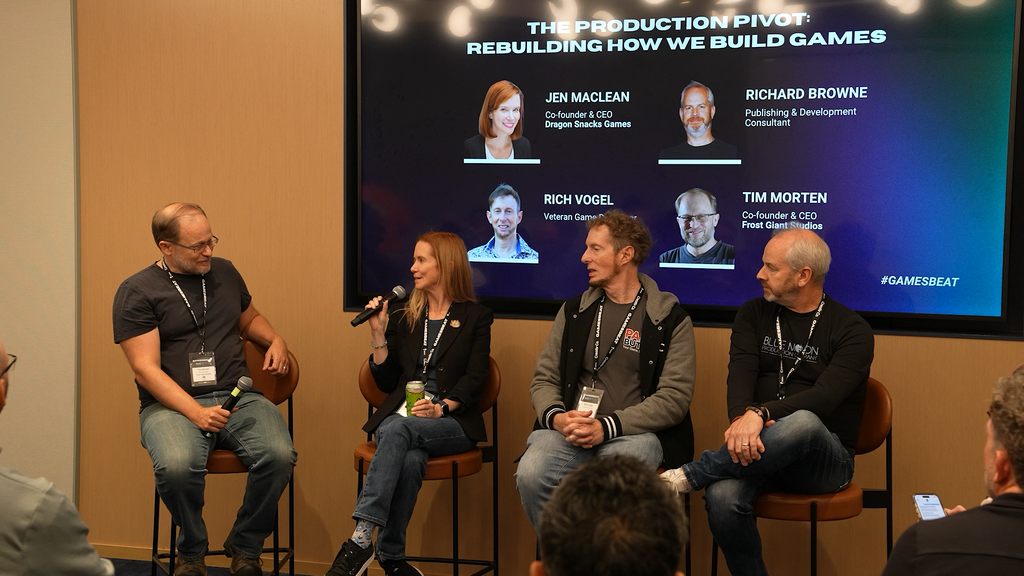
At GamesBeat Next 2026 in San Francisco, veteran game developer Rich Vogel, Blue Moon Production Company director Richard Browne and Dragon Snacks Games CEO Jen Maclean took the stage to argue that tighter funding and new tools are forcing studios to reconsider how they build games. Frost Giant Studios co-founder and CEO Tim Morten moderated.
Maclean opened the conversation by describing today’s funding market, which she says is the toughest of her 30-year career.
“I think we’re in the eye of the hurricane in a lot of ways because funding is significantly more difficult to get,” she said. “I think more difficult than I’ve ever seen it in 30 years of experience.” Maclean then explained how games-focused venture capital firms have largely disappeared from industry events, with roughly eight at Dice Europe in September 2024, one in 2025 and, as far as she knows, none this year.
Next, Vogel pointed to the gap between mid-budget hits and the most expensive blockbusters. He said games costing $40 million to $60 million are competing with titles that cost $300 million to $500 million, and that the math no longer works.
“You realize something has got to give, and the thing that has to give is how we produce our games,” he said. He added that “$250 million, $350 million budgets are not sustainable” when studios have to sell enormous numbers of units just to recover development costs.
Browne said the problem is concentrated in the West. “The cost of producing games here is just far, far too much,” he said. His answer is to keep a small core team that holds the studio’s knowledge and iterates on the game, then outsource additional work when it makes sense. He said teams of 300 or 400 people are no longer affordable.
Vogel described how he applied that approach to a studio he started about two and a half years ago. He said it kept a core team of roughly 20 to 30 people focused on prototyping, playtesting and checking whether the game was fun, with outside co-development studios producing most of the content.
“We didn’t hire managers; we hired doers,” he said. He said co-development partners have to be treated as part of the team. “It’s not throwing things over the wall. That will never work.”
Both Vogel and Browne emphasized scope. Vogel said his team shifted away from a live-service model toward a shorter, tighter game with downloadable content, which lowered its costs. Browne said the industry has lost something it needs back.
“The biggest problem that the games industry lost was constraints,” he said. “Everybody works better in a box.” He said younger players do not care about ray-traced worlds. “They just care if it’s fun. Is it social? Can I play it with my friends?”
Maclean said her experience raising money for Dragon Snacks has shifted the way she plans. “I will never make another game that requires me to raise money because it’s so hard, and your fate is entirely in the hands of people who just don’t care like you care,” she said. Her advice to would-be founders is to avoid building a budget that depends on outside funding.
Morten described himself as the most pro-AI person on the panel, and the discussion showed an array of views on the matter. Vogel said AI can help small teams scale, especially on programming and menial tasks, and can speed up prototyping. “It allows you to scale,” he said. He said he draws a line at generative art in the finished game.
Maclean was the most skeptical of the group. She said her studio uses AI on the engineering and business sides but will not ship anything player-facing that is generated. “Nothing player facing will ever be generative AI, and that is a bold statement,” she said. She argued that players in North America and Europe care about the issue. “When you lose player trust, you cannot get it back.” She also warned that AI prices are subsidized and that a studio built around a tool could be in trouble if costs rise sharply.
Browne shared his belief that the human element is what makes games work. “Feel and touch is something that only a human can really do,” he said. He agreed with Maclean about the risk of being locked into tools that become much more expensive, but said he expects attitudes toward AI to shift as more studios adopt it.
The panelists were also skeptical of traditional publishing deals. Browne said many publishers wait until a game is nearly finished before committing money. “At which point, I don’t actually need a publisher,” he said. He said marketing has become fan-driven, and that some developers now test game concepts on Instagram and TikTok before building them.
Maclean said a publisher can still add value if it enforces milestones, and said a poor one can do real damage. “A bad publisher can kill your game,” she said. “If you do not have hard milestones in your production plan, you are setting yourself up for failure.” She said a good publisher holds a team accountable without sinking the company.
Morten closed the session by summing up the discussion’s main theme. “I think the one constant is change, and we are sort of all finding our way through the dark together,” he said.