
AI is opening up new possibilities for game development, but the biggest opportunity may not be making existing games with smarter characters. It may be creating entirely new kinds of games, experiences that would not be possible without artificial intelligence.
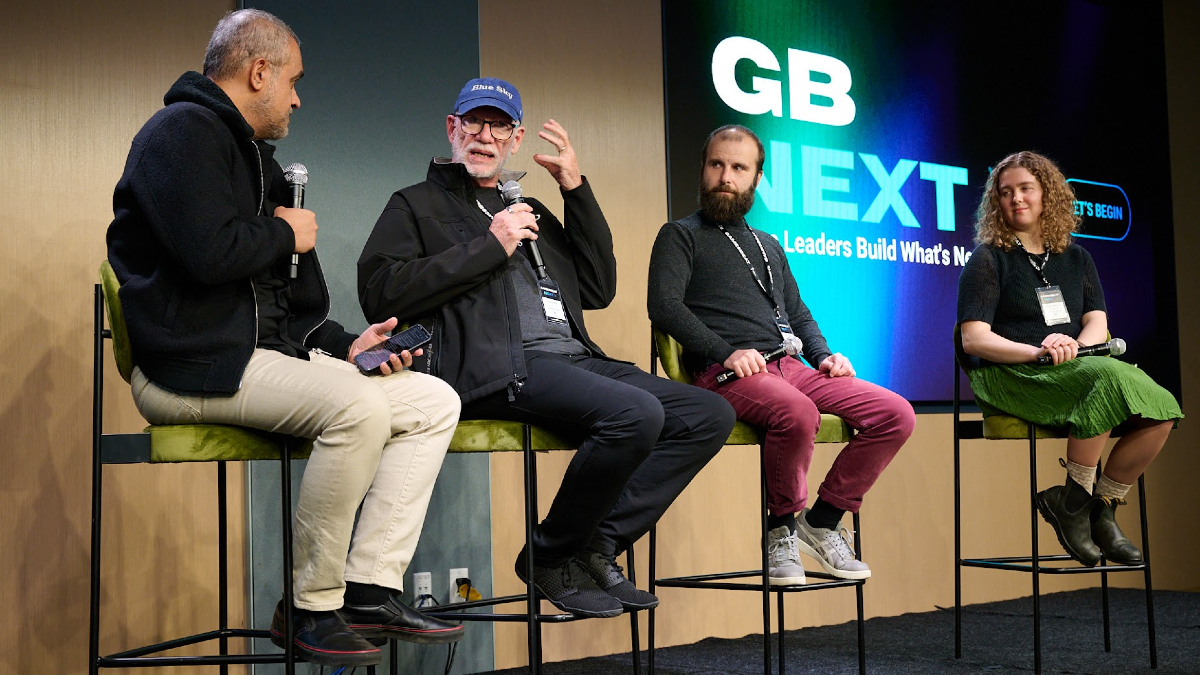
That was the central theme of a panel at GamesBeat Next 2026 in San Francisco, where Brian Tanner, the chief executive officer of Artificial Agency; Piero Molino, the chief executive officer of Studio Atelico; and Jon Snoddy, the chief executive officer of Operative Games, discussed what it means to build games around AI from the ground up. The conversation was moderated by Jamil Moledina, a partner at Principal Venture Partners.
For Tanner, the appeal of AI in games is closely tied to the broader development of agentic AI. Having worked at Google DeepMind, he saw games as a way to make the capabilities of AI agents tangible and accessible to a wider audience.
“I wanted to remind people why agents are actually really cool,” Tanner said. “Finding a way for people to play with them and to have experiences that they haven’t had before would be the way to do it.”
The challenge, however, is making those experiences feel like games rather than demonstrations of technology.
Molino pointed to the generative agent experiments that emerged from Stanford as an early source of inspiration for the possibilities of AI-driven worlds. But he also highlighted a distinction between creating an open-ended simulation and designing something that people actually want to play.
“The first ones need a lot of AI, but they are not really games, at least not in the sense that we usually ascribe to games, because there was no bite, no challenge,” Molino said.
For game developers, that distinction matters. AI can make characters more responsive and worlds more dynamic, but those capabilities still need to serve a clear gameplay purpose. The player needs goals, obstacles and reasons to keep engaging.
Snoddy approached the opportunity from a different background. Having worked in feature animation at Disney, he was interested in the possibility of letting audiences step inside fictional worlds and interact with the characters who inhabit them.
At Operative Games, conversation is central to that experience. Rather than treating dialogue as a layer sitting on top of conventional gameplay, the studio sees the interaction itself as the core mechanic.
“The game mechanic is the story. The game mechanic is the conversation,” Snoddy said.
That changes the relationship between players and characters. Instead of simply selecting from predetermined dialogue options, players can communicate with characters more directly, using formats such as phone calls, text messages and video calls.
But making those interactions work requires more than giving characters the ability to respond to anything. Snoddy argued that believable characters need to feel as though they have their own lives and priorities, rather than existing solely to answer the player.
“You have to feel something about all these interactions and all these characters,” he said.
That sense of character and independence is part of what makes AI-native experiences different. The technology can support more flexible interactions, but the creative challenge is deciding how much freedom to give players and how to make that freedom meaningful.
The panel also explored the practical economics of building games that rely on AI at runtime. Every interaction can carry a cost, making the choice of models and the design of the experience closely connected.
Tanner described the challenge in terms of balancing quality, speed and cost. Developers need AI systems that respond quickly enough to sustain an experience, deliver the quality players expect and remain affordable at scale. Model customisation and decisions about whether inference happens on-device or in the cloud can all affect that balance.
Molino stressed that cost cannot be treated as an afterthought. It needs to inform the design of the game from the beginning.
“If I’m a game designer, and I know that making a call within the game costs me a certain amount, that influences the design that I can make,” he said.
In other words, developers cannot simply build an experience around unlimited AI interactions and work out the economics later. They need to understand the cost of the systems they are using and make design decisions that fit within those constraints.
The speakers also considered the potential for AI to support more systemic and sandbox-style games. Autonomous characters could create situations that emerge from their own goals and interactions, giving players opportunities to influence a world rather than follow a tightly scripted sequence.
That idea has roots in earlier games from studios such as Bullfrog and Lionhead, which explored simulated worlds and characters with behaviours of their own. Runtime AI could make those ambitions more flexible, allowing developers to create worlds that respond to players in less predictable ways.
There are creative risks, too, particularly when games use established intellectual property. Characters need to remain recognisable and consistent with the worlds they come from. For Snoddy, the opportunity to interact with fictional characters depends on preserving the qualities that make those characters compelling in the first place.
Ultimately, the panelists described AI-native development as a design challenge as much as a technical one. The technology can make new forms of interaction possible, but it does not automatically make an experience entertaining.
The opportunity is to find the kinds of gameplay that depend on AI, experiences built around responsive characters, autonomous systems and interactions that could not be delivered through conventional game design alone. The next generation of AI-native games will need to prove that those possibilities can become compelling games, not just impressive technology demonstrations.