
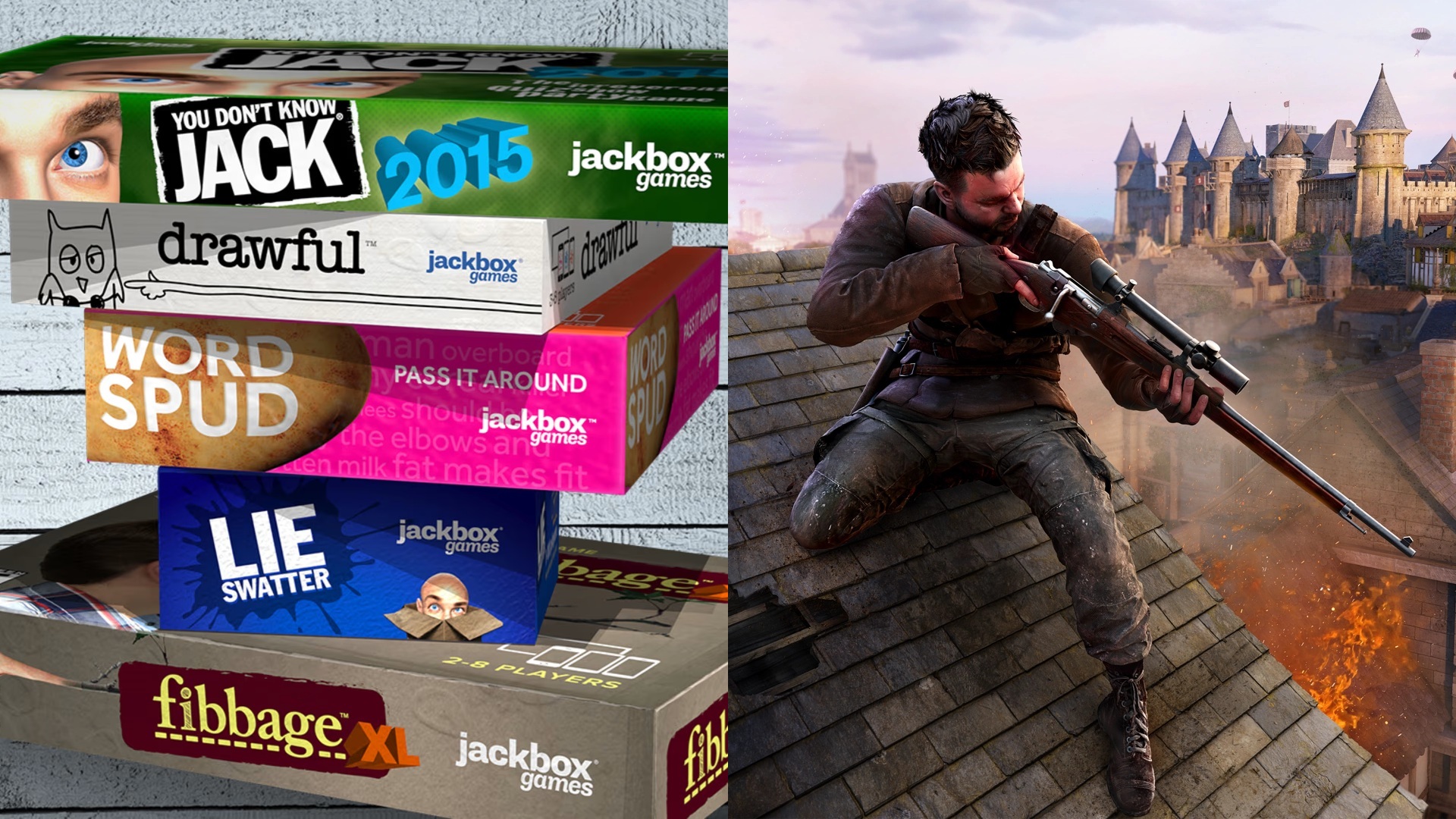
Finding studios in the games industry that haven’t had large-scale layoffs in the last few years is becoming increasingly difficult. This past week alone, we’ve seen Microsoft lay off hundreds of staffers within Xbox’s stable of studios, and the now-independent Undead Labs laid off staff in the aftermath of its employee buy-out.
However, those studios do exist, and I’ve been seeking their stories in order to understand what they’re doing differently. In my previous article in this series, I explored pathways to sustainability in interviews with staff from Fireshine Games and DreadXP.
In this one, I spoke with the leaders of two other studios, some of the longest-running in the business: Jackbox Games and Rebellion Developments, who’ve been around in one form or fashion since 1989 and 1991, respectively. Neither studio has laid off a significant number of staff within the last ten years.
And once again, I had the chance to ask the obvious question: How?
The return of You Don’t Know Jack
Jackbox Games has been around so long that I legitimately can’t remember a time when they weren’t part of my life. I played the You Don’t Know Jack CD-ROM games back in the day with my parents. The company itself launched in 1989 as Learn Television, rebranded as Jellyvision Games in 1995, went dormant for seven years between 2001 and 2008, and then went on launch one of the most successful casual game franchises of all time.
I spoke with Mike Bilder, the chief executive officer of Jackbox Games, about finding balance with the desire for growth and how Jackbox has changed over the years. He noted that the company’s model, shifting to the Jackbox Party Packs in 2014, fundamentally changed its approach to growth. At present, there are eleven Party Packs, with the twelfth launching next month.
“Every Party Pack is unique,” said Bilder. “There’s a unique batch of games in each one of them. The nice thing is, on an annual basis, any new release isn’t a make-or-break situation for the company. If the game doesn’t sell or doesn’t sell well, we’re fine. The back catalog continues to sustain what we do.”
The Party Packs have launched on consoles, PC, mobile devices and smart TV devices. Bilder noted that the COVID-19 pandemic helped boost Jackbox’s brand, as many used them to connect remotely with friends and family.
Brooke Hofer, Jackbox’s chief marketing officer, told me that players have joined Jackbox’s party games over 826 million times, but noted that this doesn’t necessarily mean the company is breaking the bank to reach new players.
“We’re not just throwing money at our marketing to reach new audiences,” she said. “We treat new ventures as experiments, with controls. We’re testing our hypotheses before we break it out in a bigger way. That’s how we approach all new endeavors.”
Speaking with Bilder about Jackbox’s lack of layoffs since 2014, he said, “Early on, we were like any other studio. Every game was critical for us, and if it wasn’t successful, we had a going concern for the company. But since 2014, since that launch of the first Party Pack, we have been conservative in the way that we grow the company… When you put all of your eggs in one basket, and that game doesn’t succeed, you’ve got a big problem on your hands. Payroll becomes an issue, and you need to downsize. We’ve built the company around a different strategy, so that isn’t a concern for us.”
When I asked about Jackbox’s trend of growth, I noted the company’s recent shift into publishing. Its first indie game is My Arms Are Longer Now, a comedy title from Toot Games about stealthily controlling your character’s very long arms. Bilder said that the company wants to do more than just make Party Packs every year.
“We were a starving indie at one point, looking for funding and looking for people to keep us alive, but over the last 12 years, we’ve built up this marketing machine and relationships with platforms and first-party contacts… We see what a challenge the industry is right now, and what a funding challenge is. There’s no shortage of great ideas, but sadly most of those probably won’t see the light of day because they won’t get funded. We want to help where it makes sense, and where it has potential for both of us.”
Spending money to make money or making money to spend money?
Maintaining sustainable finances was a major theme in all of the interviews I conducted. If there was a single running theme in all of the interviews, it was that studios do not have to grow in proportion to the popularity or sales of their products. More success didn’t necessarily mean more employees or more projects. Most of the companies built a solid foundation first.
One example: I spoke with Jason Kingsley, co-founder and CEO of Rebellion Development, who noted that Rebellion had built its business model over a long period — the company was first founded in 1992. Kingsley noted that Rebellion didn’t overexpand during the pandemic. “Our profitability flexes because, whilst we’re a big company, we don’t release many games. Our revenue depends on the long tail of our games.”
Rebellion has released one game per year in most of the years since it was founded, most of them in the Sniper Elite series. Last year, it launched British survival FPS Atomfall, while it released futuristic arcade-sports title Speedball this year. In addition to its video games, Rebellion has other revenue streams, including book publishing.
Kingsley said that Rebellion was “sticking to our knitting” without chasing industry trends or expanding past the point that a Sniper Elite game could support. It also control the budgets of its games to keep them within the range of $15-50 million — which, as Kingsley noted, is a lot of money already. Sustainable development, he said, was just as important as sustainable hiring and growth.
“We sometimes have to say no to scope,” said Kingsley, referring to himself and his brother, Rebellion’s other co-founder Chris Kingsley. “I think one of the reasons that projects can spiral out of control is parallel to why people might spiral out of control: You sometimes need an authority figure to say no… We make games that sell, and we’ve got to make controlled-budget games that sell sufficient to make more than their budget.”
Kingsley added, “I’m not very clever at corporate structures. I think, if we spend $20 million to make something, hopefully we make $40 million selling it. Great, we’ve made $20 million profit. that can go back in. We may make games that cost $20 million and only make $15 million. We just have to swallow the loss. Some games might do really, really well. To my mind, that should be the basis of business for many people, but I don’t think it actually is.”
These are the some of the biggest insights I got from these interviews, and it was an enlightening experience speaking with studios that have thus far managed to avoid major layoffs. Each studio’s story was different, but there were some common themes of strategic growth and realistic expectations.