
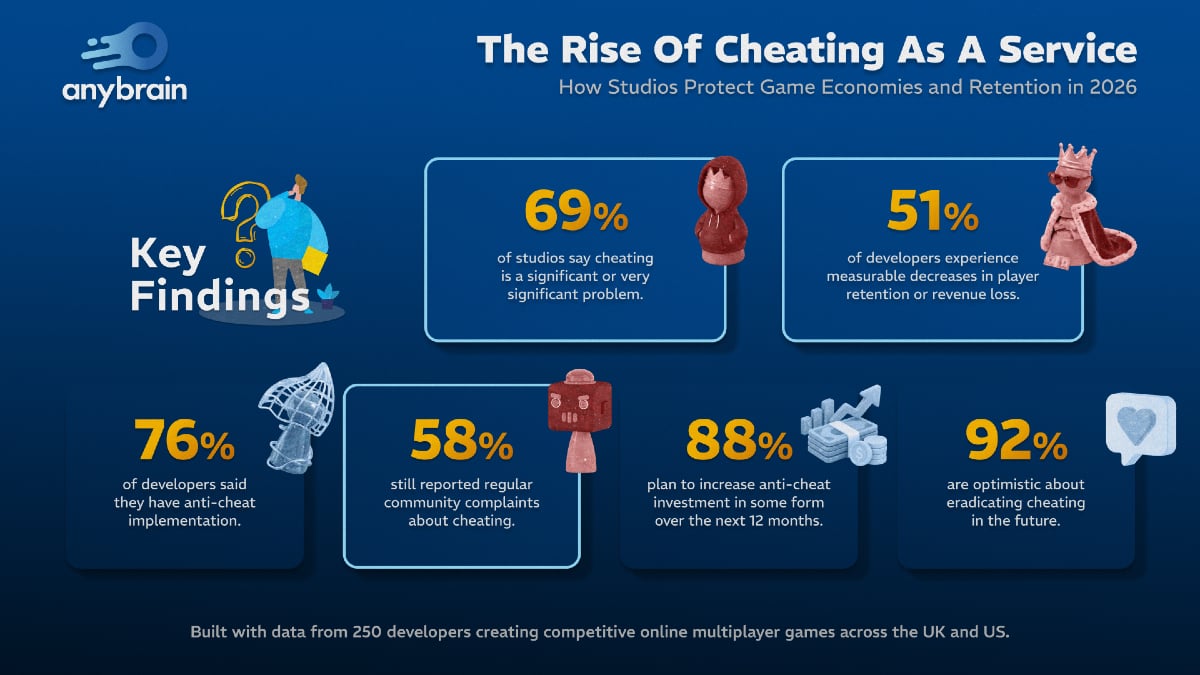
Anybrain, the collaborative AI anti-cheat built on 120+ multiplayer online games, has published The Rise of Cheating as a Service, a new industry report. The report found that 69% of game developers consider cheating a significant or very significant problem in their games, while more than half (51%) have experienced a measurable decline in player retention or revenue because of cheaters.
Cheating in online multiplayer games has become a structured and professional ecosystem, only bolstered in recent years through the introduction of generative AI. Cheat subscriptions, boosting services, and in-game economy manipulation have made the cheating market worth around $8.5 billion globally. One cheat developer in 2021 was found to have made an estimated $77 million providing a cheat service for a single game.
Prior to this report, the impact of cheating on developers has largely been unexplored by the wider industry. Commissioned through Atomik Research, The Rise of Cheating as a Service surveyed 250 developers creating competitive online multiplayer games across the UK and US to examine the scale of cheating, its impact on players and studios, and how developers are responding to the growing challenge.
“We’re seeing cheating change from something individual players did for an edge into a professionalised economy in its own right. The tools available to cheaters now, from generative AI to dedicated hardware, have raised the bar for what a cheat can do, and that’s forced studios to rethink how they approach protection entirely,” said Andre Pimenta, CEO and co-founder of Anybrain, in a press release.
“With this study, we wanted a clear, current read on how the problem of cheating is actually playing out in industry, built on real data from the game development teams fighting it on a daily basis.”
- Adoption of anti-cheat tools is already widespread: 76% of developers have implemented some form of protection, most commonly client-side anti-cheat (50%), followed by AI-based detection (48%), third-party tools (42%), anti-tamper/DRM (40%), and in-house kernel-level systems (35%).
- Having anti-cheat in place isn’t an immediate fix: 58% of developers using it still report regular community complaints, 55% cite technical issues caused by the anti-cheat itself, and 45% say cheaters are still finding ways around it,
- Gaming communities remain wary: Developers reported that community backlash (37%) and false positives banning innocent players (31%) remain ongoing risks in anti-cheat implementations.
Investment is following the problem. Almost all studios (93%) now have a dedicated anti-cheat team, and 88% plan to increase their investment over the next 12 months. AI-powered anti-cheat is now the most requested addition, ahead of third-party or in-house kernel-level options, and 92% of developers remain optimistic that cheating can eventually be eradicated from their games.
This report forms part of Anybrain’s ongoing work to track how cheating and anti-cheat evolve together as the industry responds. You can download the full report now from the Anybrain website.