
It’s been a while, but Atlas: Earth is finally living up to its full ambition of being a digital land company.
After more than four years of anticipation from its player community, Atlas: Earth recently launched its first-ever Landmark Auction, allowing players to compete for digital ownership of some of recognizable real-world places.
It represents a big change for a game that may seem obscure. But the virtual real estate game has pivoted into collecting physical places and it has done something that most of its peer group failed to do: survive without leaning on raising money from its dedicated fans.
According to RootData, more than 99 crypto projects have shut down, gone bankrupt, or gone dark in 2026 alone. It didn’t help there were a lot of scams in the space, and still too many relied on token value to get players excited about making money and then coming back to play the game — and then forgetting about the fun.
The inaugural auction featured Peggy’s Cove Lighthouse in Nova Scotia, Canada, marking the first step in a broader global rollout planned for this summer.
Since launching in 2021, Atlas: Earth has built a dedicated following by allowing players to purchase digital land tied to real world locations and earn real cash through gameplay. The app has surpassed six million downloads and distributed more than $10 million in user rewards. The game still has a million monthly active players. To date, the company raised $9 million since it launched in 2019, and so far lifetime revenues are over $100 million. There are just 32 employees.
While its rivals focused on blockchain games, Atlas: Earth never utilized crypto or blockchain from the very beginning. This was a conscious decision, while the cofounders believe there are uses for blockchain, they were unimpressed by the fad of NFTs being utilized in gaming. It felt more like a get rich quick scheme for founders than a value for the community.
“We were even offered large investments if we chose to pivot into launching our own token. We declined such investments,” Khan said. “In the end, we didn’t feel like launching a token or involving cryptocurrency fit the long term sustainability vision for the game. We built Atlas: Earth with a complex economy to last decades.”
So far, Atlas: Earth has had far more success than most blockchain games ever saw, but the founders considered and rejected the idea of selling a token to fans. By launching non-fungible tokens, many blockchain game companies induced players to buy in at inflated prices during the blockchain and crypto hype booms. But inevitably, about 99% of those NFT projects failed as the prices collapsed for tokens.
Meanwhile, Atlas: Earth grew its audience without a token and eventually came through on a long-held promise to add Landmarks to its game. The introduction of Landmarks finally allows players to bid on notable destinations around the world. Landmark owners earn Atlas Bucks whenever other players purchase badges to add to their “virtual passports” associated with that location, creating a new layer of competition and engagement tied directly to real places.
“For years, players have joked about the ‘Landmarks Coming Soon’ tab in the app,” said Sami Khan, CEO and Co-Founder of Atlas: Earth. “Launching our first Landmark Auction delivers on a promise our community has been waiting for and opens up entirely new ways for players to engage with the world around them. Peggy’s Cove is one of Canada’s most recognizable landmarks, which made it the perfect place to begin.”
How Atlas: Earth grew without an emphasis on NFTs
“As you probably know, Atlas: Earth, never really used blockchain, and I know a lot of the digital land competitors all used blockchain,” Khan said. “So from that perspective, what we say about Atlas Earth is it’s a cashback product that uses virtual land as a gamification layer. We’re actually having our best year ever, and 2025 was also our best year ever.” Before that, 2024 was our best year ever. “
He added, “Our company continues to do really well despite competitors have all basically disappeared.”
Meanwhile, Khan said the company has its highest daily active user rates ever, and the number is now approaching 250,000 daily active users.
“It’s been growing quite rapidly, and I’ve never chosen to share that. A huge chunk of our DAU is actually surprisingly consecutive 12-month players. Something that surprised us is the longstanding power of our community,” he said. “I think you’ll agree it’s very uncommon for a mobile game to have people who play consecutively for 12 months” where people return every week for a year or more.
Khan believes Atlas: Earth is similiar to how people will perceive social media and gaming. The game gamified travel, and it inspired people to catalog their trips and log into what was a virtual real estate game and now is more like a game for collecting physical places.
“We found people really relate to this idea of literally collecting a physical place that they’re going to, and and that’s been really cool to see,” Khan said. “And that digital version of the physical place you went to, when you collect it, it starts earning you cash back.”
It’s a nominal amount of cash at first, but collectively, the total cash back paid to the community is now over $13 million.
“Where landmarks come in is our ultimate vision is to have everything you do in the real world have an analogwithin Atlas Earth,” Khan said. “Ultimately, we have future plans of partnering with sports teams and concerts and events.”
Following the launch, Atlas: Earth recorded an increase in app visits to the Peggy’s Cove area, while community members noted that Google reported the lighthouse as “busier than usual” the day after the auction.
The winning bid for Peggy’s Cove Lighthouse totaled 1,361 Atlas Bucks, less than $60. Atlas Bucks can be earned through gameplay and engagement within the app or purchased through optional in-app purchases.
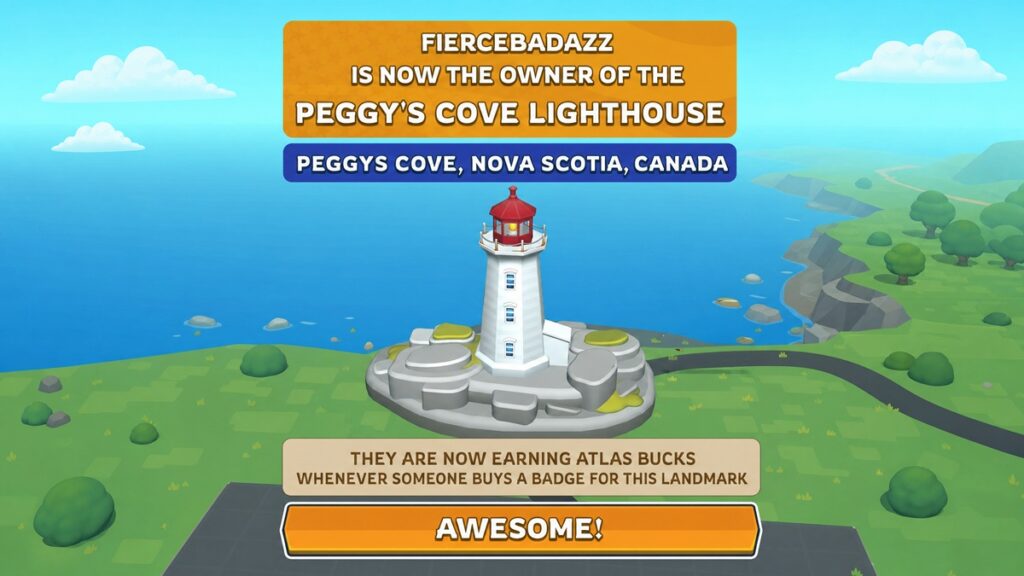
“I was shocked that I actually won the Peggy’s Cove auction. Being new to the game, it’s pretty awesome, said the Port Dover, Ontario, Canada player who secured ownership of Peggy’s Cove Lighthouse. “It totally turned my game around, and is going to help me grow my earnings faster.
Atlas: Earth plans to continue to roll out Landmark Auctions globally this summer, introducing one to two new landmarks each month. You can download Atlas: Earth from the Google Play or App Store.
Thousands compete to own New Orleans landmark in Atlas: Earth auction
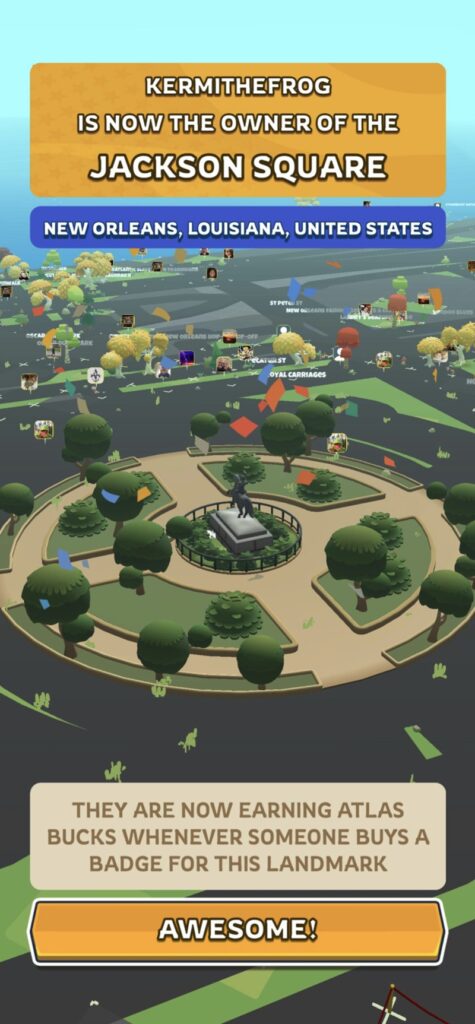
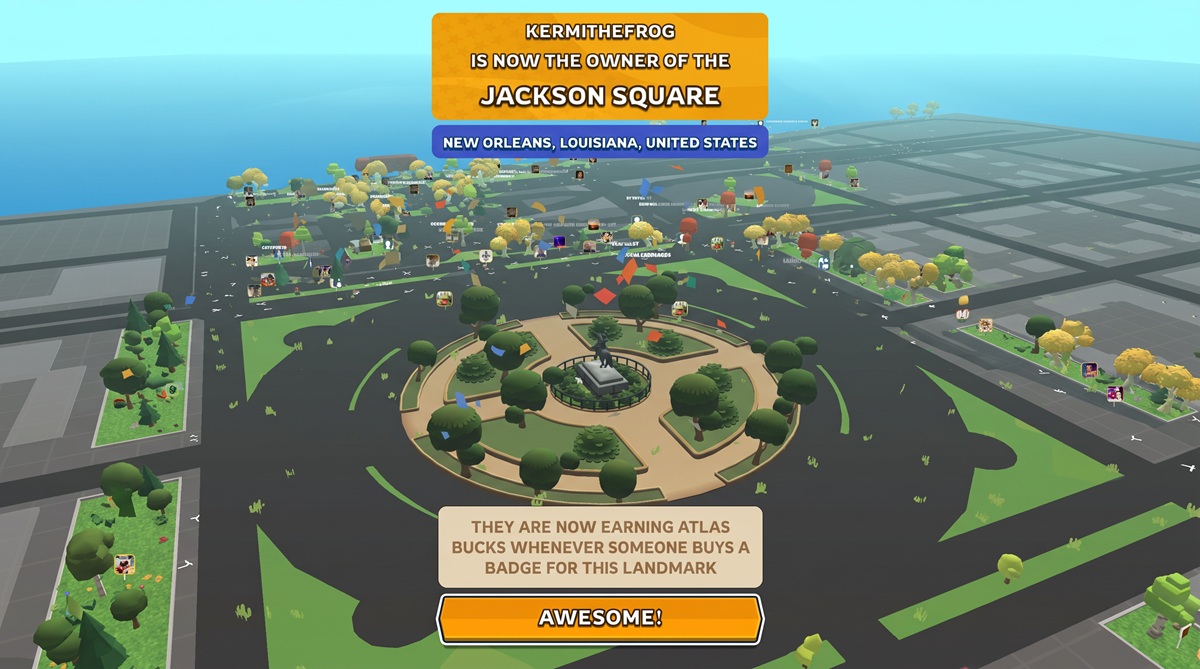
Last month, thousands of players competed for ownership of the iconic New Orleans destination. The winning bidder secured Jackson Square for 24,460 Atlas Bucks (approximately $1,000). The winner, a Texas-based player, described the opportunity as a “once in a lifetime” chance to own one of the first landmarks released in the game.
Landmark owners earn Atlas Bucks each time a player purchases a badge while visiting that location. Since the Jackson Square auction launched, Atlas: Earth has seen players purchasing roughly 10 badges per day at the landmark, showing that visitors are interacting with the game while exploring one of New Orleans’ most recognizable destinations.
Tesoro XP
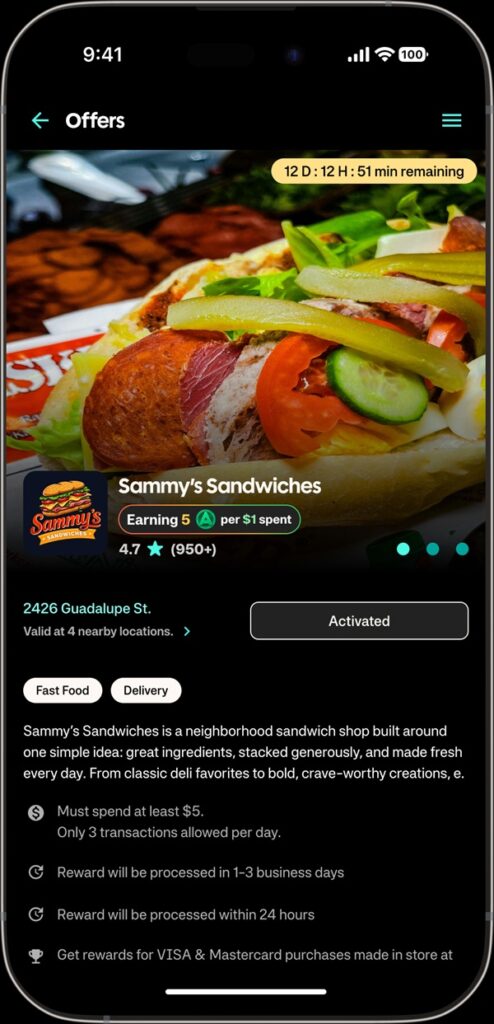
Meanwhile, Khan started a second company, Tesoro XP, which rewards players for visiting their favorite local fast-food restaurants. It gives players rewards in the game if they buy food from a favorite place and use a credit card to pay for it.
That business has taken off enough where Tesoro XP will offer it as a way for other games to monetize restaurant loyalty and reward players. (There’s a national campaign going with Subway right now). In addition to Subway, 17,000 small restaurants are using Tesoro XP. Atlas: Earth players can earn a virtual dollar for every real dollar they spend at those places. Other restaurant chains are expected to join the program.
“You can actually earn in-game currency when you shop at Subways, and so we’re really, really trying to build this kind of digital layer of the real world,” Khan said.
Game companies can sign up with Tesoro XP to create similar reward programs for their own games. When a player does a transaction at a restaurant and it is recorded with a credit card that has been entered into the game, then the game could make 40 or 50 cents on that one transaction alone. And for restaurant companies, Khan believes this digital solution will work better than paper coupons, which are still a big part of restaurant sales.
“Tesoro is this clean, new incremental money that your game is currently not making. Tesoro is not asking your player to leave your game to download another game,” Khan said. “We’re not even asking player to leave your game at all. We’re simply saying, ‘Hey, you just earned some hard currency in this game.’ So it encourages the gamer to come back. And there’s no there’s no inflation or margin loss because the game company can make as much as they want on that game currency. It’s it’s almost like the retailer is footing the bill for what would otherwise be a microtransaction.”
About 20% of Atlas: Earth’s monthly active players are already participating in Tesoro. Tesoro has just 14 employees. Atlas: Earth has also made money as it has sold hundreds of thousands of hotel bookings through the game using Atlas: Travel, which is part of the game.
How Landmarks work
And Landmarks will eventually be another way that the company helps reward players and monetizes relationships with brands in the real world. Right now, the company is putting actual landmarks from the real world into the right spots in the digital map of the game.
“You’ll see it on the map when you’re physically there. So this is our first time where we’re having real world three-dimensional art that’s curated to the location that actually represents what what it looks like in the real world,” he said. “We’re releasing them one at a time.”
The first release was Peggy’s Lighthouse in Canada and the second was Jackson Square in New Orleans (where Khan and one of his cofounders are from).
Instead of people having to buy auction tokens, players are actually earning what the company calls bid tokens through engagement through the game. So by playing monthly challenges, one of the reward ladders is free bid tokens. By walking around Pokemon Go style and Atlas Earth, you can pick up diamonds, and then when you use those diamonds to spin the diamond wheel, one of the prize options is bid tokens. And you need bid tokens to try to become a bidder. And whenever the auction timer hits zero, whoever is holding the top bid can buy the landmark for the Atlas Bucks price, which is the company’s hard currency.
Each bid increases the time of the auction, and the Jackson Square landmark auction went on for days, even though the auction started at 10 minutes. More than 4,000 players were in the bidding room at one point, and a total of 13,000 unique players placed a bid for Jackson Square inside Atlas: Earth. It went for around 25,000 Atlas Bucks, or a little over $1,000.
The auction was not designed for those who have a ton of money. It was designed for those who have perseverence, and submit multiple bids. To make a bid, you have to submit a bid token, and the goal is to stick with it and submit the last possible bid and then pay the bid price. That is, if you have the last bid, you have the opportunity to buy it. If that person doesn’t want to buy at that price, it goes to the next person in line.
Once you own a landmark, people visiting the landmark physically can buy a landmark badge to say they have visited that landmark. Then the player who owns it gets a cut of the hard currency from that landmark purchase. It’s almost like collecting rent, and it takes advantage of a kind of virtual tourism in Atlas: Earth, Khan said. Right now, anyone in the world in the game can make a bid to own a landmark.
Why Landmarks took so long to make

Some players were joking about how Landmarks were likely to never come in the game, since they had been promised for so long.
I asked Khan why it took so long to get Landmarks right. He said that when Atlas: Earth first came out, it had stability issues and the small team had to fix that. Originally, Landmarks were going to be like an eBay option, where whoever pays the most wins.
“As we got more and more into it, we just realized we needed to let the economy of Atlas: Earth mature, and for us to understand a little bit more about what the direction of the universe was going to be before we locked ourselves into a mechanic,” he said. “With this type of situation, once the mechanic is built and players say, ‘Okay, this is a mechanic, you can’t undo that.’ So it wasn’t really a technical challenge as much as it was understanding.”
Khan believes Atlas: Earth is now the undisputed king on digital real estate now, based on what others are saying on social media.
“We’re paving a new way, and we’re building this new world, and we just want to make sure we do it right. And that’s really what took so long. It was making sure the system was correct,” he said.
There’s a third beta test coming soon, he said. The team is trying to make each one look good in the game, using human artists to create the landmarks. And the team doesn’t want to fatigue the community by launching everything all at once.
“There’s a lot of complexities around chat and bidding, and when we have thousands of concurrent users submitting a bid at the same time, there are a lot of things to handle,” he said. “What we’ve really build is a concurrent room. The entire planet is a real-time room.”
“We’re continuing to prove like, ‘Hey, Atlas Earth is here to stay. Atlas Earth is here to fulfill the the promises we’re saying,” Khan said. “If you search Atlas: Earth and ask if it’s a scam, Google autofills it with an answer that says, ‘No, it’s not a scam.’ And we are very much set on building a great game.”
On top of that, he said, “Atlas is a new paradigm for what social media and gaming can be.”