
The Khronos Group today announced that the KHR_interactivity extension for glTF 2.0 has been submitted for ratification.
As interactive 3D content becomes central to a growing range of markets, KHR_interactivity lets creators build portable, self-contained interactive behaviors — expressed as behavior graphs — into the glTF asset itself, eliminating the need to hard-code interactivity for every platform and application. The extension is the result of substantial collaboration across the 3D content ecosystem, with support already established in multiple tools and runtimes.
glTF is a candidate to enable better web graphics in everything from the metaverse to games to e-commerce.
“KHR_interactivity is a critical step on glTF’s path from a 3D asset format to a spatial experience building block,” said Neil Trevett, President of the Khronos Group. “glTF assets are no longer just something you look at: They become experiences you can use, portable across every platform, viewer, and engine that supports glTF.”
Interactive 3D: A New Creative Toolbox for glTF
With embedded behaviors, a single glTF asset can now power a wide range of self-contained interactive experiences without requiring custom code in every host application. A single asset could contain a product configurator, an interactive how-to guide, or a mini-game, all portable to any supporting viewer.
The extension uses a behavior graph system. These graphs are made of interconnected nodes that represent operations, events, control flow, and data transformations. Behavior graphs can read and write glTF properties at runtime and manage state using custom variables. Responding to user input or scene events, a behavior graph can drive animations, object transformations, and trigger other behaviors.
This approach gives creators powerful interactivity while keeping everything self-contained inside the glTF file. Example use cases include:
- Triggering animations when a camera approaches an object
- Showing or hiding content in response to user interaction
- Objects that dynamically rotate to face the active camera
- Procedural animations that never repeat, or that vary in speed and intensity based on scene state
Behavior graphs are expressive enough for rich interactivity, yet they can be constrained to prevent infinite loops and limit possible outcomes. This combination of flexibility and safety makes behavior graphs suitable for a wide range of viewers, including web-based experiences.
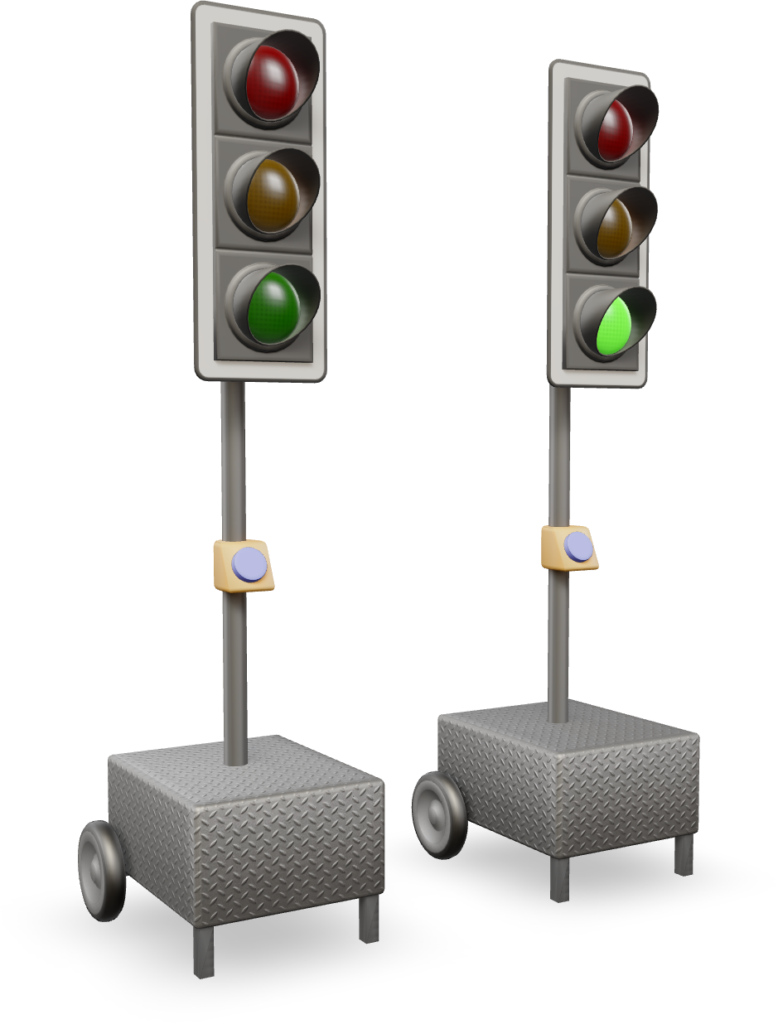
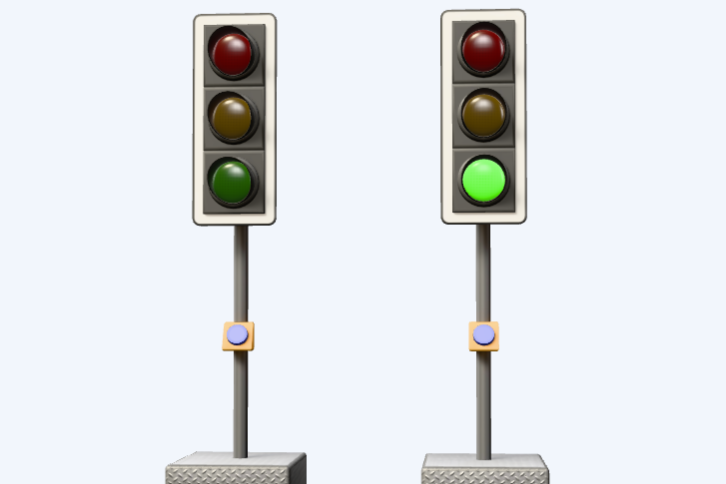
Two independent examples of glTF interactivity: the left traffic light runs a full sequence from a single click, while the right advances one phase per click: two different behaviors, each self-contained in its glTF asset. View an interactive version of this model.
A Safe, Extensible, and Composable Design
Like many glTF extensions, KHR_interactivity is designed for extensibility. This specification is just the first step in bringing rich interactivity to glTF.
The core specification defines a broad set of built-in capabilities. In addition, a formal declaration mechanism allows behavior graphs to reference operations defined in companion extensions such as KHR_node_selectability, KHR_node_hoverability, and KHR_node_visibility. This approach removes the need to include platform-specific behaviors in the core extension. References to unavailable extensions gracefully degrade to no-ops.
KHR_interactivity also integrates cleanly with the glTF Asset Object Model, using JSON Pointer-based operations to get and set asset properties at runtime. This approach gives behavior graphs direct access to node transforms, material properties, morph target weights, and more.
“Designing an interactivity system that is portable, safe, and practical requires real tradeoffs and a lot of iteration,” said Eva Ma, glTF Interactivity Chair and Software Engineer at Meta. “The behavior graph model and extensible design we’ve landed on gives the ecosystem a solid, future-proof foundation.”
Real-World Adoption
Support for KHR_interactivity grew throughout its development:
- Babylon.js supports playback of interactive glTF files.
- Needle’s UnityGLTF Exporter allows creators to export interactive glTF content directly from Unity’s Visual Scripting graph, and Needle has KHR_interactivity and related extensions on the Needle Engine roadmap.
- Amazon has developed a functional prototype of an interactive glTF authoring tool.
- Magic Leap has a completed runtime playback engine for Unity built on top of UnityGLTF.
- Google’s Android XR platform will support glTF interactivity playback through the Jetpack XR SDK.
- UX3D has added full interactivity support to Khronos’s glTF-Sample-Viewer for all glTF content.
Leaders bringing KHR_interactivity to their tools and engines see it as a turning point for interactive 3D:
“The upcoming ratification of KHR_interactivity is a milestone for 3D on the web: it lets basic asset logic finally travel with 3D models, turning a promising idea into a stable, portable standard the whole ecosystem can build on,” said David Catuhe, creator of Babylon.js, in a statement. “Creators and developers can now invest in interactive 3D content with the confidence that it will behave consistently everywhere glTF is supported, not just in a single engine. For Babylon.js, this is exactly the future we’ve been working toward: making interactive 3D on the web accessible to creators of every skill level. We’re proud that Babylon.js fully supports KHR_interactivity today, and we can’t wait to see what people build with it.”
“KHR_interactivity is a big step toward an open ecosystem for interactive 3D,” said Felix Herbst, founder, Needle Engine, in a statement. “After helping shape the extension, we’re excited about its potential across the Needle suite and its ability to help creators build rich, portable experiences.”
Khronos has also developed sample and test assets to help creators and developers explore extension capabilities and test tool and platform conformance.
Call for Action and Feedback
KHR_Interactivity represents a significant expansion of glTF capabilities with far-reaching implications. As the ratification process proceeds, the Khronos 3D Formats Working Group welcomes feedback from creators, developers, and implementers — especially reports of behavioral differences between engines — to ensure this new capability delivers the cross-platform consistency and backwards compatibility that are the hallmarks of glTF’s value to developers.
Please share issues and commentary on GitHub, along with use cases and requirements to help plan the next wave of interactivity extensions.
SIGGRAPH 2026 attendees can also share feedback in person at the glTF Ecosystem forum on Thursday, July 23. This event is also open to virtual attendees via Zoom. Contact [email protected] to request an event invitation, and view the full slate of Khronos BoFs and events on the SIGGRAPH 2026 event page.
Help Shape the Future of glTF & Khronos Open Standards
Companies interested in actively shaping the future of glTF, 3D interactivity, and other Khronos standards are invited to join the Khronos Group. Learn more at khronos.org/members.