
Nvidia is advancing a historic partnership between the U.S. and Japan, its first international partner in the Genesis Mission.
Genesis Mission’s large-scale initiative to harness AI for scientific discovery calls on U.S. labs and industry, as well as international collaboration.
NVIDIA and Japan are answering the call — from AI to quantum computing.
Nvidia and Riken driving AI for science
At Riken, Japan’s leading national comprehensive research institute, two supercomputers driven by Nvidia GB200 and Nvidia Quantum-X800 are beginning operations.
Rikyu, a new supercomputer for “AI for Science” development, deploying 1,600 Nvidia Blackwell GPUs using the GB200 NVL4 platform, will support Riken’s development of open foundation models and contribute to accelerating AI adoption across broad fields, including life sciences, materials science and laboratory automation.
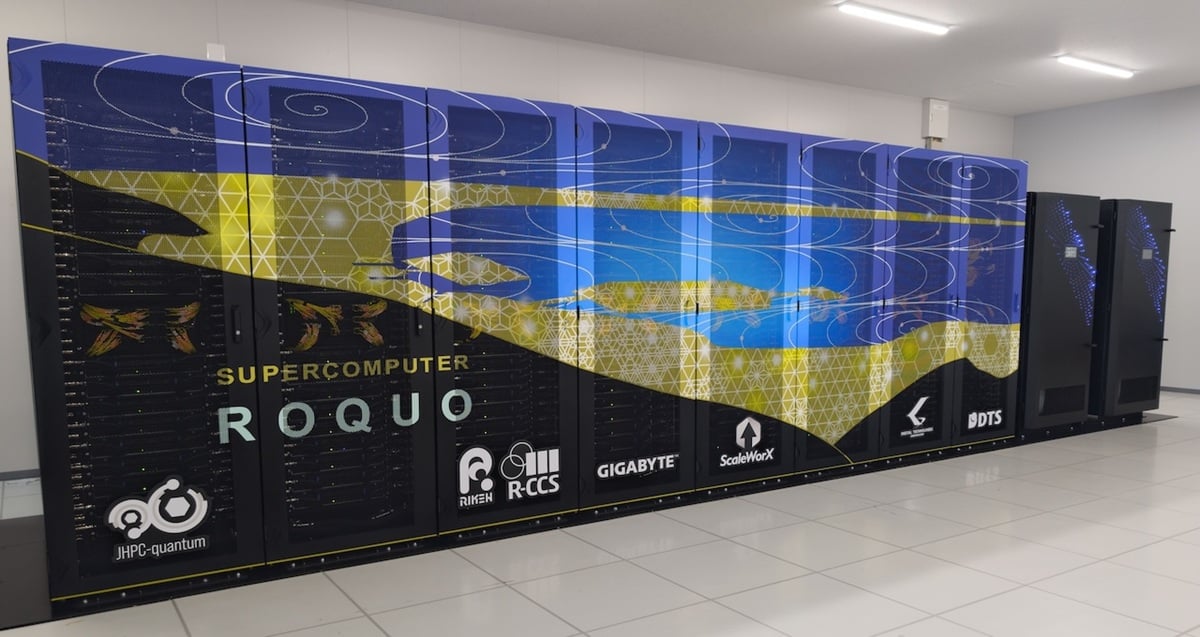
JHPC-quantum GPU supercomputer “ROQUO” is a quantum-HPC system tightly integrating quantum processors with accelerated computing from 540 Blackwell GPUs accessed through the GB200 NVL4 platform. ROQUO is connected to on-premises quantum computers at RIKEN’s facilities in Wako and Kobe, Japan — including Quantinuum’s trapped-ion Reimei system, enabling hybrid quantum-HPC workloads.
In ROQUO’s first months of operation, researchers are beginning to explore an evolutionary AI framework, developed with Nvidia and integrated with the Nvidia CUDA-Q platform for quantum-classical computing, to generate quantum circuits for the Reimei system.
Building an Ecosystem That Brings AI to Quantum
AI is the unlocking technology for scaling quantum processors into useful quantum-GPU supercomputers, but the adoption of AI in quantum computing workflows remains a key challenge.
At the National Institute of Advanced Industrial Science and Technology’s (AIST) Global Research and Development Center for Business by Quantum-AI Technology (AIST G-QuAT), Nvidia is working to bring state-of-the-art AI to the center’s current and future quantum processor systems.
Nvidia NVQLink provides the low-latency connection between GPUs and quantum processors, while Nvidia Ising open models support automated QPU calibration and AI-based decoding for quantum error correction.
Advancing Quantum Chemistry
High-accuracy simulations of chemical systems are fundamental for next-generation research in areas such as materials science and drug discovery. AI approaches can expand what quantum algorithms are capable of, improving how these simulations scale.
Mitsubishi Chemical, Mizuho Bank, Keio University, AIST, the University of Toronto and Nvidia have demonstrated an AI- and GPU-driven workflow for harnessing quantum processors in molecular spectral analysis — a key tool for understanding the electronic structure and properties of molecules and materials.
Nvidia GPUs achieved a 13.4x speedup for this workflow over CPU-only nodes. Accelerating this analysis lets researchers apply it more quickly to early targets, like extreme ultraviolet photoresist for semiconductor manufacturing.
Developing useful quantum chemistry applications also means building workflows suitable for tomorrow’s large-scale hybrid quantum-GPU supercomputing systems. Fujitsu and Nvidia are now investigating efficient ways to use Nvidia CUDA-Q for large-scale quantum-chemistry simulation. Through the collaboration, Fujitsu has started the trial of NVQLink to determine if it can be utilized to realize efficient control of their quantum-classical hybrid computing environment.
Together, the U.S. and Japan are building on the Nvidia platform to develop a shared foundation for useful, large-scale quantum computing and AI-driven science, and uniting industry, academia and government.