
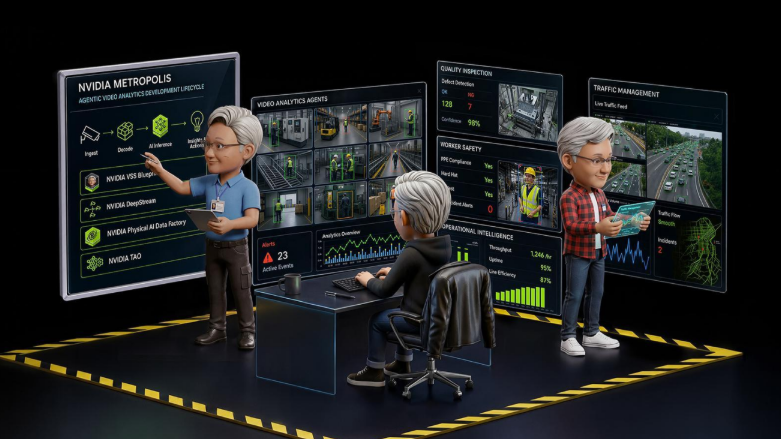
Nvidia announced that its Nvidia Metropolis platform provides developers agent-ready libraries to build Nvidia Cosmos-powered vision AI agents faster.
As enterprises capture more video data across the physical world, vision AI is transforming
beyond passive perception and dashboards into agentic systems that can understand, reason and act in real time.
“We have built this platform called Nvidia Metropolis for vision applications. With over two billion cameras worldwide, traditional vision AI development used to take extremely long,” said Deepu Talla, vice president of robotics and edge AI at Nvidia, in a press briefing. “Now, our Metropolis platform, which is has been made agentic, comes with more than 80 skills. We are cutting the development time by at least six times compared to before.”
He noted that numerous Japanese companies are using the platform.
Powered by reasoning vision language models (VLMs) such as the Nvidia Cosmos of open models, these agentic systems extract rich insights from video, whether on operations, environmental context or root causes for issues.
Building production-ready, high-accuracy vision AI agents can require thousands of developer-
hours across data collection, model training, validation and deployment. Nvidia Metropolis now packages more than 80 new skills, including Nvidia VSS Blueprint 3.2, Nvidia DeepStream 9.1, Nvidia TAO 7 and Physical AI Data Factory, that help developers use coding agents to speed that process by at least six times.
Japan’s industrial and smart-space leaders including Asilla, AWL, Fujitsu, Hitachi, OMRON, Shimizu Corporation and Yazaki North America are using Metropolis to bring vision AI agents into factories, construction sites, stories, buildings and public spaces.
Metropolis Open Libraries and Skills span the Vision AI lifecycle
Metropolis provides a comprehensive set of open libraries and skills that span the entire vision AI development lifecycle, from creating data pipelines to generating synthetic data, fine-tuning
models and deploying agents at scale.
New libraries include:
● Nvidia VSS Blueprint 3.2 helps developers build and operate vision AI agents that can see,
reason and act over live or recorded video using natural language. New skills for coding
agents make it faster to build and operate custom, always-on video agents that alert,
summarize and search across large camera networks.
● Nvidia DeepStream 9.1 helps developers create and deploy real-time, multi-sensor video
analytics pipelines from edge to cloud for large-scale ingestion, multi-camera tracking and
operations analytics.
● Nvidia TAO 7 helps developers customize and optimize Nvidia Cosmos and other vision
AI models with agent skills for labeling, performance diagnostics, fine-tuning, data
generation and automated machine learning.
● Nvidia Physical AI Data Factory skills help developers use Nvidia Cosmos to
automatically generate and augment synthetic image and video data to fill training gaps
for rare or new product defects, environmental changes and other edge cases, pushing
vision model accuracy to new levels.
Companies advance agentic Vision AI with Nvidia Metropolis
Japan-based companies are using the new Nvidia Metropolis technologies to bring real-time
intelligence to physical operations.
For industrial inspection and operations, Omron is enhancing automated inspections with VSS-
powered video analytics agents, while DeepHow is helping Yazaki North America automate time and motion studies, reducing current process from weeks to days and unlocking millions of dollars in annual savings.
For smart spaces and public safety, several Hitachi HMAX solutions use VSS-powered agents to generate actionable insights and identify issues in building and rail infrastructure, reducing
maintenance costs and energy consumption by 15% in rail applications alone. Fujitsu Kozuchi AI platform combines VSS with its Agentic Memory technology to transform long-duration video intooperational knowledge, accelerating decision-making across manufacturing, logistics, retail and smart spaces. Meanwhile, Shimizu Corporation is piloting VSS for construction worker safety.
With DeepStream and VLMs, Asilla is monitoring public spaces and commercial facilities to detect incidents and improve response time, while AWL is building retail and manufacturing solutions with DeepStream.