

Partner content, presented by Chris Han, Co-Founder of ThinkingData
After ten years of working with gaming studios on their in-game analytics and live operations, I have had the unique opportunity to see into hundreds of data teams and how they operate. I’ve applied the practices I’ve seen work across studios and avoided the worst mistakes in building ThinkingData’s analytics and liveops framework, but I haven’t talked much about what I’ve learned externally, until now.
Most studios consider themselves to be data-driven, but that is rarely the case. Funnels, cohorts, retention curves, return on ad spend (ROAS) models, segmentation tools, and lifetime value (LTV) projections are now standard across game development. Studios have more data than at any point in gaming history. No one has to be convinced of the value of data, but there are several key problems to overcome to be considered data-driven.
The challenge isn’t volume; it’s connection, consistency, and making it very easy to complete an optimization loop.
Data fragmentation
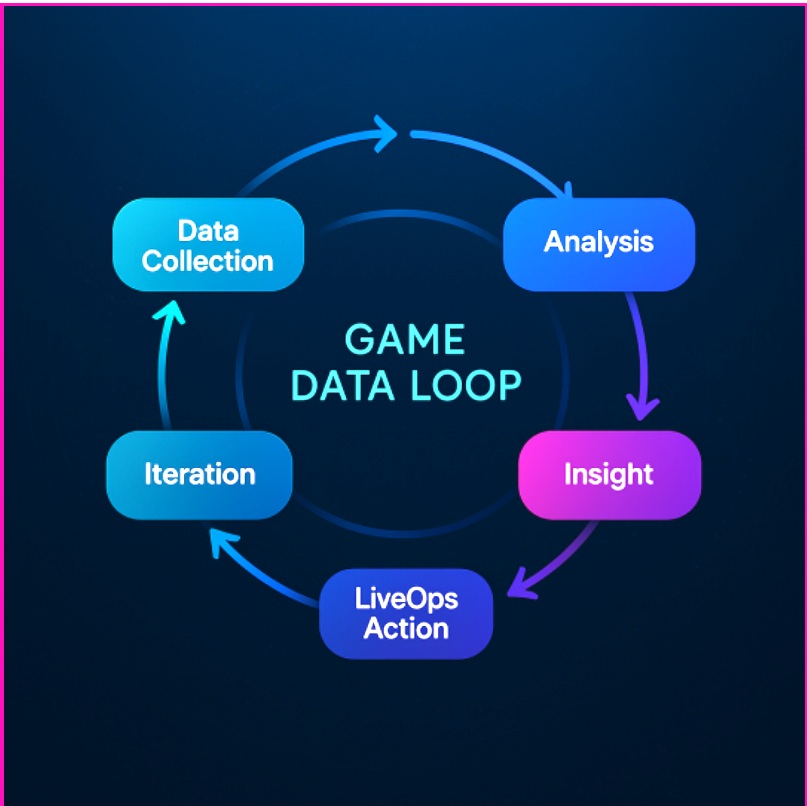
The most common bottleneck I see is the fragmentation of data. No matter the studio size, fragmentation is the biggest culprit in muddying the value of data. Each department has a different tool, success metrics, and thus interpretations of data.
For one of our big casual studio clients, their user acquisition (UA) team was prioritizing only low cost per install (CPI) until operations let them know that a more expensive channel has a five times LTV average. Dozens of situations like this come up every week, and each requires great communication, extra bandwidth, and a shared understanding of the whole player journey. The problem is, every handoff between teams introduces friction and delays. Sometimes when teams get busy, the handoff doesn’t even happen.
This one is a constant battle, but the studios that overcome this the best have two things in common: their teams can complete a full loop, from data to action to validation, and a data infrastructure that minimizes handoffs, friction between handoffs, and chances for miscommunication. Some build this in-house, others rely on tools that bring analytics, segmentation, and liveops together.
Visualization versus insights
This is especially true for live service games with constant updates and new features. Teams spend too much energy on building dashboards that rarely lead to action. One-off requests to analysts bog them down and keep them from actually providing deep insights. Static dashboards and traditional data frameworks, in the best case, add days and sometimes weeks to optimization loops.
If you don’t have live and dynamic player behaviour tracking dashboards, you’re losing out on immensely valuable retention and monetization opportunities.
Transition away from traditional models and static hand-built dashboards to dynamic models that are specific to and can be self-managed by each team member. This allows for less time wasted waiting for visualization or data pulls and more time on analysis and action. Like the fragmentation problem, this can consistently be achieved either through internal or outsourced tooling.
A clean data loop and accessible tools, as I mentioned above, create leverage for your LiveOps team. This is where player behavior is most directly convertible into value for the studio.
With the right systems in place, LiveOps teams can identify and act on hundreds of micro-opportunities: tuning campaign launches in real time, adjusting difficulty ramps for individual segments, or automating deeply personalized offers.
The strategy titles topping the charts today mainly have their LiveOps departments to thank for leading the gaming industry in revenue generation.
Problems scale faster than players
Studios don’t fail to scale because of a few big problems, but instead because of hundreds of small ones. Games inevitably become less efficient as they scale. Adding new metas, segment-based customizations, markets, and eventually new titles, multiplies the difficulty of managing data and operations.
One horror story comes to mind. I spent several days onsite with a client right after a major launch into a new market. The game was live, players were coming in, but no one could answer when the C-level asked how the new market was performing. They didn’t have the infrastructure in place to monitor key metrics by region, timezone, or other segments, let alone make quick campaign tuning.
AI is a multiplier, not a savior
This is not so much an observation as it is a prediction, but given the excitement around AI right now, it needs to be stated. I’ve seen dozens of studios experimenting with AI across everything from development processes, in-game characters, metas, and data analysis. But AI isn’t going to make up for your shortfalls. AI is a multiplier.
If your data is clean, your segmentation is live, and your teams can already test and iterate quickly—then yes, AI can speed things up, find patterns faster, even automate pieces of your LiveOps flow. But if your teams are still stuck waiting two days for a CSV export or running dashboards by request, AI just adds more noise.
This might not be new information; most in the industry will likely have struggled with one or more before. They’re simple problems and even simple solutions in theory, but very difficult to execute on in reality.
For more actionable insights, follow along with my posts on LinkedIn or read our real customer case studies, like the work we did with Century Games’ Whiteout Survival.