
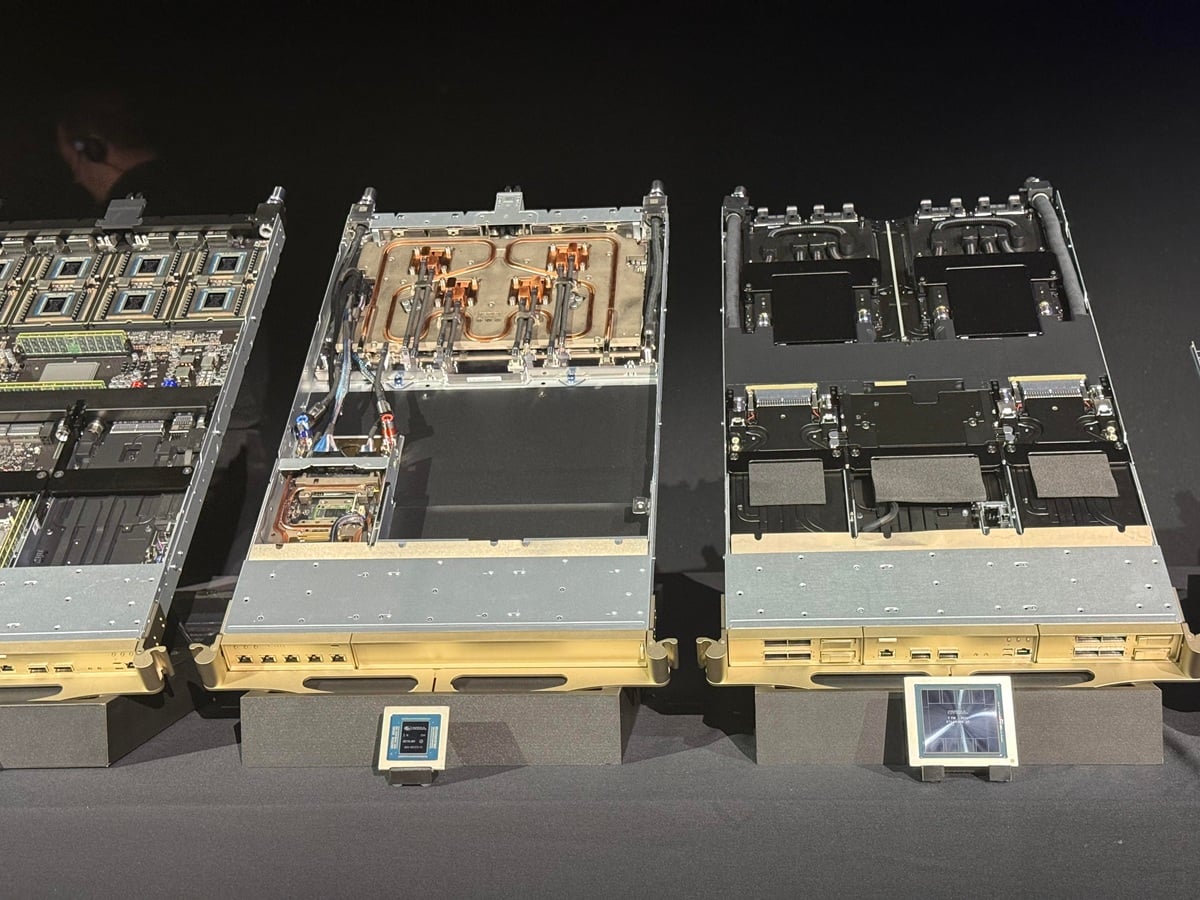
Super Micro Computer, a maker of hardware under the Supermicro brand, announced new solutions based on Nvidia’s Vera Rubin platforms.
Supermico unveiled its Data Center Building Block Solutions (DCBBS) Blueprints based
on the Nvidia Vera Rubin NVL72 and the Nvidia HGX Rubin NVL8 platforms. The
Blueprints are designed for gigawatt-scale AI data center deployment, starting from
building blocks of a single 1,152-GPU scalable unit that can be multiplied to virtually any
size. Vera Rubin is the code name for Nvidia’s latest AI processors and GPUs and supporting hardware that will launch later this year.
Supermicro’s DCBBS Blueprints include the design and delivery of an end-to-end
total solution with a dedicated team of experts covering the full deployment lifecycle, the company said.
DCBBS provide the necessary compute, storage, networking, advanced liquid cooling,
power distribution, and site infrastructure, accelerating time-to-online for large-scale
liquid-cooled AI Factories.
“The Nvidia Vera Rubin NVL72 platform sets a new standard for AI factory
performance, and our DCBBS Blueprints give customers a proven, end-to-end path to
build at any scale — from 5MW to 1GW,” said Charles Liang, CEO of Supermicro, in a statement. “We have delivered some of the earliest and largest liquid-cooled AI factories, and that experience is built into every Blueprint — so our customers can move from design to fully operational faster than ever before.”
Supermicro’s DCBBS Blueprints address the challenges of the practical implementation
behind the most advanced AI infrastructure in the world. The Nvidia Vera Rubin platform vastly improves AI Factory performance density, doubling speeds across multiple computing domains.
Nvidia’s latest reference architecture precisely defines what an ideal 1,152-GPU scalable unit should contain —a Supermicro’s DCBBS Blueprint defines the steps to achieve deployment success, with a proven track record for deploying the world’s largest liquid-cooled AI factories featuring over 100,000 GPUs.
Supermicro’s DCBBS Blueprint Addresses the Reality of AI Factory Implementation
Customers planning AI factory buildouts or retrofits start from a fixed constraint: available
power. DCBBS Blueprints for Nvidia Vera Rubin NVL72 features a balanced bill-of-materials
for a given power envelope, ranging from 5MW to 1GW, and provides the right ratio of cooling
capacity, power delivery, compute nodes, management nodes, high-performance storage
nodes, context memory storage platform nodes, and networking to ensure optimal performance
due to bottlenecks such as network oversubscription, power capacity limitations, thermal
throttling or other encumbrances.
The Blueprints cover the full end-to-end sequence that Supermicro has successfully used to
complete large-scale AI projects at record-breaking speeds:
● On-site facility surveys are conducted by the Supermicro dedicated team to analyze
the physical site against the deployment requirements. Surveys include assessment of
loading dock access, data hall measurements and clearances, floor plan, floor load
ratings, and more. The site is assessed for existing prospective power and cooling
infrastructure to accurately inform Supermicro’s design proposal, tailored to each
customer project.
● Project design and proposals include all critical details into a specific buildout plan
customized to the customer’s requirements and facility constraints. Supermicro defines
the right combination of DCBBS components, including the cooling solution (in-row
CDUs up to 1.8MW for fully direct liquid-cooled compatible facilities, liquid-to-air sidecars
for facilities without facility water infrastructure, in-rack CDU options based on a 52U
rack configuration are currently in development, and rear-door heat exchanger options
are available as a supplementary option for environments with higher ambient
temperatures). Customers receive a complete proposal with a transparent bill of
materials and a clear deployment timeline.
● Solution Integration with Full On-Site Service: Supermicro’s solution integration
process starts well before on-site delivery, with much of the heavy-lifting happening in
Supermicro’s US-based manufacturing facilities. This includes the processes of racking,
stacking, and cabling within each rack. Supermicro verifies functionality with a testing
process that exceeds industry standards, extending to system-level (L10) and cluster-
level (L11) multi-node tests. The Supermicro dedicated team manages the logistics of
site-level components such as CDUs, cooling towers, and power infrastructure, including
coordination with any third-party vendors of the customer’s choice, if applicable.
Integration delivery service and on-site integration include rack placement, power and
cooling connections, network cabling, system commissioning, software stack installation,
and on-site solution validation.
● Support, Services, and Software provide a range of continued on-site options for long-
term success, including on-site response times as fast as 4 hours for mission-critical
uptime requirements. Integration with Supermicro’s software suite of infrastructure.
management tools are available, including Supermicro’s SuperCloud Composer ® and
SuperCloud Director for unified infrastructure control ranging from bare-metal
management to multi-tenant workload orchestration, and Nvidia’s full AI software stack
including Nvidia AI Enterprise and Nvidia Run:ai. Asset tracking features ensure
physical asset information and sensor data for every CDU, and other components, are
readily available.
Supermicro’s DCBBS Blueprints Align with the Reference Architecture for Nvidia Vera
Rubin NVL72
The NvidiaVera Rubin platform has the potential for transformative generational performance
improvements but requires a repeatable and dependable approach to deploy successfully.
Supermicro ensures alignment with the latest Nvidia reference architecture, giving customers
confidence that their deployment aligns with the Nvidia Cloud Partner ecosystem.
The scalable units at the heart of the Supermicro DCBBS Blueprints provide 1,152 Nvidia Rubin GPUs with 331TB of HBM4 GPU memory. The Vera Rubin generation doubles GPU memory bandwidth, GPU-to-GPU NVLink bandwidth, and per-GPU networking bandwidth compared to NVIDIA Blackwell, providing the architectural foundation for training and inference of frontier AI models with multiple trillions of parameters.
Supermicro’s DCBBS Blueprint Ensures Single-Vendor Accountability
A typical AI infrastructure buildout involves more than a dozen distinct supplier relationships across compute, storage, networking, racks, cooling distribution, cooling towers, power infrastructure, battery backup, cabling, transceivers, and services. When these relationships are managed across multiple vendors, every vendor handoff introduces schedule risk and accountability gaps that slow deployments and complicate troubleshooting processes.
second half of 2026 aligned with Nvidia Vera Rubin general availability. Supermicro
will demonstrate the Nvidia Vera Rubin NVL72 and Nvidia HGX Rubin NVL8
platforms at Computex booth N0824, June 2-6, 2026, in Taipei, Taiwan, with additional
demonstrations at Nvidia GTC Taipei.