
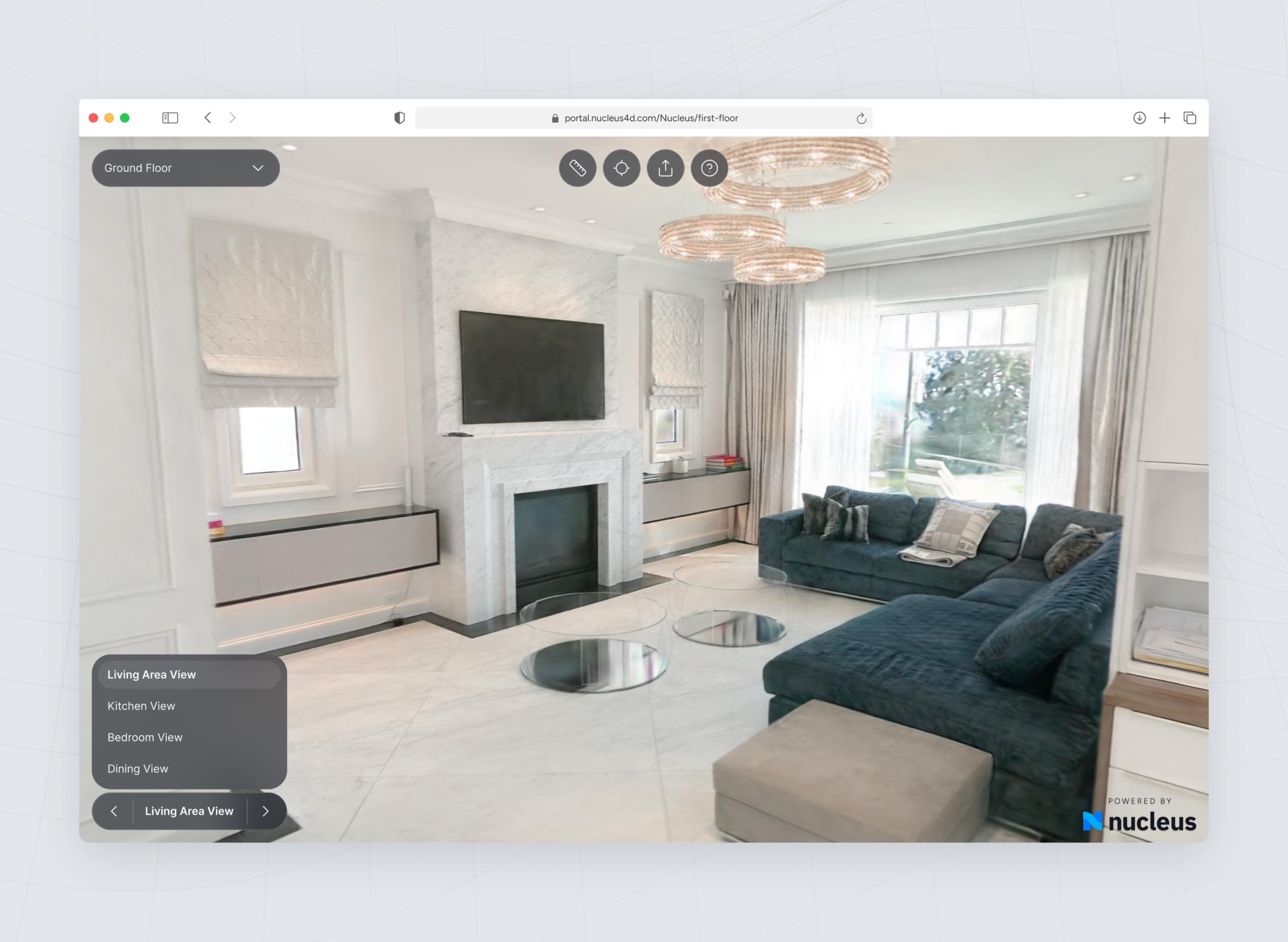
Nucleus4D is looking to digitize the world through real estate — and has raised over a million dollars to accomplish this goal.
Founded by Navjeet Chhina, Paulin Byusa and Miran Brajsa in 2024, Nucleus4D uses Gaussian splatting and other advanced spatial capture techniques to build immersive, three-dimensional virtual tours of homes and apartments using a relatively small number of two-dimensional photos. Since launching its product last year, Nucleus has digitized more than 25 million square feet of space on its platform, according to numbers shared by the company, and is the first spatial computing technology to be approved to list its immersive experiences on Zillow’s three-dimensional tour ecosystem.
Today, January 20, the San-Francisco-based startup announced the closure of a $1.5 million pre-seed funding round led by the venture capital firms Antler and South Loop Ventures, with additional participation from angel investors across the fields of real estate, artificial intelligence and immersive technology.
“Since this Zillow partnership, things have just really ramped up,” said Chhina, Nucleus4D’s CEO, in an interview with GamesBeat. “Now, we’re going to double down on the features that our customers really like — making them scalable, making them more efficient and then really expanding to go to market.”
What is Gaussian splatting?
Gaussian splatting is a form of three-dimensional photogrammetry that allows the user to reconstruct very lifelike three-dimensional spaces and images from a series of two-dimensional images. Beyond that description, Gaussian splatting is a bit beyond my technical grasp, so I asked Michael Rubloff, a 3D photography consultant and the managing director of RadianceFields.com, to explain:
“It is very similar to how Jackson Pollock would throw paint onto a canvas,” Rubloff said in an interview with GamesBeat. “Basically, you’re going to take these three-dimensional ellipsoids, almost like footballs — those are Gaussians — and imagine throwing these ellipsoids onto a virtual canvas. You’re not going to be throwing just one or 10 of them; you’re going to be throwing hundreds of thousands to several millions onto this canvas, and you’re going to do this for every single viewing direction that someone could potentially experience.”

Although Gaussian splatting tech has been in development for years, Nucleus4D is one of the first companies to monetize Gaussian splatting in the form of an actual product and raise funds to develop that product, although Rubloff said a few other companies operating in stealth mode in other sectors such as tech have been able to raise seed funding as well.
“With Gaussian splatting, it doesn’t just take photos and videos and turn them into photo-real 3D — it takes photos and videos and turns them into photo-real 3D with very low file sizes, compared to traditional photogrammetry,” Chhina said. “So, a scene that we’re producing might be half a gigabyte, compared to a scene that was using photogrammetry, which might be 100 gigabytes.”
Cutting-edge tech notwithstanding, Nucleus4D’s pre-seed investors were not wooed by the underlying tech, but rather by the outcomes they observed from the startup’s approach to virtual real estate tours.
“Buyers and sellers do not care how the 3D is rendered. They care that the experience feels real, loads instantly, and helps them make decisions within their workflows,” said Antler general partner Prerna Sharma in an interview with GamesBeat. “Nucleus is using Gaussian splatting as invisible infrastructure inside a very opinionated, end-to-end real estate workflow.”
The gaming implications
Nucleus4D’s current focus is real estate, but the company has bigger dreams. They believe Gaussian splatting and other spatial computing technology can have vast implications across many other sectors — including gaming, with the technology having the potential to drastically reduce the amount of time necessary to model a three-dimensional, virtual version of a real-life space.
“If you wanted to reconstruct a playable level of Grand Central, if you send someone with a phone or an expert’s camera — or just a general camera — they could capture that location very quickly, reconstruct it and add collisions to it,” Rubloff said. “You could have a quasi-playable level in about an hour.”
And although Nucleus4D’s real estate products were the primary motivation for Antler and South Loop Ventures to back the startup, representatives of both venture firms acknowledged that they were also enticed by Nucleus4D’s potential to grow further as it expands into gaming and other areas.
“I have had interactions with some game developers, and the level of energy and time and effort that goes into creating a world in a video game is just tremendous,” said South Loop Ventures founder and managing partner Zach Ellis. “And so the fact that they can walk through a space in 15 minutes, upload it, and now, you can play in it, you can do all these things — this could be revolutionary.”