
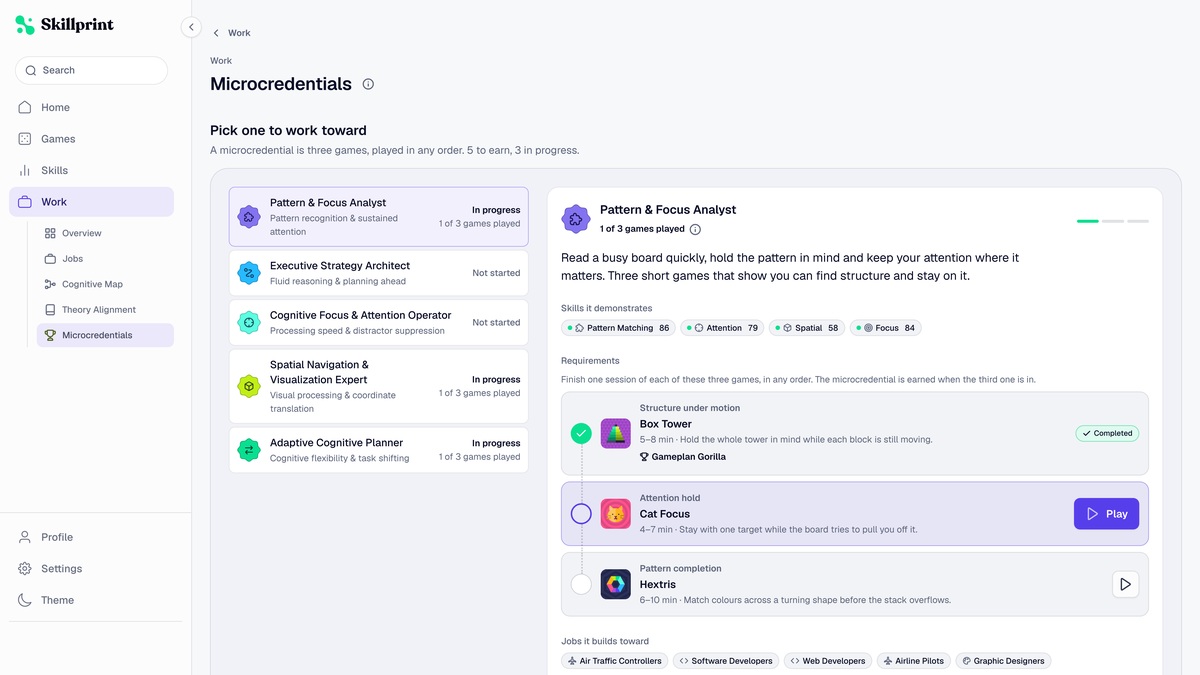
Skillprint is a human intelligence platform that measures how people think, adapt and grow through gameplay. And today it is teaming with the Endless Games and Learning Lab at Arizona State University’s MIX Center to explore a new model for recognizing the real-world skills people develop while playing games.
The collaboration will bring together Skillprint’s technology for measuring human performance
through gameplay with the Endless Games and Learning Lab’s expertise in learning through
playing and making games. The partnership builds on the Lab’s existing Play microcredential
infrastructure to turn skills demonstrated during gameplay into verifiable credentials for learning
and the future of work.
In short, you could earn microcredentials, or a step toward degree, by playing games and applying what you learn toward a field of work, said Chethan Ramachandran, CEO of Skillprint, in an exclusive interview with GamesBeat.
“Games generate an incredibly rich picture of how people solve problems, make decisions, adapt and persist, but most of that learning disappears the moment the game ends,” Ramachandran said. Together with the Endless Games and Learning Lab at ASU, we have an opportunity to change that. We want to make the skills people demonstrate through play visible and useful, giving people a new way to understand what they’re good at, how they’re growing, and where those abilities could take them.”
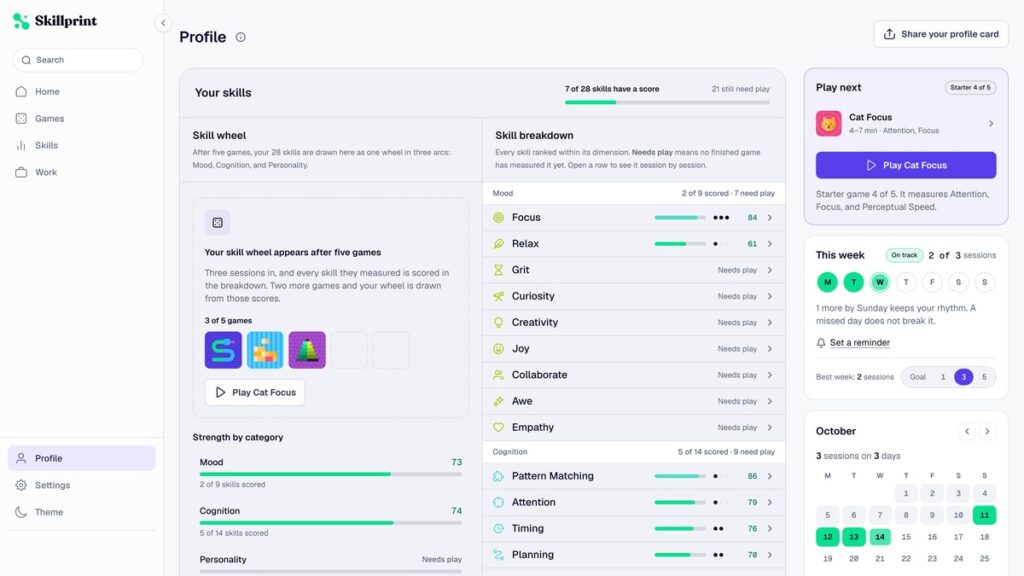
He said Skillprint is expanding its games-and-neuroscience platform toward AI collaboration, career discovery, and university micro-credentials through partnerships including Arizona State University.
Skillprint can find some interesting games that speak to all these different functions, and the microcredentials you can earn.
“Different types of games do different things that then lead to different badges, and then ultimately, that will lead into the actual credentials that ASU has on their side, and just map into what actually relate to their university work,” Ramachandran said. “At the lab, they believe that games can power microcredentials and give people an assessment on what they can do in terms of their future and give them a pathway. That’s basically what we are powering here: both an assessment of what you’re good at and a pathway to get there.”
The collaboration will bring together Skillprint’s technology for measuring human performance
through gameplay with the ASU Lab’s learning-science expertise and credentialing
infrastructure. The organizations will work to create “Play” microcredentials that translate skills
demonstrated during gameplay into verifiable credentials that can help people better understand and communicate their capabilities for learning and the future of work.
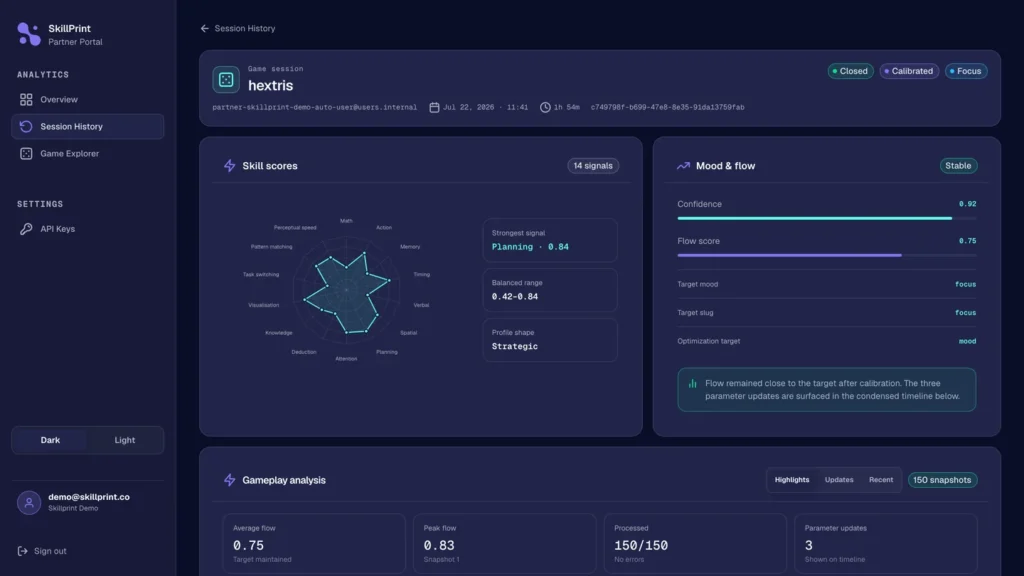
Skillprint’s technology instruments gameplay to understand how players act and make decisions in context, generating personalized profiles of skills and performance over time. Its career-mapping technology can then connect those capabilities to broader competencies and
professions.
Through the partnership, Skillprint and the ASU Lab will pair those capabilities with ASU’s
credentialing infrastructure to explore how demonstrated skills can become verifiable
microcredentials. The organizations will also collaborate on research examining measurable
learning through gameplay and plan to develop a joint case study demonstrating the approach
with a game or partner.
Mark Ollila, director of the Endless Games and Learning Lab at Arizona State University, said in a statement, “Games are incredibly powerful learning environments because they challenge people to solve problems, make decisions, adapt and develop new strategies in real-time. Our work with Skillprint gives us an opportunity to better understand what people are learning through play and demonstrate the value of those experiences beyond the game itself. Together, we can explore new ways for games to help people discover their strengths, develop their potential and prepare for a rapidly changing world of learning and work.”
The collaboration reflects a broader shift in how learning and human potential can be measured. Traditional assessments typically capture what someone knows at a particular moment. Instead, games create dynamic environments where people continuously make decisions, develop strategies, respond to setbacks, collaborate and adapt.
“We’ve been spending time using games and simulations to understand and enhance human intelligence, and that same set of data is very valuable and interesting if you want to understand and enhance machine intelligence, especially if you’re you know looking at a world where AIs and humans will need to collaborate and coordinate,” he said.
“The focus of the company is still the same. It’s just the aperture has widened. So our games themselves are enabled to be adaptive to people. They adapt to AIs playing them. That creates a lot of interesting training situations for AIs to get smarter and act more like humans, to understand humans better to collaborate with humans, and it just makes our system smarter because then we can understand human intelligence better and make humans smarter,” Ramachandran said.
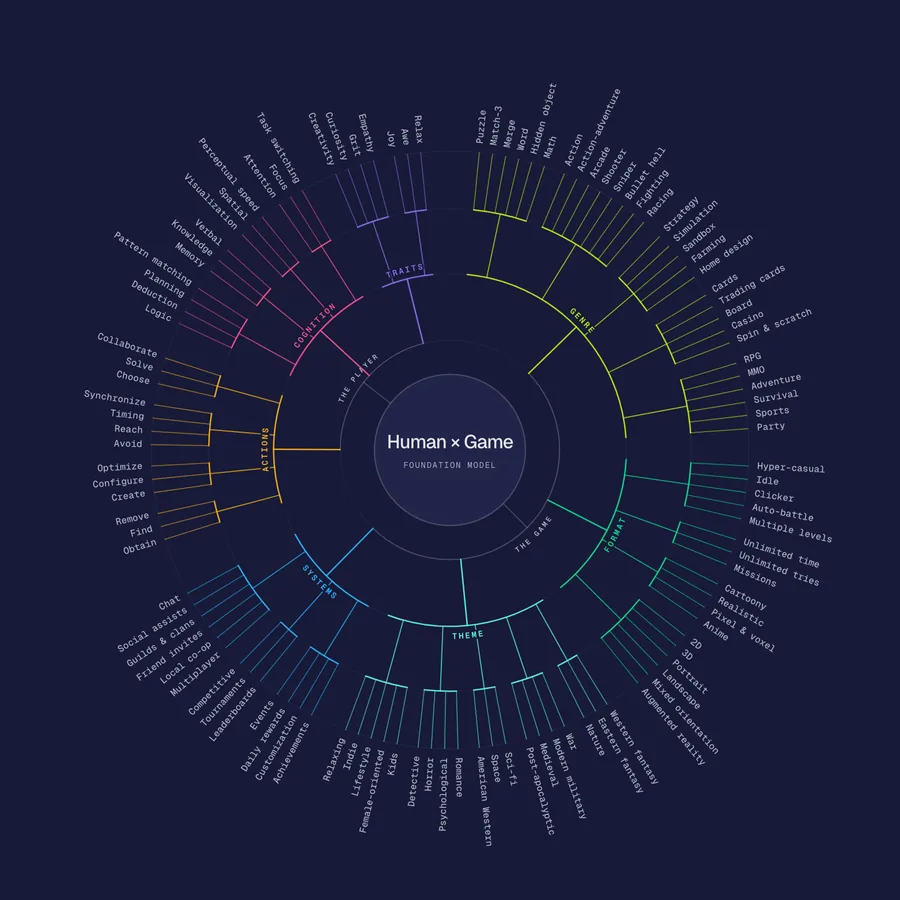
Skillprint’s human-performance intelligence platform is built on more than 800 game-based
cognitive studies across more than 500,000 player sessions and more than 1,000 games,
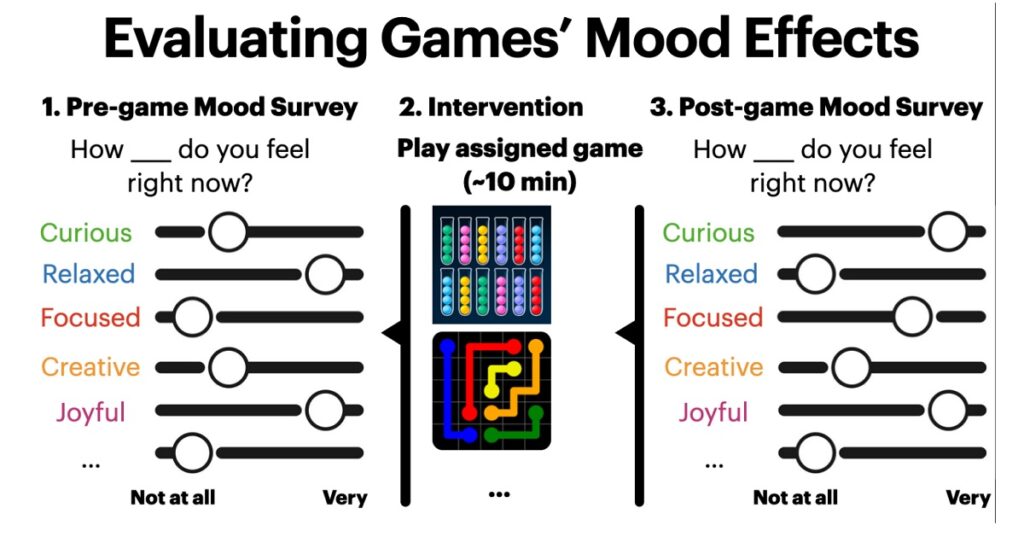
mapping more than 150 game mechanics to signals spanning cognition, mood and personality
to understand how people think, feel and perform.
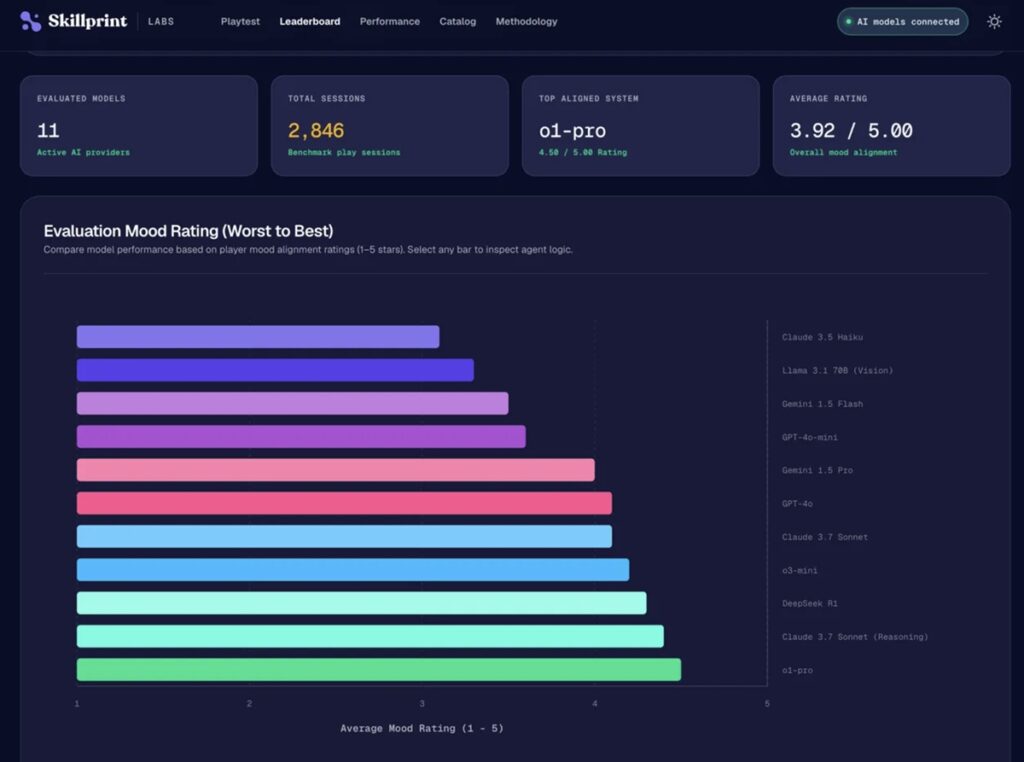
This technology powers Skillprint’s growing portfolio: Skillprint Signal applies human-performance intelligence to evaluating how AI models enhance real human outcomes and Skillprint Flow helps game studios transform gameplay into structured human-performance and player intelligence. Together, these applications are designed to make the rich signals generated through gameplay measurable and useful far beyond the game itself.
Since 2020, Skillprint has combined cognitive science, game mechanics and AI to translate real gameplay into measurable human-performance signals. Skillprint’s mission is to help build a future where AI augments and enhances human capability. Skillprint is raising funding.
The Endless Games and Learning Lab at Arizona State University’s MIX Center explores the
intersection of games, learning and opportunity. Supported by Endless, the Lab brings together
games, learning science and credentialing to investigate how play and game creation can help
people develop, demonstrate and gain recognition for valuable skills.
“It’s pretty attractive for people if you can train AIs to actually augment humans and not the other way around,” he said.
The ASU Labs
The ASU lab’s mandate is to turn gameplay into a vehicle for people to make games, learn from games, and earn from games.
“They believe as we do, and as always have believed at Skillprint, that games can tell you a lot about how the mind works and can enhance the mind. So it’s a really nice combination. You can do things like look at how people play a real time strategy game, and what they’re interested in is giving microcredentials for things like strategic planning,” Ramachandran said.
He added, “If you’re good at a resource management game like Age of Empires, you’re probably pretty good at strategic planning. ASU as a university is probably the most innovative university in the country, and they really want to redefine the nature of what learning is and what degrees are,” Ramachandran said.
This is happening at a time when people need to remix skills more often than ever, he said.
“No one has one kind of career path anymore. It’s multiple career paths going in every different direction. What they’re doing is really timely and very much in line with our philosophy and mission,” Ramachandran said. “We are going to be working with them on a couple of fronts, using some of the technology they’ve built around adaptive learning. And most interestingly, we are going to be really blowing out the idea that games can be good for you.”
He added, “We’re also going to be helping power these microcredentials around things like strategic planning. You’re going to see the use of how games plus neuroscience plus our AI actually enhances human experience and builds on human strengths.”
A long gestation
Back in the day, Ramachandran ran Playnomics, which pioneered machine learning and prediction. This is the business that enabled him to win a GamesBeat contest for best game startup.
“I was pretty aware of what was going on in AI for many years. When we started this in 2020, I thought it would still be humans are 80% driving skill enhancement and intelligence, and then machine intelligence would be 20%. With the rise of GPUs and transformer architecture and reinforcement learning, it is more like 60% to 40%. That’s great. It’s just a it happened faster than I thought that the machines would get there.”
He thinks the key is can you help the machines actually augment people.
“It’s a broadening and expansion of the core vision, and we’ve just had to, over the years, build every piece of the puzzle. We’ve had to be able to figure out how to take almost any game, certainly any game made in an engine, and translate that into understanding a specific person,” he said. “On the other side, predicting their strengths, we’ve had to create a layer inside these games that adapt the games in real time to the person’s mind to see how we can increase their focus while they’re playing a Tetris game, for example. So Tetris might speed up and change for you, and then we’ve had to be able to expose all this data to AI labs and companies who want to train to make their their AIs more human-like.”
He added, “So it’s all been building blocks that fit together nicely and just coalesced and grown outward over time. I didn’t think this was going to happen that quickly. I don’t know if you’d want to call it a pivot, but we’ve expanded to really think about a world where humans and AIs are really interacting. And we’re so well positioned for it again. It’s it’s basically core data.”
Google and DeepMind started training on Atari-like games and that led to a paper in 2015. And DeepMind trained on AlphaGo it made the AI boom possible.
“It’s exciting to see it going in this direction,” Ramachandran said.
This is broadly applicable to people and their careers.
“If you’re a graphic designer, and we see that you’re good at certain key things, and then we can map it and say, ‘Here’s a hot career right now: landscape architecture, which is not being automated. It’s getting hotter and hotter.”
What do games tell us about the careers to pursue?
Skillprint can break down careers into individual skills that are needed, and it also connects those skills to the kind of games that could help you develop those skills. Then it can develop a recommended pathway if you want to become something like an executive strategy architect.
If I’m a decent sniper in Call of Duty, that can probably be mapped to some skills like good reflexes, being calm under pressure and making decisions fast, Ramachandran said.(That’s a guess on his part).
“I would imagine the correlation between good high-frequency traders in the stock market and Call of Duty Snipers is pretty high,” he said. “Games are microcosms of reality, and they show you all sorts of things about your cognition, your personality, your mood, and things like long-term planning.”
By contrast, a puzzle game might indicate someone who has a lot of patience and is thoughtful about reasoning and solving complex problems. The variety of games can match the variety of jobs in the market.
There are also collaborative games where four or five people have to staff the different functions on a spaceship, like an engineer, navigator, captain and more. You see core personalities come out. And you can become good at pattern matching, he said, in these kinds of games and the careers that they suggest for the players.
Perhaps one of the important things to train people for is how to coordinate with AI tools and be more productive at a job.
“How do you coordinate and collaborate with AIs most effectively? And I think everybody will have different personalities,” he said.
The nature of work is changing, and many people have to remix their skills to perform the work that’s demanded, Ramachandran said.
“Everybody thinks AI is going to eat up all the jobs, and it probably will eat up some jobs, obviously. But at the same time, other jobs will be created that will need new types of skills, and it’s just going to require people to be much more fluid in terms of understanding what they’re good at, what they want to do, how to get there, and I think having this game-like fabric is a really elegant way” [to be prepared], he said.
Going full circle
I noted that while Skillprint pivoted over the years to do different things with its game data, this part of the business feels closer to the original mission that Ramachandran and his team had in 2020 when they started.
“It just took a years to actually build it and make it live, and to work with the university to do it now. So here we are,” he said. “We had to build a neuroscience lab in the cloud. We had to train games. We had to build our own AI.”
In the past, it would be strange for a graphic designer to consider a job as a landscape architect.
“They would say, ‘No, I’m going to be a graphic designer forever. But obviously, in the last couple of years, the nature of how people have looked at what their work is in their careers has changed dramatically. I think everybody’s a little bit worried about what the future holds.”
“But if you can find a way to really enhance people’s core skills, give them a sense of the continual opportunities that come in front of you, that’s the purpose of this partnership fundamentally,” he said. “We can help people understand what they’re good at. Help them do it in a way that’s natural and playful, and in a way where they actually start to unlock some of these skills that lead to microcredentials. I think you have a real shot of people actually finding jobs, That would be the optimistic view here, where technology can take us and games can take us. I’m certainly a believer of that view.”
When it comes to education, Ramachandran said, “The genie is out of the bottle on both those fronts. People are playing games more than ever. AI is being used more than ever, and to hope and dream that it won’t happen is is probably not the right way to think about it. I think you have to contextualize it, and frankly, you have to put people first. That’s what are we doing here.”
He said this will help people find better jobs by informing people about what their skills really are and the kind of jobs that are ideal for them.
“Some of us get really lucky and figure out what it is we want to do and what we’re good at. Some people never get that shot. So if you can bring that to people and give them a sense of how they can go from A to Z, that’s pretty big. I think there is a really amazing opportunity for personalized learning, personalized growth.”