
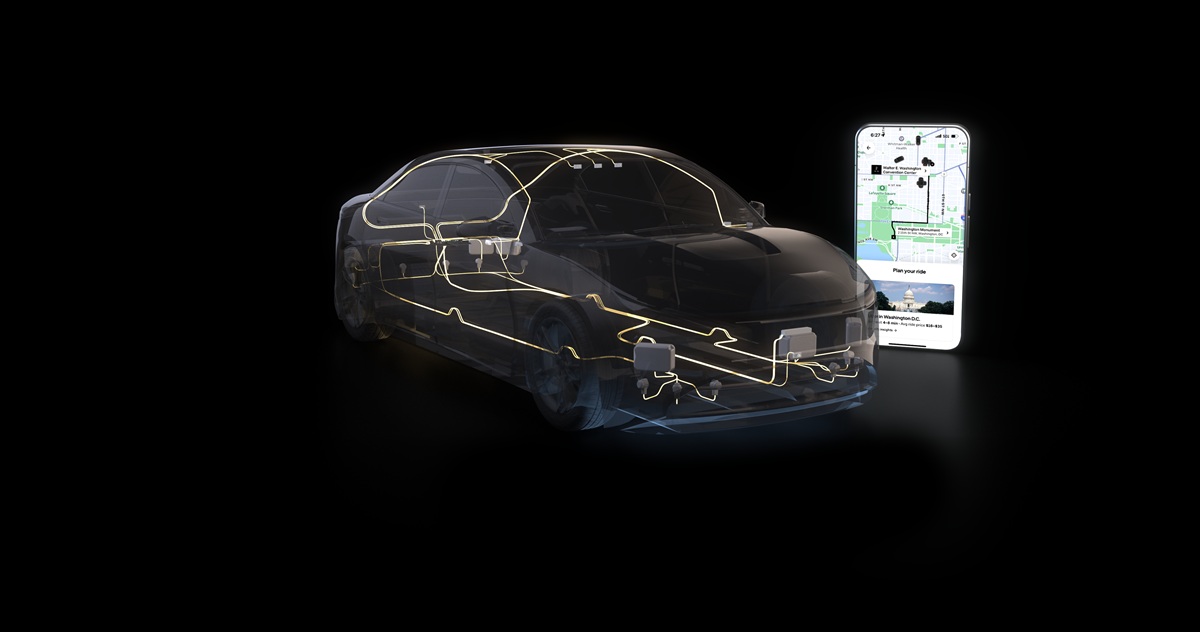
Nvidia is ushering in the coming of Uber’s self-driving cars as a result of a robotaxi and autonomous car fleet deal announced today.
Nvidia said it is partnering with Uber to scale the world’s largest level 4-ready mobility network, using the company’s next-generation robotaxi and autonomous delivery fleets, the new Nvidia Drive AGX Hyperion 10 autonomous vehicle (AV) development platform and Nvidia Drive AV software purpose-built for L4 autonomy.
A “Level 4 ready” car has the hardware and software for high-level self-driving, where a car can drive itself without human help in specific conditions—but still requires regulatory approval or further testing before full activation.
By enabling faster growth across the level 4 ecosystem, Nvidia said it can support Uber in
scaling its global autonomous fleet to 100,000 vehicles over time, starting in 2027. These
vehicles will be developed in collaboration with Nvidia and other Uber ecosystem partners, using Nvidia Drive, said Kari Briski, vice president of generative AI software at Nvidia, in a press briefing.
“We’re announcing a global partnership with Uber to build and deploy a worldwide fleet of Uber robotaxis. Nvidia provides the drive Hyperion platform for the ecosystem of automakers and developers. Uber builds the data infrastructure and hailing network to support the fleet,” Briski said. “Together, we’ll deploy more than more than 100,000 robotaxis worldwide in the next three few years.”
That’s a fleet 20 times larger than today’s most advanced robotaxis.
“This is incredibly exciting for local industry. New job, new local jobs are already being created for today’s robotaxi fleets, and will scale even more with this new partnership manufacturing and vehicle integration, fleet operations, depot logistics, cleaning, charging, remote assistance, support, compliance and more,” Briski said.
Of course, Nvidia will get some pushback on that notion, as it will likely eliminate a lot of worker-level driving jobs as Ubers go robotic.
Nvidia and Uber are also working together to develop a data factory accelerated by the Nvidia Cosmos world foundation model development platform to curate and process data needed for autonomous vehicle development.
Nvidia Drive AGX Hyperion 10 is a reference production computer and sensor set architecture that makes any vehicle L4-ready. It enables automakers to build cars, trucks
and vans equipped with validated hardware and sensors that can host any compatible
autonomous-driving software, providing a unified foundation for safe, scalable and
software-defined mobility.
Uber is bringing together human drivers and autonomous vehicles into a single operating
network — a unified ride-hailing service including both human and robot drivers. This
network, powered by Nvidia DRIVE AGX Hyperion-ready vehicles and the surrounding AI
ecosystem, enables Uber to seamlessly bridge today’s human-driven mobility with the
autonomous fleets of tomorrow.
“Robotaxis mark the beginning of a global transformation in mobility — making transportation safer, cleaner, and more efficient,” said Jensen Huang, CEO of Nvidia, in a statement. “Together with Uber, we’re creating a framework for the entire industry to deploy autonomous fleets at scale, powered by Nvidia AI infrastructure. What was once science fiction is fast becoming an everyday reality.”
“Nvidia is the backbone of the AI era, and is now fully harnessing that innovation to unleash L4 autonomy at enormous scale, while making it easier for Nvidia-empowered
AVs to be deployed on Uber,” said Dara Khosrowshahi, CEO of Uber, in a staetment. “Autonomous mobility will transform our cities for the better, and we’re thrilled to partner with Nvidia to help make that vision a reality.”
Nvidia Drive Level 4 Ecosystem Grows
Leading global automakers, robotaxi companies and tier 1 suppliers are already working
with Nvidia and Uber to launch level 4 fleets with Nvidia AI behind the wheel.
Stellantis is developing AV-Ready Platforms, specifically optimized to support level 4 capabilities and meet robotaxi requirements. These platforms will integrate Nvidia’s full
stack AI technology, further expanding connectivity with Uber’s global mobility ecosystem.
Stellantis is also collaborating with Foxconn on hardware and systems integration. Lucid is advancing level 4 autonomous capabilities for its next-generation passenger vehicles, also using full-stack Nvidia AV software on the DRIVE Hyperion platform for its upcoming U.S. models.
Mercedes-Benz is testing future collaboration with industry-leading partners powered by its proprietary operation system MB.OS and Drive AGX Hyperion. Building on its legacy of
innovation, the new S-Class offers an exceptional chauffeured Level 4 experience combining luxury, safety and cutting-edge autonomy.
Nvidia and Uber will continue to support and accelerate shared partners across the worldwide level 4 ecosystem developing their software stacks on the Nvidia Drive level 4 platform, including Avride, May Mobility, Momenta, Nuro, Pony.ai, Wayve and WeRide.
In trucking, Aurora, Volvo Autonomous Solutions and Waabi are developing level 4
autonomous trucks powered by the Nvidia Drive platform.
Their next-generation systems, built on Nvidia Drive AGX Thor, will accelerate Volvo’s upcoming L4 fleet, extending the reach of end-to-end Nvidia AI infrastructure from passenger mobility to long-haul freight.
Nvidia Drive AGX Hyperion 10: The Common Platform for L4-Ready Vehicles
The Nvidia Drive AGX Hyperion 10 production platform features the Nvidia Drive AGX
Thor system-on-a-chip; the safety-certified Nvidia DriveOS operating system; a fully
qualified multimodal sensor suite including 14 high-definition cameras; nine radars, one
lidar and 12 ultrasonics; and a qualified board design.
Drive AGX Hyperion 10 is modular and customizable, allowing manufacturers and AV developers to tailor it to their unique requirements. By offering a prequalified sensor suite
architecture, the platform also accelerates development, lowers costs and gives customers a running start with access to Nvidia’s rigorous development expertise and
investments in automotive engineering and safety.
At the core of Drive AGX Hyperion 10 are two performance-packed DRIVE AGX Thor in vehicle platforms based on Nvidia Blackwell architecture. Each delivering more than 2,000
FP4 teraflops (1,000 TOPS of INT8) of real-time compute, DRIVE AGX Thor fuses diverse,
360-degree sensor inputs and is optimized for transformer, vision language action (VLA)
models and generative AI workloads — enabling safe, level 4 autonomous driving backed
by industry-leading safety certifications and cybersecurity standards.
In addition, Drive AGX’s scalability and compatibility with existing AV software lets
companies seamlessly integrate and deploy future upgrades from the platform across
robotaxi and autonomous mobility fleets via over-the-air updates.
Generative AI and Foundation Models Transform Autonomy
Nvidia’s autonomous driving approach taps into foundation AI models, large language
models and generative AI, trained on trillions of real and synthetic driving miles. These
advanced models allow self-driving systems to solve highly complex urban driving
situations with humanlike reasoning and adaptability.
New reasoning VLA models combine visual understanding, natural language reasoning and
action generation to enable human-level understanding in AVs. By running reasoning VLAs
in the vehicle, the AV can interpret nuanced and unpredictable real-world conditions —
such as sudden changes in traffic flow, unstructured intersections and unpredictable
human behavior — in real time. AV toolchain leader Foretellix is collaborating with NVIDIA
to integrate its Foretify Physical AI toolchain with Nvidia Drive for testing and validating
these models.
To enable the industry to develop and evaluate these large models for autonomous driving,
Nvidia is also releasing the world’s largest multimodal AV dataset. Comprising 1,700 hours
of real-world camera, radar and lidar data across 25 countries, the dataset is designed to
bolster development, post-training and validation of foundation models for autonomous
driving.
Nvidia Halos Sets New Standards in Vehicle Safety and Certification
The Nvidia Halos system delivers state-of-the-art safety guardrails from cloud to car,
establishing a holistic framework to enable safe, scalable autonomous mobility.
The Nvidia Halos AI Systems Inspection Lab, dedicated to AI safety and cybersecurity
across automotive and robotics, performs independent evaluations and oversees the new
Halos Certified Program, helping ensure products and systems meet rigorous criteria for
trusted physical AI deployments.
Companies such as AUMOVIO, Bosch, Nuro and Wayve are among the inaugural members
of the Nvidia Halos AI System Inspection Lab — the industry’s first to be accredited by
the ANSI Accreditation Board. This lab aims — amongst other things — to accelerate the
safe, large-scale deployment of level 4 automated driving.