
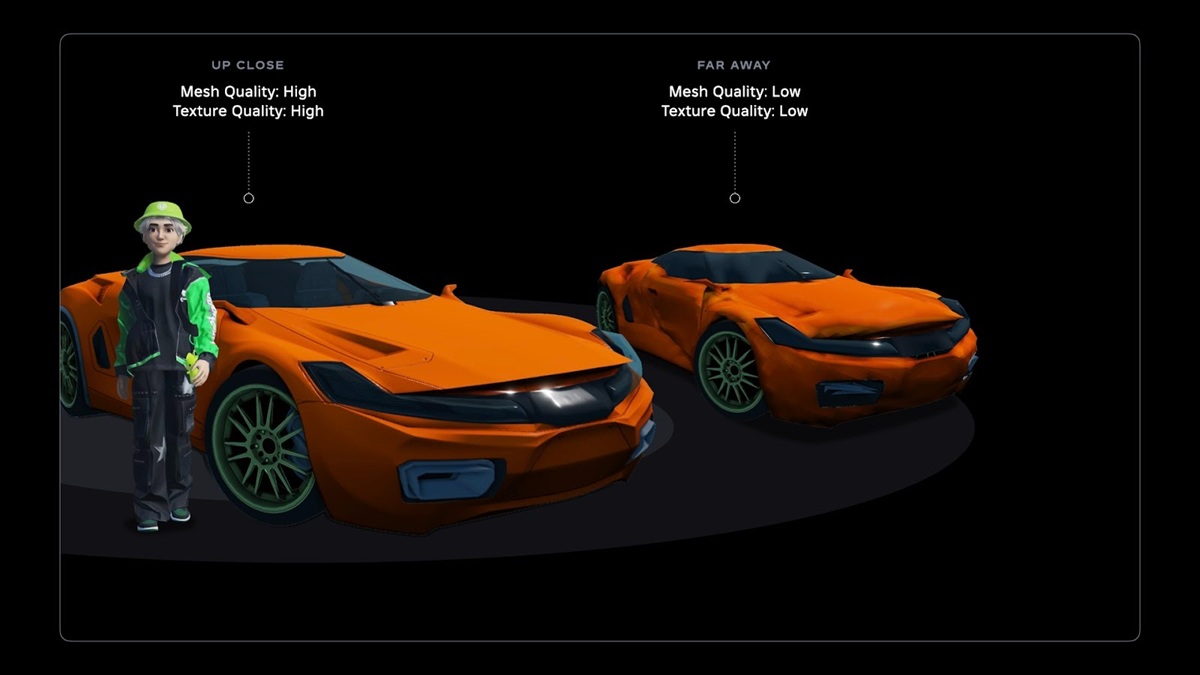
Roblox is having a grown-up moment today. It’s not leaving behind its blocky graphics, but it is taking realism in 3D animation to a higher level than ever before.
The company, which started with kids but now has 151.5 million daily active users of all stripes, is launching SLIM: Scalable Lightweight Interactive Models. And now it’s live.
These leverage the power of lightweight rendering composites to build larger and more detailed worlds that can run on every device. SLIM alters the level of detail needed in a scene on the fly as needed for a given device like a phone or a heavy-duty desktop.
“Roblox supports the creation of vast worlds, and we also support the viewing interaction with those worlds on devices of any sort, from low-end Android devices to high-end gaming PCs,” said Nick Tornow, senior vice president, engine and creator engineering at Roblox, in an exclusive interview with GamesBeat. “The creator creates these worlds once and Roblox takes care of adapting that experience, preserving the artistic creations, artistic intent, and utilizing the best capabilities of whatever the user’s device happens to be, such they can engage with those worlds regardless of the hardware that they’re on.”
Roblox is home to millions of experiences, from simple mini-games to vast open worlds full of high-fidelity 3D assets. The goal is to support the increasingly dense and complex experiences that creators envision across a broad spectrum of user devices, which requires innovation in Roblox’s engine, content delivery systems, and infrastructure.
SLIM is one part of a multi-part development effort that enables creators to achieve their grand artistic visions without compromising performance.
“What we’re announcing is a piece of technology that builds upon this vision, enables this vision to go even further. It’s called SLIM. And SLIM stands for Scalable Lightweight Interactive Models. And what it does is essentially create lightweight, optimized representations of any object in the world to minimize the data and the rendering needs of any visual device,” Tornow said.

SLIM allows creators to automatically create lightweight representations of any object in a
Roblox experience, minimizing the number of draw calls, triangles, and data model instances required by the client to render a robust, seamless world. SLIM gives the streaming model powerful new ways to optimize content, allowing a user with a high-end gaming PC and a user with a low-end mobile device to share the same experience at the highest fidelity their device can handle.
In layman’s terms, you can think of SLIM through a comparison to streaming TV. When you watch a movie on an online video platform, your device doesn’t download the entire file before you start watching. It downloads just enough data for you to immediately start watching, then continuously downloads (or buffers) the next few seconds so there’s no interruption to the experience. If you’re streaming on a low-end device or slow connection, the platform automatically adapts by sending you a lower-fidelity version of the content while it downloads enough data to stream the high-fidelity content.
Roblox uses a similar concept to stream data on the fly, but the data required to represent a high-fidelity 3D simulation presents its own challenges. Where a video has a linear timeline of content viewed from a single perspective, Roblox experiences contain vast, interactive 3D worlds full of many types of assets that can be viewed from many perspectives controlled by the user.
Two pillars of streaming: Instances and assets
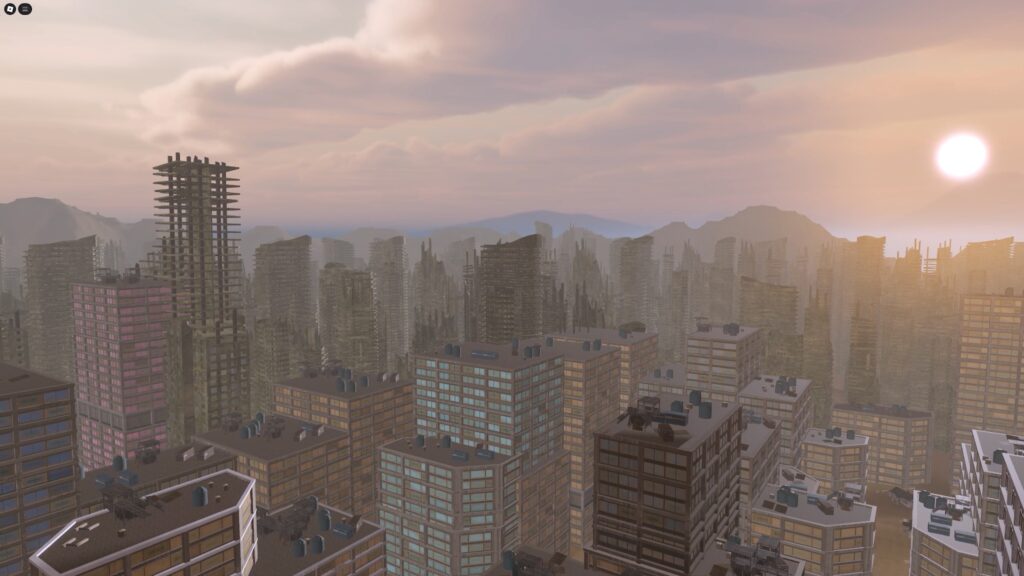
The level of detail you see in a city changes based on where you focus and what you need to see. Source: Roblox
Add in 151.5M daily active users playing, exploring, and ultimately streaming content from
a wide variety of devices, and there is enormous potential for optimizing how content is
delivered and displayed.
That’s why Roblox developed SLIM. SLIM can automatically create lightweight representations of any object in a Roblox experience to minimize the amount of data required by the client to render a robust, seamless world. SLIM gives our streaming model powerful new ways to optimize content, allowing a user with a high-end gaming PC and a user with a low-end mobile device to share the same experience at the highest fidelity their device can handle.
Everything a user sees on Roblox—a car, a tree, an avatar, or a building—is represented as a number of instances within the engine. A usable car, for example, is broken down into instances for the bumpers, doors, wheels, and so on. Each instance is constructed in the experience using multiple assets, like 3D meshes, textures, animations, and audio.
Nearly all streaming on Roblox is separated into two core technologies: instance streaming and asset streaming.
● Instance streaming determines which instances a user’s device needs to stream. There’s no need to stream parts of the experience that the user can’t yet see or interact with. In the above example, only the instances representing the nearby buildings are streamed into the client.
● Asset streaming determines the quality of streamed instances. There’s no need to download a high-resolution 4K texture for a mountain so far away that the user can’t discern fine detail. In the image above, buildings in the distance and buildings that take
up a small amount of screen space use decimated meshes and lower-resolution
textures.
The central brain for this operation is a system Roblox calls Harmony, which monitors each user’s available resources every frame. Harmony adjusts both instance and asset streaming to provide the best experience based on a device’s memory, GPU and CPU load, and network bandwidth.
For a high-end gaming PC, Harmony cranks everything up to the highest quality. For a mobile device with a weak connection, it automatically scales down to keep the user experience smooth.
SLIM: Scalable Lightweight Interactive Models
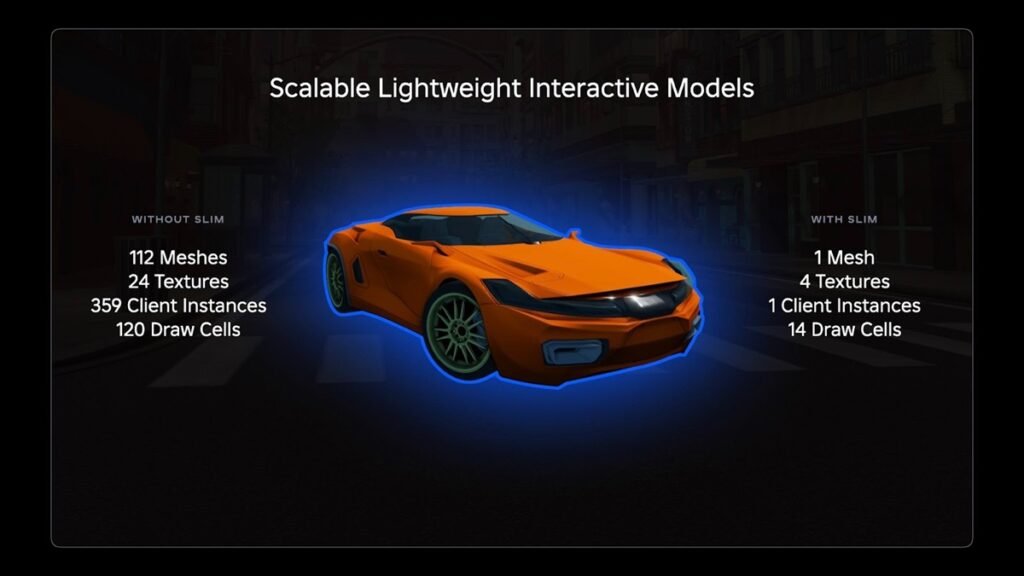
The core idea of SLIM is simple but powerful: SLIM can automatically create multiple lightweight, optimized representations of any object or model in a creator’s world and store them on the server to be fetched at runtime. Each user’s client can then dynamically switch between rendering the original instances and assets or one of the lightweight SLIM representations, based on the device’s available resources.
SLIM uses two main techniques to generate a lightweight representation:
Compositing
First, SLIM combines multiple parts into fewer parts. Instead of the car below requiring 112 separate meshes and 24 separate textures, its lightweight representation might require only one mesh and four textures. The compositing process is precisely tuned to match how the engine will finally render the content, eliminating invisible geometry within an object and reducing the number of draw calls necessary to render it.
Level of Detail (LoD)
After compositing the model, SLIM generates multiple versions at different levels of detail. This means creating versions of the 3D mesh with significantly fewer triangles and generating textures at much lower resolutions, as we do with any individual mesh or texture asset using traditional LoD techniques.
This is something that many different games do, but Roblox has its own way of doing it.
These techniques can be further optimized when applied to SLIM models since we have the individual coordinate frames of each underlying instance. This gives us full context of how the creator intended each of these assets to be rendered together. With this knowledge, SLIM allows us to make more informed decisions about where to remove unnecessary detail and where to keep the details that users will notice.
The right representation at the right time
Once Roblox creates multiple representations of an object, SLIM must decide which one to use for a specific user’s device or whether to use traditional rendering techniques instead. The system splits the world into three distinct regions. A simple way to think of these regions is to imagine concentric circles of detail extending outward from the player.
Streaming boundaries are not actually circular. Their shape depends on a variety of factors.
HH Region (Heavyweight Instances, Heavyweight Rendering)
In the HH region, full, heavyweight instances are streamed from the server to the client data model, and the client determines the specific asset representation to download and render for each instance. Scaling can still be achieved with mesh LoDs and texture mips in this region, but there’s no compositing. Before SLIM, this is how every instance that was streamed into an experience was rendered.
HL Region (Heavyweight Instances, Lightweight Rendering)
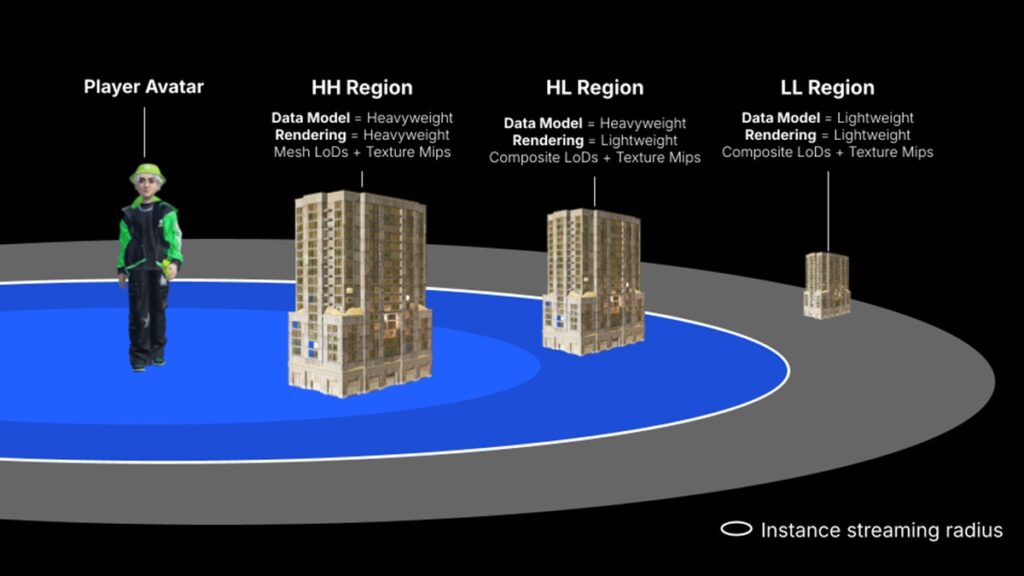
The HL region sits between the HH and LL regions. In this region, the client has the heavyweight instances in the data model but can choose to render using either the full render pipeline or the SLIM pipeline. This region adapts to ensure a seamless transition between the HH and LL regions even if the user encounters network latency. The transition point between the HH and HL regions is dynamic, which allows Harmony to scale up or down immediately in response to a resource spike in either direction.
LL Region (Lightweight Instances, Lightweight Rendering)
In the LL region, the client only streams super-lightweight representations of instances necessary to define a coordinate frame for a SLIM model, along with the bare minimum
metadata. Only lightweight composited SLIM models are rendered in this region, rather than every single instance and asset. The LL region requires far fewer triangles and draw calls, and reduces memory usage on the user’s device compared with streaming in every heavyweight instance and using the traditional render pipeline.
This region technique allows the client to render the entire visible world at all times without incurring the full computational cost of using every heavyweight instance and asset at once. Faraway objects are highly optimized, lightweight representations, which are replaced by their high-fidelity counterparts as the user gets closer. SLIM’s ability to create composites and multiple scaled LoD models gives Harmony more levers to pull to optimize asset quality for each user’s device.
When everything comes together, the player should feel completely immersed and not notice any of the transition points or varying levels of detail.
The future: Where does SLIM go from here?
SLIM is just step one of a multistep journey, and the team is excited to see how creators integrate the technology into their workflows.
“SLIM is a leap forward in our vision to support more expansive and detailed worlds for our players, and it uses two main techniques to accomplish this,” he said.
The first is compositing. Any individual object may consist of many meshes and textures. SLIM composites these into fewer parts, so 100 meshes or textures can come down to just a handful. And it also includes a level of detail capability, which can generate multiple versions, multiple levels of detail of that composited mesh or texture, as appropriate for the device.
SLIM splits the world into kind of three distinct parts of the immediate surroundings. Depending on where you are looking, Roblox will use SLIM to render at the highest possible degree of fidelity. For the parts of a scene that are away from your view or further away from you, it will reduce the amount of detail.
“You can have this very long view across very complicated worlds, without having all the overhead of those objects being represented in our data model on a client,” Tornow said.
Determining what else can be SLIM-ed
Roblox is starting with the static models that creators designate in Studio, but in the future, SLIM will be able to optimize some of the most complex models on Roblox: platform avatars. Avatars, with all of their associated animations, layered clothing, and accessories, can be an unpredictable variable for creators. Allowing avatars to be SLIM-ed means the engine can effectively cap the resources an individual avatar model uses.
Eventually, Roblox wants to give creators the option to leverage SLIM for changes to dynamic models. Imagine a model where the server can actively make changes (e.g., a door opens or a part is destroyed), but with a few clever tricks, the client can reuse the same lightweight representation.
This builds on the Harmony system that Roblox introduced last year. That’s the brains of this SLIM technology.
“Depending upon the device that we currently find ourselves running, Harmony controls the nature of those three regions,” he said.
As you move through a world or a scene, it should all be seamless. Trees should not pop into your view as you get closer to them when flying over them in an airplane. Rather, they should just seamlessly come into your field of view, like when you see them in the real world and focus on them with your eyes.
“As you move through the world and as things move through these different spheres, representation on the client — it’s all seamless,” he said. “You can’t even tell that it’s happening, because when things are further away, obviously they’re smaller. Perhaps you’re paying less attention to them, and then, as you get closer, it pops into a real, full representation. But there’s no transition, there’s no hitch.”
Optimizing the SLIM pipeline

Now that we have an end-to-end pipeline that provides the engine with a new dimension of flexibility, we’re also focused on making the pipeline itself smarter, faster, and more efficient.
This includes:
● Texture re-atlassing: Intelligently packing multiple model textures into a single, optimized texture sheet.
● Automatic segmentation: Automatically using semantic and spatial understanding of
the world to identify the best SLIM-able models.
● Lighter-weight representations: For dynamic objects that are less latency dependent,
we’re exploring generating 2D representations that are virtually resource-free to render
on the client.
● Hierarchical SLIM: Nesting SLIM models one after another so that entire groups of
instances can be simplified and the engine can dynamically select between levels of
granularity—e.g., from a single tree to a forest to an entire landmass full of forests and
other objects.
● Up-rezzing: Today, we’re focused on optimizing down for performance, but very soon,
this same system will allow us to increase the resolution of assets for future hardware
while maintaining the creator’s original artistic intent. This new architecture means that
as our engine gets better at simulating reality, we can continually upgrade the representations it uses.
SLIM, in combination with Harmony and the rest of our streaming and content delivery
architecture, is a massive leap forward in our vision to support more expansive and detailed worlds for more players.
The tight integration of our engine, content delivery, and cloud infrastructure coupled with the massive content base from millions of creators allow the company to build deeply interconnected systems that improve the whole experience. As Roblox engine gets better at simulating reality, we can continually upgrade the representations it uses. Today, Roblox is focused on optimizing down for performance, but very soon, this same system will allow the team to up-rez assets for future hardware while maintaining creators’ original artistic intent.
Roblox is building a platform that not only respects that artistic intent but also can intelligently and automatically deliver their creations to any user on a wide variety of devices anywhere Roblox is available. The company said it can’t wait to see what the community builds with it.
Beyond objects that “pop” into view
I noted that in many games, I often see the “pop,” where objects like trees just pop into existence just as they come within view. It’s not a bad way to stream in content on the fly, but it’s so noticeable that it destroys the realism of a landscape.
Tornow said the goal is to eliminate that “pop” and make the transition seem invisible.
“When something is very distant, and that outer sphere I was describing earlier, it would still be drawn, but it would be drawn with maybe far fewer meshes and far fewer textures,” Tornow said. “You would still see the trees. They might be quite far away so you can’t perceive the details, but we’re also not shipping those details to the client, because they don’t need to be rendered to achieve that performance goal. But then, of course, just naturally, as you get closer to it, the details start to become visible.”
Then you could walk right up to the tree and interact with it, see the branches blowing in the wind and whatnot.
“The system is currently focused on sort of optimizing performance in this way that we’re describing, basically providing that seamless transition and allowing it to work even on extremely low-end devices,” he said.
The benefit is that this kind of streaming also uses less of the network resources. Less data flows through the infrastructure, and this will eventually enable Roblox to move to ever higher levels of fidelity and performance.
“Over time, we believe we will start operating and providing even higher degrees of fidelity,” he said.
Sometimes when a world is really big, you see a jarring transition from one game server to another. This is a problem many worlds have had, and it’s a reason for limiting the number of people in a given world, particularly if you want to maintain a fast frame rate.
“I won’t get into too much detail about our internal architecture, but our intent is to support worlds of arbitrary size, and if and when that requires transitioning across server boundaries, that’s something we would handle within the Roblox cloud,” Tornow said.
Over time, not only will Roblox be able to handle bigger scenes on a variety of devices. It should also be able to accommodate more interactivity among the objects in a given scene. The next step for SLIM, Tornow said, is to enable the extension of this technology to “rigged” objects and animated objects, such as avatars, that could interact with each other in real time. You would see people shaking hands or touching things.
A world for adults?
I asked if this meant that Roblox would graduate from the world of kids and move on to the world of adults through more realistic graphics.
Tornow answered that a few ways.
“As you know, Roblox is aiming to represent 10% of the game industry, and our path there involves an expansion of genres and expansion of the types of content that can be built on the platform, and an expansion of our audience, the types of people who are engaging with that content. And yes, there are certain limitations of our existing technology in terms of scale, which then is helping [realize] these genres in which we hope to expand. Like open world RPGS or quite complicated large worlds.”
One of the dimensions of complexity is visual fidelity. There are other dimensions like the scale or richness of worlds, the number of objects and such, he said. Like when Roblox showed a view of a big city in the background of a 3D scene. It’s not always about photorealism or even realism. The last dimension to consider is performance and a sene of immersion. You want to feel immersed in a world, even on low-end devices.
“We think SLIM, even in its current incarnation, is going to help existing experiences on the platform. In addition, it’s going to help open up opportunities for new types of content on the platform. And then in addition, we believe it’s going to set the stage for even further advancements along each of those fronts,” Tornow said.
I asked what else SLIM would be useful for in visualizing another type of scene.
Tornow said, “The one that we’ve been toying around a lot with is this this notion of the open world. In an open world RPG, there are hills and scenic views. Maybe you can have high level vantage point overlook. And then the notion that you could have binoculars or something like that, zoom in and see things miles away. These things are moving extremely rapidly through such a world. Imagine you could fly some sort of superhero type capabilities.”
And he said, “Imagine being able to look at this vast world, but it’s not static. There are little things moving around all over the place. And then imagine being able to rapidly fly through that, or traverse through that. You could get close to something that was formerly miles away that you could just see barely moving, either visually or actually by moving there and have it become something you can see very clearly. And no popping, none of this artificial jitter that is characteristic of most games.”
The challenges ahead
I asked what is still too hard to do.
“Things that are too hard to do right now, with the version that we’re announcing now, include things like the dynamic movement. That’s something we’re working on,” Tornow said. “We’re going to share that in 2026 and then I think one of the things I alluded to earlier that is still too hard to do is the notion that if you have thousands of individual objects, like a crowd.”
And he added, “Imagine a complicated explosion. Imagine thousands of things moving around, for whatever reason. This notion of being able to dynamically determine that cluster, that group of objects, and in real time, convert it into a SLIM model. That’s still a work in progress. But that’s really the huge unlock that’s going to allow us to scale far beyond its existing limits, to that combination of vastness and then lots of moving parts.”
The company has worked on SLIM for about 18 months. As for the inspiration, Tornow said, “Our inspiration is really consistent. Roblox has been on this mission for quite a while, of [enabling the creation of] megascale worlds, lifelike worlds,” Tornow said. “And this is all part of our longer arc, bringing those worlds into reality, and, of course, making them perform on low-end devices.”
He added, “So in a way, SLIM is just part of a much larger journey Roblox is on to achieve our vision of 10,000 people in a complicated world on a low-end device, on a slow network.”
The company can fit about 200 people in a game server now, but it has been raising its limit.
“This [technology] is a key part of the reason why that limit is less about the server’s ability to handle more than 200 and more about making sure the game is incredibly fluid, even on a low-end device,” Tornow said. “nd so as we roll out SLIM and a variety of other technologies, it should be possible for these low-end devices, again, to not have to deal with the fact that there’s 200 avatars. Then we can go far beyond that number.”
In closing, I said to Tornow, “All right. Looking forward to the metaverse one these days.”