
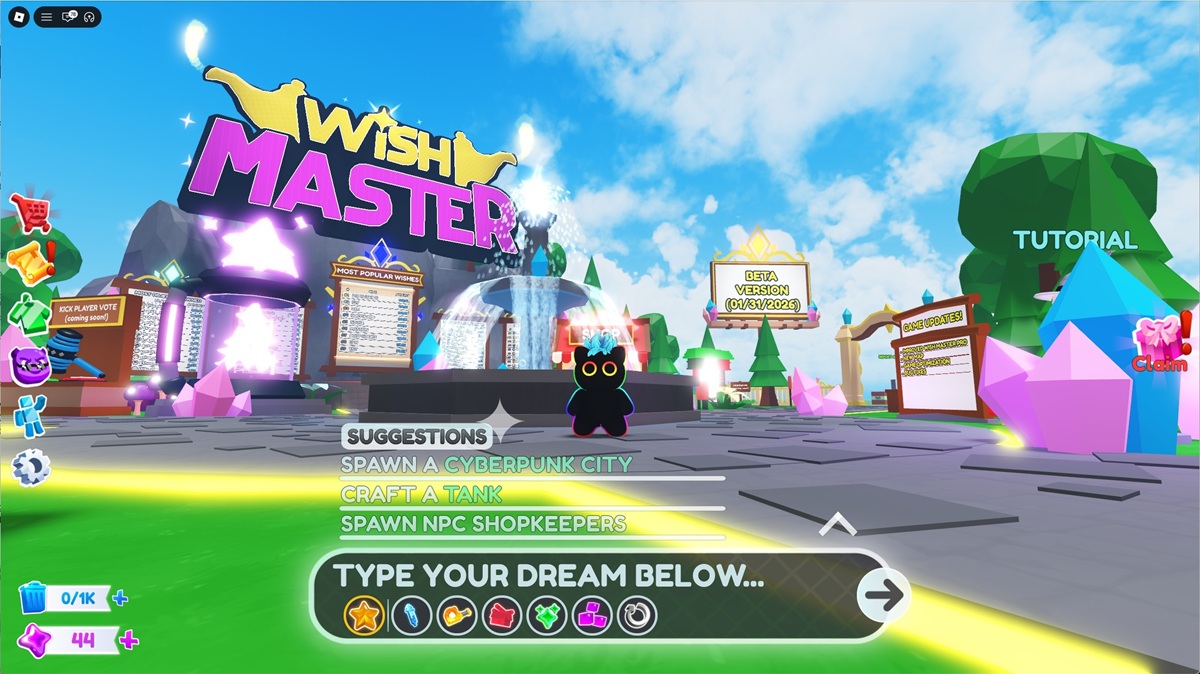
Roblox is launching 4D Creation into open beta to create functional objects within game worlds.
Last year, the game platform launched Cube 3D, a foundational AI model that transforms text prompts into static 3D objects in seconds. This means if you create a shovel in a Roblox scene, a player’s avatar will be able to pick it up and dig a hole with it.
4D creation adds the crucial dimension of interactivity, generating dynamic objects that behave the way players expect. The system uses schemas to define how specific objects are broken down into parts and behaviors that bring them to life in a 3D environment.
New experiences like Wish Master have already begun to implement the technology in early access.
“About six or seven months ago, I was experimenting with Roblox Studio’s AI Assistant and found it really impressive,” said Laksh, the creator of Wish Master. “I thought it would be amazing to create something similar for players to use in-game. When I saw the 4D announcement at RDC, I knew I had to apply to the early access program. I brought on developers I had collaborated with on previous games and began building…We’ve noticed that players who have used 4D at least once have three times the playtime of players who haven’t.”
The Big Picture
4D Creation & Studio Assistant: These are the foundational pieces of a suite that will eventually allow creators to generate everything from code and animations to entire environments using natural language prompts.
The Concept of “Real-Time Dreaming”: This is Roblox’s North Star — a future where interactive worlds are generated on the fly, bringing anyone’s imagination to life within a live experience.
Empowerment, Not Replacement: These innovations will lower the barrier to creation and help experienced creators move faster, not replace creator vision and autonomy.
AI on Roblox to Date
Roblox sees the potential of AI to dramatically improve the experience of both users and creators on Roblox. The company embraced AI as a core part of its platform with over 400 machine learning models driving intelligent systems to make communication and interactions safer, surface content that resonates with users, and accelerate creation.
AI is already transforming the way over 151 million users per day interact with Roblox.Creator tools like Assistant and our generative model, Cube, are lowering the barrier to creation and helping experienced creators move faster.
Three times more creator accounts are using Assistant daily compared with a year ago.
Over 1.8 million objects have been generated using Cube since launch.The company understands that taste and autonomy are paramount and creators will use AI tools at different stages of their process (or not at all) based on their goals and vision. We build creator tools in service of the creator’s vision, never to replace it.
Roblox’s upcoming announcement marks an important milestone on Roblox’s AI creation roadmap: the beta release of 4D creation.
4D Creation for Players
Last year, Roblox launched Cube 3D, a foundational AI model that transforms text prompts into static 3D objects in seconds. 4D creation adds the crucial dimension of interactivity, generating dynamic objects that behave the way players expect.
The system uses schemas to deconstruct specific objects into the parts and behaviors that bring them to life in a 3D environment.
With 4D creation, creators can unlock new types of gameplay and allow players to bring their own creativity into their experiences.
How 4D Creation Works
During the beta, we’re focusing on in-experience creation and two schemas to test the system before expanding to an open schema model that allows creators to define their own rulesets.
The two schemas available during beta are Car-5, a five-part, multimesh car composed of a body and four wheels, and Body-1, which can generate any single-mesh object.
On the back end, schemas define the required mesh outputs to make a model functional.
For example, the Car-5 schema ensures that generated cars have five separate MeshParts, named body, front left wheel, front right wheel, rear left wheel, and rear right wheel. Now, instead of a single mesh with no articulation, users can generate a car model with wheels that spin and turn based on scripts.
After geometry is generated with a schema, the next step is to add functionality. With users generating objects on the fly, scripts that attach behavior must adapt to a range of shapes and sizes. 4D creation includes a step that retargets scripts to the unique dimensions of the generated object so that parts work as expected.
In the future, creators will be able to define their own schemas, which will enable many more types of interactive objects. You can see how this will work in the press kit images.
Roblox is also working on technology that allows creators to use a reference image to upsample a 3D model, matching visual style and increasing fidelity. Check out the press kit for an example.
What starts with 4D creation and a collaborative Assistant will eventually unlock a holistic suite of AI creation tools that augment specific parts of the creation workflow and allow creators to move faster. Roblox is also exploring other avenues to evolve creation, including our most research project: real-time dreaming.
Real-Time Dreaming
AI world models are a burgeoning topic in the research community, and we think there’s an enormous opportunity for the tech to enable new types of experiences on Roblox.
World models seek to understand the rules and dynamics of the world around them so they can predict future states.
For self-driving cars, this might mean understanding the streets, traffic laws, and emergent scenarios encountered while driving.
For games, this might mean understanding the physics, visual style, and player inputs so that new environments and gameplay can be generated.
The opportunity for Roblox lies in combining the intuitive prompt-based creation and visual fidelity of world models with the interactivity and consistency of a game world, all in real time. Objects must persist, simple player inputs must drive contextual actions, and the experience must run smoothly.