
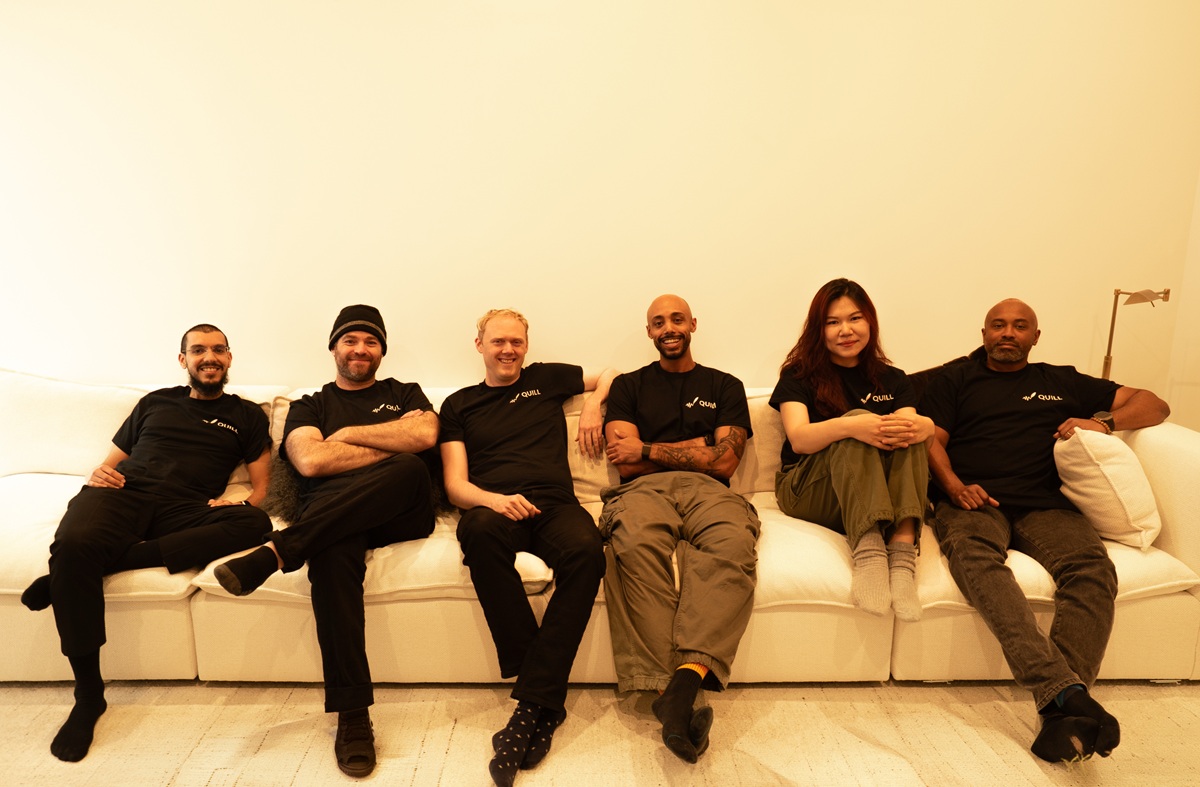
Quill today announced $6.5 million in seed funding and the launch of Quilliam, a sovereign Chief of AI Staff agent for modern professionals.
As professionals increasingly rely on multiple AI tools — for writing, coding, research, and
communication — they need a layer that holds context and coordinates across all of them. But where does that context come from? Conversations. Professionals spend 75% of their day talking with others — in meetings, calls, and collaboration. Quill starts there, capturing context from every conversation, and evolves into a Chief of AI Staff that coordinates your growing fleet of AI tools with full knowledge of how you work, the company said.
Unlike AI tools that lock users into rigid workflows and opaque cloud infrastructure, Quill gives users complete control over where their data lives, how AI inference runs, and how their workflows evolve over time.
Basis Set Ventures led the funding round, with participation from 500 Global, Naval Ravikant, Morado Ventures, and AME Cloud Ventures. The funding will accelerate product development and team expansion, including the recent additions of COO Yacob Berhane and head of enterprise, Clayton Bryan.
“Work is becoming AI management,” said Michael Daugherty, CEO of Quill, in a statement. “But AI tools don’t talk to each other and don’t really remember how users work. Our goal is to eliminate the coordination tax. Quill starts where the context is — conversations with other humans — learns how users operate and coordinates their AI staff on user’s behalf. So users can focus on the conversation, not the follow-through.”
Sovereign by Design

Quill’s architecture reflects its philosophy of user sovereignty. All user data lives on the user’s device and Quill can operate fully without ever touching Quill’s cloud:
- Audio never leaves the user’s device — transcription happens entirely locally.
- Cloud sync is optional; when enabled, all data is end-to-end encrypted and Quill’s servers never see plaintext content.
- Users choose where AI inference runs, whether in enterprise cloud providers (Google Vertex, AWS Bedrock) with zero content logging, or even fully local models for air-gapped or completely offline operation.
- Workflows, integrations, and templates are fully customizable.
- No user data is ever used for model training.
This configurable approach allows enterprises to meet their specific compliance requirements — from GDPR and the EU AI Act to industry-specific regulations without sacrificing functionality.
For organizations requiring complete data sovereignty, Quill can operate entirely on-device with no external network calls.
Proactive, not reactive
Quilliam connects to 100s of tools via Model Context Protocol (MCP), including Linear, Notion, Slack, Salesforce, and Gamma. But unlike simple integrations, Quilliam uses context from meetings and user history to proactively suggest and execute workflows:
- After a product meeting, Quilliam can create or modify tickets in Linear, update documentation in Notion, and draft stakeholder updates.
- Before a client call, Quilliam surfaces relevant history and prepares briefing materials.
- Over time, Quilliam will help to customize Quill with automations, templates, and other improvements specifically for you.
Availability
Quill is available now for individuals and enterprise teams. To see Quilliam in action, visit
www.quillmeetings.com or contact [email protected].
Origins
I asked the company about its origins. In a message to GamesBeat, Daugherty said, “I spent most of my startup career at AngelList, where I built out Syndicates and the venture platform and loved our mission of empowering high agency people to make a difference in their lives and the world. Around 2022, I started hacking on AI projects because it felt like such a powerful technology to provide leverage to everyone in the world. AI enables software to be personalized for every user.”
At the same time, he became fascinated by the idea of running AI locally because the most personal context doesn’t live in the cloud.
“When we added local transcription + the power of LLMs to understand context and think about next steps, we hit on a great mix,” Daugherty said.
Specifically the moment that stood out to him was after he visited the ER one day, his wife called a doctor in her hometown of Chengdu, China, to get a second opinion.
“We transcribed the call (in Sichuanese) and used an LLM to turn it into a list of questions for me to discuss with my U.S. doctor. This was incredibly helpful – whereas the original transcript on its own was not,” Daugherty said. “A transcript of a meandering conversation in Chinese isn’t something I can take to a U.S. doctor, but a pointed list of questions to ask makes sure I have a great conversation and don’t forget important information.”
Conversations are the richest and most personal data source in your work life and nobody was doing anything useful with them, he said.
“The existing tools gave you a transcript or at most gave the same generic summary to every participant in the call, and users told us they felt obligated to record but never went back to read a 10,000 transcript. So the question became: what do you actually do after a conversation? You write follow-ups, update your CRM, create tasks, brief your team. That’s where Quill started, and the ‘Chief of AI Staff’ is the natural evolution: an AI that knows your full context and proactively takes action,” Daugherty said.
Saving time

Quill’s head of enterprise, Clayton Bryan, was previously a partner at 500 Global where he’d run their accelerator and do 500-600 calls per batch.
“He told us that during acceptance and rejection cycles, Quill saved him upwards of 20 hours per batch because he could generate contextual, personalized emails to founders and sync notes with his investment team in minutes instead of spending a full week on it,” Daugherty said. “He also uses Quill to draft quarterly cover letters to his LPs by querying three months of conversation history for portfolio highlights, revenue leaders, and companies that raised or shut down. That alone saves him six to eight hours per letter.”
Daugherty added, “For me personally, I found it doesn’t just save time. It helps me do things I wouldn’t have done at all. I used to be bad at sending follow-up emails after sales calls. I set up a Quill template that auto-drafts them in my voice with the right details filled in, and now they go out fast and they’re better than what I’d write manually.”
Balancing personalization with privacy
Daugherty said the balance of personalization with privacy is core to how the team built Quill.
“Audio recording, transcription, and speaker recognition all happen locally on your device and your transcripts live on your computer, not in the cloud,” he said.
“The architecture means we never have a central database where we could read anyone’s conversations. If Quill shut down tomorrow, your data would still be on your machine. Likewise, you could delete your hard drive and we would not be able to get your data,” Daugherty said.
So, Quill will be grounded in your personal context while empowering you to decide how to use them, he said.