
Qualcomm and Meta announced a strategic multi-generation collaboration for Qualcomm Technologies to be a supplier for data center CPUs for Meta.
Qualcomm’s data center CPU, the Qualcomm Dragonfly C1000, is planned to power Meta’s next-generation server fleet, underscoring the growing importance of high-performance, power-efficient compute in large-scale scale-out environments. It’s another sign of the rapid growth of data center tech in the AI era.
Qualcomm’s chip solutions will be in production starting in the second half of 2028 and future data center capacity expansions. Qualcomm’s platform approach, spanning advanced compute, high-performance connectivity, and system-level optimization, is designed to deliver substantial performance per watt and help reduce total cost of ownership at scale.
“We designed our data center CPU to deliver leading performance per core and a breakthrough in power efficiency for large scale data center deployments, and this multi-generation agreement with Meta is a significant validation of that approach,” said Cristiano Amon, President and CEO of Qualcomm, in a statement. “We’re thrilled to build on our partnership with Meta, expanding from devices to data center. And this is just the beginning.”
“We’re excited to continue partnering with Qualcomm as they design the next generation of CPUs for Meta,” said Mark Zuckerberg, founder and CEO of Meta, in a statement. “Along with our other compute investments, we’re quickly building the infrastructure we need to deliver personal superintelligence to everyone in the world.”
Qualcomm’s larger CPU outlook
Qualcomm also announced expanded earnings expectations over the years. The company’s CFO said Qualcomm is raising its fiscal 2029 non-handset revenue target to $40 billion, approximately twice the prior fiscal 2029 target.
And the company also announced new data center solutions, including the Qualcomm Dragonfly C1000 CPU, Qualcomm High Bandwidth Compute (HBC), Qualcomm Dragonfly AI300 inference accelerator, and connectivity products, together with custom silicon solutions, all engineered to maximize performance per watt and token throughput at lower total cost of ownership.
The new platforms highlight Qualcomm’s growing role in building full‑stack data center infrastructure optimized for AI, spanning agentic and data‑center‑class CPUs, AI inference accelerators, high‑performance connectivity, and at scale custom silicon solutions. The Qualcomm Dragonfly AI300 joins the previously announced Qualcomm Dragonfly AI200 and AI250 in its data center solutions portfolio with an annual cadence AI accelerator roadmap.
“Agentic AI is driving a significant increase in demand for AI inference in the data center. As these become the dominant workloads, infrastructure has to deliver much higher performance at lower power and cost,” said Amon, in a statement. “That plays directly to Qualcomm’s strengths, and we’re well positioned for this shift. With Qualcomm Dragonfly, we’re bringing our high-performance, low-power computing into the data center, with multi-year, multi-generation agreements with leading customers.”
Inference-First Platforms Built for Hyperscalers
Qualcomm draws on decades of expertise in systems-on-chips (SoCs), low-power design, high-performance processing, and leading IP, combined with experience engineering over 40 billion components, to deliver disaggregated, rack-scale AI infrastructure designed for data-center-grade, agent-intensive AI inference workloads at hyper scale.
These innovations enable improved token economics, low latency, simplified integration, scalable deployment, and lower total cost of ownership. As agentic AI dramatically increases token demand, Qualcomm Technologies’ solutions are optimized for tokens-per-watt as the key lever to reduce total cost of ownership (TCO).
“What enterprises need now goes far beyond individual components. Orchestrating multiple types of compute across distributed, always-on infrastructure is critical,” said Tony Pialis, EVP and GM, Data Center, Qualcomm, in a statement. “With Qualcomm Dragonfly, we’re bringing together compute, AI, memory, and connectivity into a unified, rack-scale platform designed for increasingly complex, agent-driven workloads while addressing key bottlenecks in memory bandwidth and power consumption. This builds on what Qualcomm Technologies has been delivering for decades: high-performance, low-power compute at scale, now applied to the data center in a way that very few companies can match.”
From Silicon to Rack: A Disaggregated, Rack-Scale AI Inference Platform
Qualcomm Dragonfly C1000 CPU

- Purpose-built data center CPU designed for leadership performance and utilization for agentic, general-purpose, and AI head node workloads at best-in-class power efficiency and TCO
- Custom-designed Qualcomm Oryon CPU cores optimized for core performance and frequencies > 5 GHz to deliver superior performance for agentic workload deployed at scale
- 250+ core count chiplet design for exceptional throughput and scale while delivering exceptional per-core performance
- > 2x better performance per watt estimate compared to existing product benchmarks for server CPU competitive offerings based on specs
- Architected and designed for best throughput, responsiveness, and infrastructure utilization for critical data center usages and lowering CapEx and OpEx to deliver best-in-class performance per TCO leadership at scale
- Multi-chiplet architecture enabling modular integration with advanced packaging technologies for performance and IO scaling addressing general-purpose to AI CPUs in the data center domain
- > 2 TB/s leading-edge PCIe Gen 7 connectivity, plus CXL connectivity, to support next-generation accelerators, high-speed networking & storage and memory disaggregation
- Memory sub-system built to deliver superior bandwidth, capacity, latency and power efficiency using leading-edge low-power memory technology
- CPU-based inference with optional HBC attach
- Built with advanced reliability, availability, and serviceability (RAS) features, including ECC, fault isolation, and error recovery to enable resilient operation at scale
- Support for both air and liquid cooling, enabling deployment across diverse data center environments with OCP ORv3 compliant racks and servers
- CPU portfolio includes: agentic CPU designed for high-throughput agentic orchestration and low latency interactive AI use cases; general-purpose CPU designed for optimal performance-per-TCO for first-party workload and performance-per-vCPU for third-party usage elasticity; AI head node CPU designed to maximize XPU utilization of XPU for generative AI compute through low overhead host processing through high-speed CPU
- Commercial availability is expected in 2028
Qualcomm High Bandwidth Compute (HBC)
Qualcomm High Bandwidth Compute (HBC) Technology
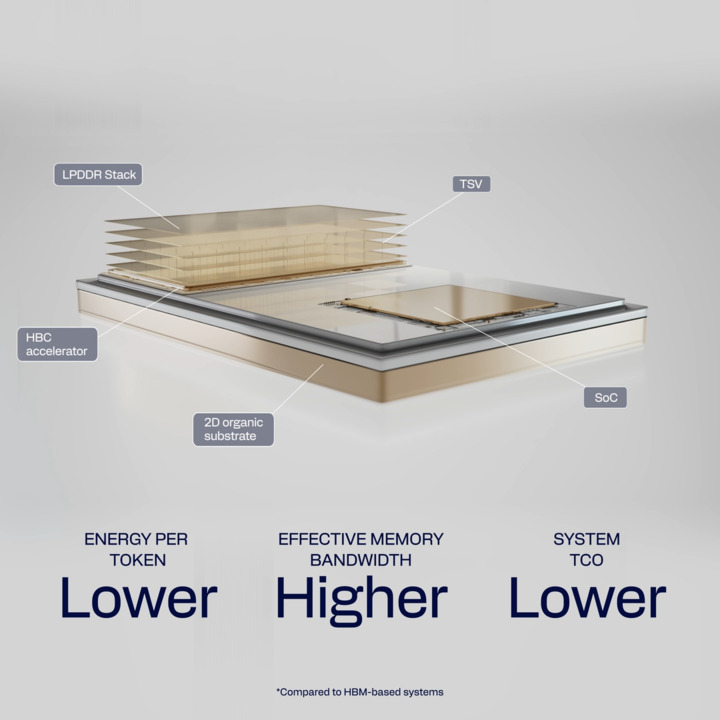
- Innovative purpose-built near-memory computing architecture that bonds compute with highly-accelerated memory bandwidth in a 3D-stacked silicon solution to address AI’s fundamental data movement bottleneck
- HBC has a multi-generation roadmap to deliver faster, more efficient, and more scalable processing at lower total cost of ownership and higher energy efficiency compared to high bandwidth memory (HBM)
- With HBC Gen 1, AI250 is designed to enable an industry-leading 133 TB/s per card, an 18x increase in effective memory bandwidth compared to AI200 with LPDDR5X; AI300 with HBC Gen 2 is designed to enable another stepwise improvement with a 54x increase over AI200
- HBC is designed to enable a 6x increase in bandwidth per watt versus HBM compared to competing published product specifications normalized at card-level
- HBC is designed to enable a 200x increase in capacity per watt versus SRAM compared to competing published product specifications normalized at rack-level
- HBC is designed to enable efficient scaling of AI agents to meet the demands of continuous reasoning, memory bandwidth, and real-time responsiveness
- Our strategic relationships with the supply chain and unique implementation addresses near-memory computing complexity due to 3D integration leadership, system-level design, LPDDR leadership, and power efficiency expertise
- Commercial sampling of HBC Gen 1 with AI250 is expected in mid-2027
Qualcomm Dragonfly AI300 (Card and Rack)

- Third-generation, air- and direct-liquid-cooled rack-level AI inference platform – following the introduction of the AI200 and AI250 solutions last October
- AI300 integrates breakthrough Qualcomm HBC Gen 2 technology for compute acceleration with integrated memory and increased effective memory bandwidth, designed for disaggregated inference deployments (AI250 uses HBC Gen 1)
- Enables industry-leading memory capacity and effective bandwidth enabling high-throughput, low-latency performance for large language & multimodal model (LLM, LMM) inference and agentic AI workloads
- Expecting 4x-8x better performance-per-watt compared to existing GPU-based architectures on memory bandwidth per watt per card
- Scale up with UALink (Ultra Accelerator Link) and ESUN (Ethernet for Scale-Up Networking); scale out with copper and optical
- Commercial sampling is expected in 2028
- Performance-optimized silicon at scale for next-generation AI and cloud data center infrastructure
- Bespoke custom silicon for agentic AI and other specialized workloads
- End-to-end co-design capabilities across silicon, system, and software to address customer-specific performance, power, and integration requirements
- Advanced packaging and modular architectures designed to improve performance, power efficiency, and scalability
- Proven IP and streamlined design execution to support faster time-to-market and reduced execution risk
- Execution from design through high-volume manufacturing, supported by ecosystem and supply chain relationships
- Broad connectivity portfolio spanning die-to-die, copper, optical, and campus-reach interconnects for next-generation AI data centers
- Supports high-bandwidth 800G and 1.6T connectivity across optical, AOC, and AEC applications, from intra-data-center links to campus-reach deployments up to 20 km
- Combines Qualcomm Technologies’ SerDes, PAM4, coherent-lite DSP, signal integrity, and telemetry capabilities to support scalable, high-performance AI infrastructure
- Addresses data movement bottlenecks that are central to AI data center performance in increasingly distributed, disaggregated, and bandwidth-intensive infrastructure