

PvX, a financial services platform, said it has surpassed $250 million in committed user acquisition (UA) financing facilities to 20 mobile gaming and consumer app companies.
That means it can provide much-needed user-acquisition funds to fuel the growth of fast-growing mobile games and apps, said PvX CEO Joe Wadakethalakal, in an exclusive interview with GamesBeat.
General Catalyst, an existing investor in PvX, provides the balance sheet for the UA financing commitments via their Customer Value Fund (CVF). Singapore-based PvX is focused on cohort financing and market intelligence for consumer applications.
”We are excited to scale our partnership with PvX as they help mobile apps scale their growth,” said Pranav Singhvi, cofounder and co-head of CVF at General Catalyst.
While equity investments in games seemed to have weakened, user-acquisition funds are another story. Tilting Point has access to a $150 million user acquisition fund through its bank partnership. And Sharp Alpha, a private equity firm, raised $150 million toward user acquisition as well earlier this year. Each one of these companies is operating in a different way.
In mobile gaming alone, Wadakethalakal estimated there is $30 billion to $40 billion of user acquisition funding. That’s where he thinks there is big opportunity. In the past, Wadakethalakal built a business that reached massive scale.

“We want to bring lending and intelligence that is helpful for the customer. We want to bring that power back to the mobile game developers,” he said.
Wadakethalakal was an early contributor to Mobile Premier League (MPL), a skill-based gaming company in Bengalaru, India. Wadakethalakal joined Mobile Premier League, an Indian game company that started in 2018 and grew to become one of India’s gaming unicorns as it expanded through Asia, Europe and the U.S.
Wadakethalakal was president of MPL at one point, working closely with founders Sai Srinivas and Shubham Malhotra. He left in 2023 after five years and then started PvX. PvX started operating quietly in May 2024.
When it comes to user acquisition funding in gaming, Wadakethalakal said, “The opportunity is just massive. And I think with AI coming in, the velocity of studio creation is going to increase massively. Despite having a great mobile game, you will need to spend more on UA because just relying on organic growth is disappearing because of the number of apps that are out there. Having capital that is dedicated to UA is even more important. So that opportunity is going to get even bigger.”
PvX Lambda machine-learning platform
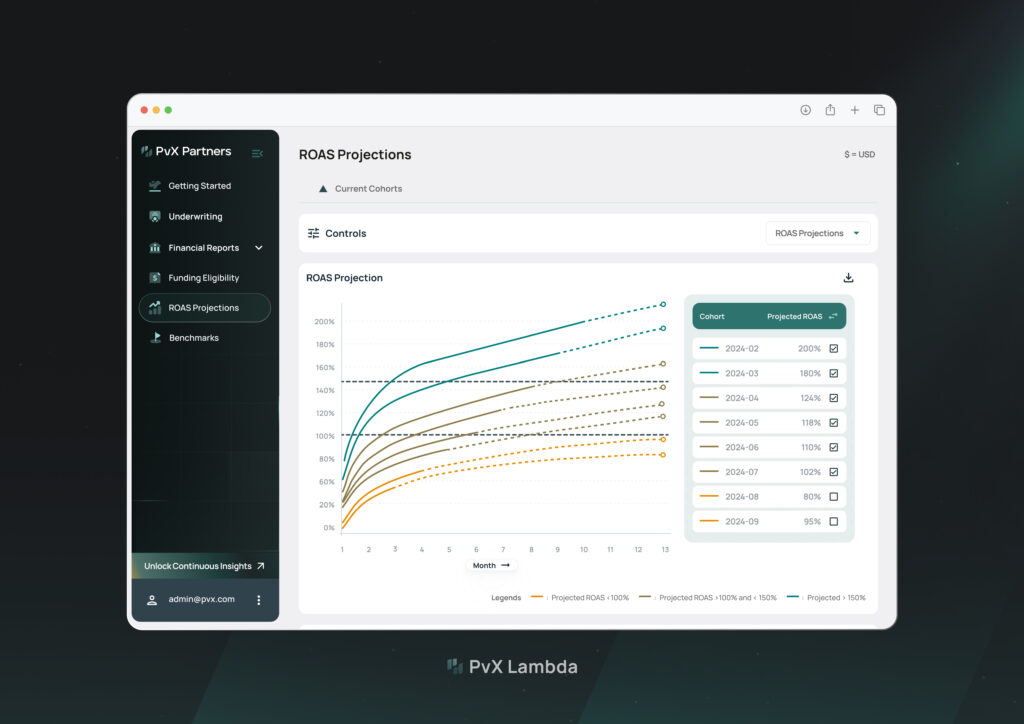
Alongside the commitment, PvX has raised a $4.7 million seed extension led by Z Venture Capital, the corporate venture capital of LY Corporation (LINE and Yahoo Japan), followed by Drive by DraftKings, with participation from existing investors General Catalyst, Play Ventures and Storyhouse Ventures.
The seed funding will go toward building out PvX’s software-as-a-service (SaaS) platform, including PvX Lambda, the firm’s proprietary machine-learning platform.
“Scaling consumer apps is exceptionally difficult,” said Daniel Song, investor at Z Venture Capital, in a statement. “Rising UA costs, crowded markets and restrictive financing make it a key challenge for founders. What stood out to us about PvX is that the team isn’t just providing financing, they’re reinventing how growth capital works.”
Song added, “Their unique blend of gaming and financial expertise has created a model that aligns capital to performance and equips founders with the tools to scale more effectively. We’re excited to back a team that is setting a new benchmark for how consumer businesses grow.”
The trick about doing proper user acquisition is identifying fast-growing games and apps and providing cash to them at the right time. They need to invest in advertising that can help grow their users and generate viral growth. If that growth materializes, then the company can reap revenue growth that justifies the cash infusion. And it’s able to back pay the money it uses quickly and with a capped percentage fee.
How it works
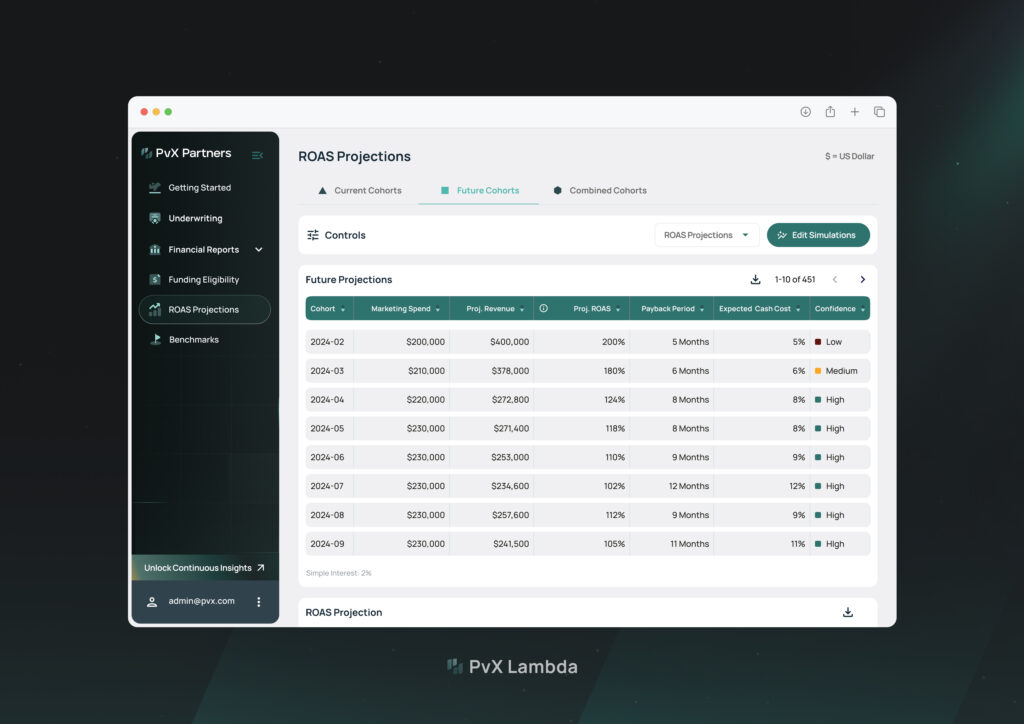
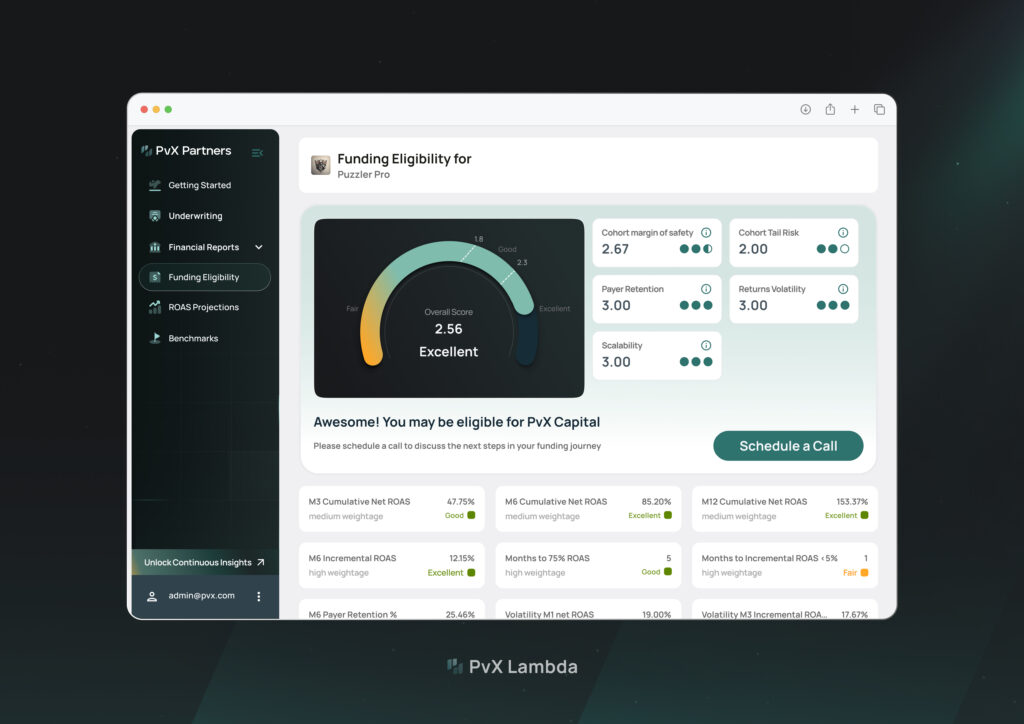
The PvX Lambda tool is an intelligence tool that gains access to a target company’s data and then discerns how the business is growing.
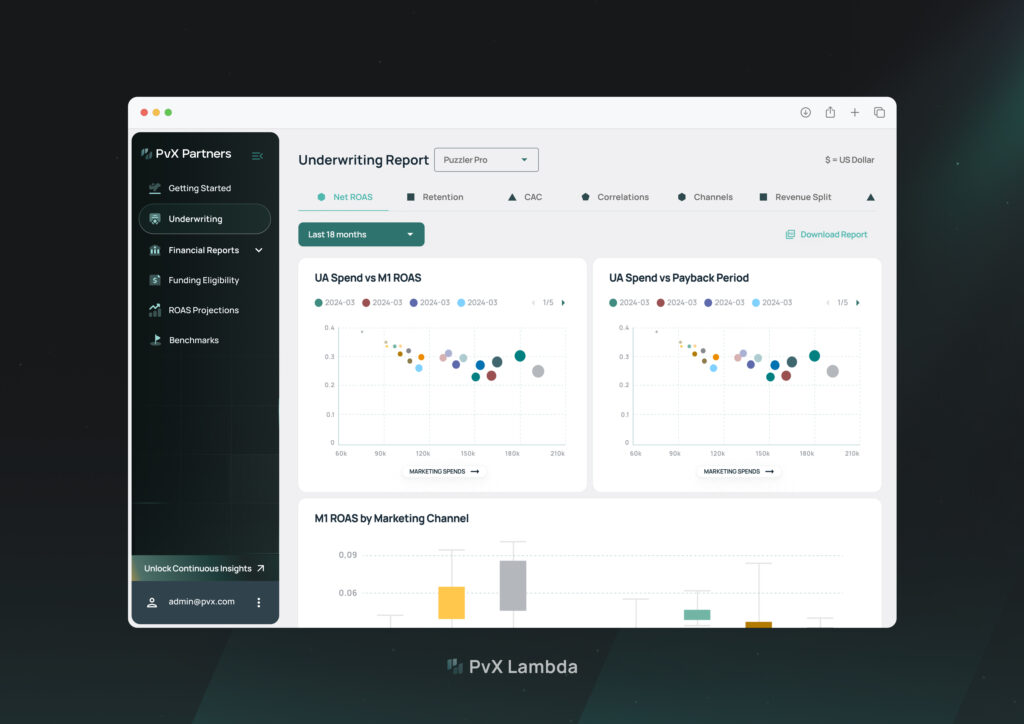
The company collects data from benchmarking, but it can provide information to a company about its relative ranking in its category and genre of gaming. The company can find out where it stands in terms of percentile of performance. One of the harder questions is when a company should start paying back the funds it uses.
Lambda analyzes industry trends, benchmarks performance and forecasts outcomes to support underwriting and capital allocation. These tools have become integral to helping companies like Fumb Games, Malpa Games and Zencat Games scale by tying historical marketing performance to financing decisions and data-driven insights on user acquisition. Lambda was central in evaluating the 20 companies eligible to access the capital commitment.
PvX’s committed UA financing facilities will support clients with non-dilutive and scalable funds for marketing as the model becomes more attractive to companies and investors.
The approach enables businesses to expand more efficiently through cohort financing, increasing marketing budgets as performance scales while sharing in downside risk if cohorts underperform. This fills a longstanding gap in financing options for the sector, which has historically relied on equity dilution or traditional debt structures.
“Surpassing $250 million in commitments alongside this new round underscores the demand we’re seeing for financing that is both flexible and tied directly to growth,” Wadakethalakal said.“ This extension round allows us to continue investing in the tools our clients use to optimize ROAS and scale more effectively. Cohort financing has quickly become a preferred option for founders, allowing them to avoid equity dilution and rigid debt structures, giving them the ability to grow on their own terms.”
“In my opinion, a lot of VCs are basically seeing that it’s hard to deliver venture outcomes with respect to just backing individual studios,” Wadakethalakal said. “And directly, there are some studios that can deliver exceptional outcomes, like Dream Games. The market is realigning to reflect that change in supply and demand.”
So far, PvX has funded 20 companies and seen “phenomenal momentum,” Wadakethalakal said. He said, “We’re closing anywhere from three to five deals every month. There’s a lot of demand, and we’ve built the brand reputation tools and technology that provides a lot more than just capital.”
The capital commitment functions as a revolving facility across 20 pre-approved companies in PvX’s portfolio, each able to draw from the allocated maximum facility size over the next 12 to 24 months. Unlike a traditional venture fund, PvX does not take an equity stake in exchange for financing. Instead, companies repay the capital along with a fixed, capped percentage of revenue generated from the deployed funds.
“We have a lot of credibility when we’re talking to founders. We’ve literally sat in their shoes. We know what it means to raise hundreds of millions of dollars of equity to fund UA,” he said. “Coupled with the way that we monitor our deals — the benchmarks that we provide, the financial forecasting tools we provide, all these other services — we make the PvX offering differentiated and really compelling.”
In contrast to some models in the past, Wadakethalakal said that PvX does not plan to take equity positions in the companies that it is backing. It wants to be more like Switzerland in terms of who it backs. Sometimes it will pass on backing a company and then come back when the moment is right.
“We have now built the models where we can identify the winners, or at least best in class, companies, earlier and earlier,” he said. “We really look for a lot more track record with respect to financing a business. Now, because we have so many data points in our database, we can” make a better educated bet on backing a company with limited data.
In the big picture, PvX is building the operating system for gaming and consumer app growth, combining user acquisition, product development, and capital allocation in one powerful platform.
The flagship service, PvX Capital, provides cohort financing that lets companies fund user acquisition to scale without the constraints of traditional lending.
Not making a quick buck
Wadakethalakal acknowledges that gaming isn’t an easy industry where you can make a quick buck.
“Gaming is the hardest business I’ve ever built because there’s no real IP protection,” said Wadakethalakal. “In mobile gaming, if you build something that works, it will still be copied in just a matter of months. There’s no distribution protection. Everyone knows the channels that are available. Building a mobile game is like discipline, execution and running faster than everybody else for really sustained periods of time,” Wadakethalakal said. “You can’t hide behind regulations. Companies will have these windows where they can scale spending. If they don’t leverage that window and invest aggressively during that point in six months, that advantage is gone because someone else has picked up that feature, and now it becomes a standard feature for everybody else.”
The amounts can vary by company and the amount available to invest will also be dependent on the partners. But the company doesn’t talk about an actual fund size, except to say its very large, Wadakethalakal said.
The company pays back the funds as the cohorts recoup, rather than via a single short-term payment.
“We’re funding companies as they scale, and at some point, companies will hit a point where they’re not able to scale the spending, and they will start to mature and then pay the money back,” Wadakethalakal said.
Wadakethalakal said that by the end of this year, the company will have helped somewhere between 30 and 35 companies grow.
“We’re deploying double-digit millions per month now already,” he said.
The Lambda tool drives a lot of organic signups and allows the flywheel to take off. The company targets growth companies that are spending less than $2 million a month in marketing.
He explained, “There are fewer gaming companies that are spending $5 million that can then go and spend $25 million. There are thousands of mobile game companies that are spending $100,000 or $250,000 and can spend $1.5 million or $2 million. That’s who we want to mainly serve.”
PvX is a small firm, with about 13 people, with perhaps twice that working as contractors. PvX itself has raised a small amount of money and yet it can tap a lot of money from General Catalyst.
“They’re an amazing balance sheet partner for us, because they understand the underlying risk of this. Our partner is very comfortable with cohort risk,” Wadakethalakal said. “We have an amazing partner in General Catalyst that we’ve built a partnerhip with. They’ve been like a founding partner for us.”
Machine learning has improved over time and Wadakethalakal thinks it will get better and help his company underwrite deals faster and faster, thanks to its growing body of intelligence from its data.
“We see daily information on these companies. It’s very rapidly surfacing to us changes that we should pay attention to,” he said.
“I wish we were, but we’re not in a place where I can look at a company at soft launch, and then tell you if this is going to be a winner. There’s so much volatility involved,” he said. “There are so many things we cannot control. But we are leveraging AI a lot with respect to deal monitoring. We’re leveraging a lot with respect to learning. We’re leveraging it with just making our processes a lot more efficient and also building an AI to feed intelligence back to the customer.”
He added, “These are the channels that seem to be outperforming for you. And going a bit deeper, these are some of the creatives that seem to be outperforming for you. And by the way, these are the creatives that are outperforming for your category or for an adjacent category where we see a lot of correlation.”