
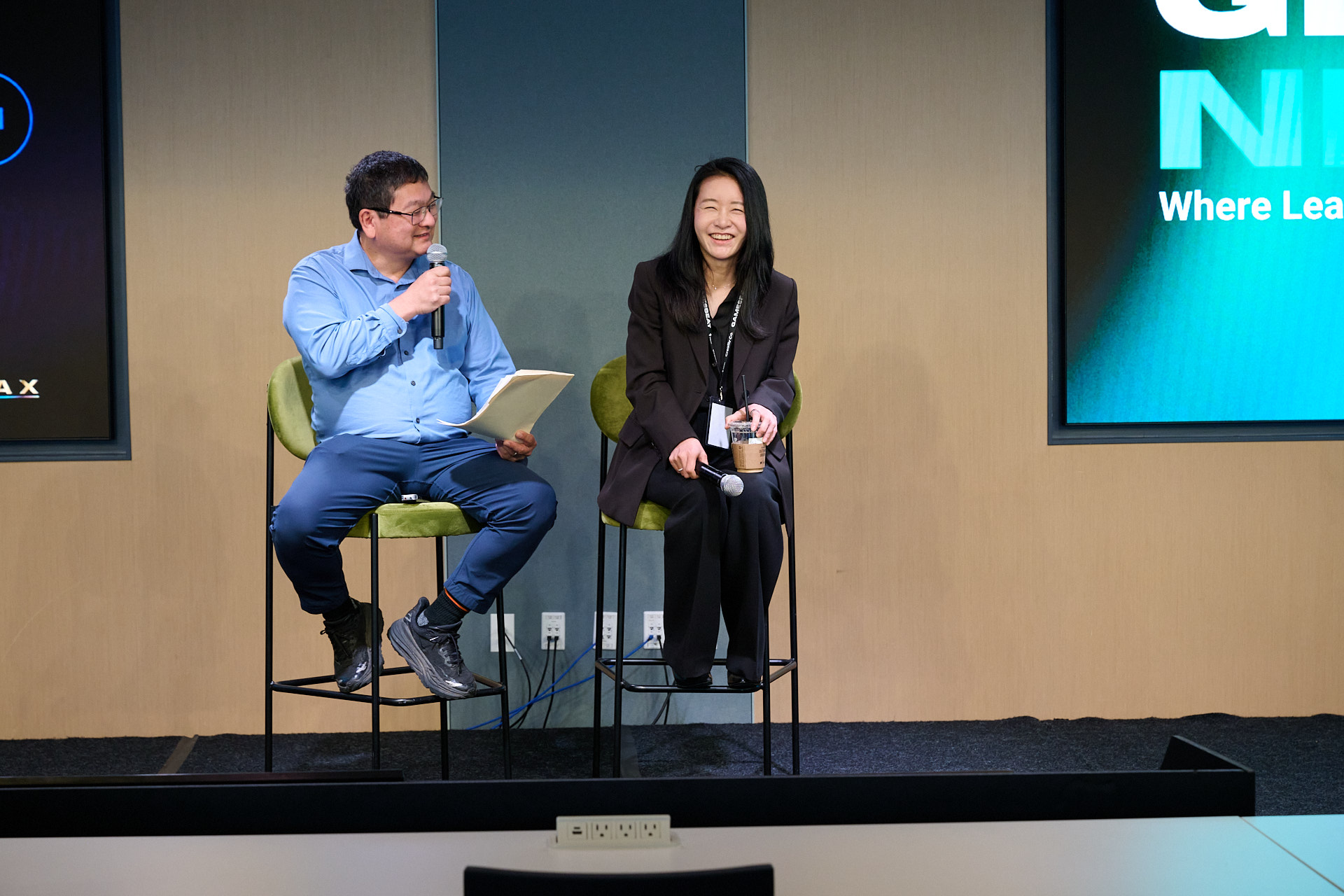
Songyee Yoon believes that gaming’s playbook will build the next wave of AI companies, even when there isn’t a dungeon in sight.
Yoon, a managing partner at Principal Venture Partners and a former president and chief strategy officer at NCSoft, spoke at GamesBeat Next 2026 in San Francisco in a fireside chat with GamesBeat’s editorial director Dean Takahashi. She said the mechanics that keep players coming back to games now apply to consumer AI apps, and that gaming’s biggest rivals for attention increasingly come from outside the industry.
Yoon, who has worked at the intersection of AI and games since the early 1990s, said her firm invests in early-stage, AI-native companies it believes can become “generational winners.”
The essence of gaming is “retention and engagement,” Yoon said, the pull that repeatedly brings people back to the same content. That doesn’t require levels, characters or heroes. She said the founders she wants to back understand those mechanics and apply them to consumer AI applications rather than building a conventional game.
Personalized story progression, character development and generated dungeons have existed for years, Yoon said, but only recently reached a quality that players enjoy. She pointed to portfolio company Operative Games, which uses AI for storytelling in which characters can show up in Zoom meetings and calendar invites. Other portfolio companies, still in stealth, are reworking games and social networks using the vocabulary of game design, she said.
Games now compete for user acquisition spending with prediction market apps, Yoon said. She cautioned that she isn’t calling prediction markets games, but said they share an element of engaging users. When Takahashi cited AI-made micro dramas on social platforms as another example, she said those also compete for the same audience.
“We’re in strange days now,” she said. “The industry’s challenge,” she added, “is to build content that is just as engaging and entertaining.”
AI-generated work tends to be more homogeneous than human work, with narrower variance, Yoon said. She cited a recent study, which she attributed to Georgia Tech, that found content by competent, experienced human authors who take a view different from the AI consensus is no less creative than AI-aligned content. That leaves room for contrarian creators, she said.
Asked about the competing narratives around AI, from “AI slop” to job losses to the rise of indies, Yoon said all of them are true. The outcome depends on whether teams understand a tool’s limits, she said, comparing today’s tools with the start of her career, when she wrote her own exporter in Java to move 3D Max models into OpenGL. Small studios can now produce far more, she said, but leaving the first output untouched can produce slop.
Whether players care that AI was involved depends on the game, she said. In a competitive shooter, players are less likely to care whether 10 or 200 people built it, while those who value artistry will care who authored it. She said that difference comes down to player motivation, not a divide between the U.S. and Asia.
Yoon attributed the concentration of AI activity in Silicon Valley to data, talent, capital and compute coming together in one place. She said San Francisco’s peer energy matters, citing more than 200 hackathons in a single weekend. She also noted that South Korea was the first country outside the U.S. to deploy TCP/IP, which she said helped lead to the MMORPG.
The technology itself is still early, Yoon said. Some investors call it the first inning of a baseball game, she said, while others say the game hasn’t started. Either way, she said, there is a lot left to disrupt.