
Power Integrations has teamed with Nvidia to make low-power gallium nitride chips to power data center AI infrastructure.
The San Jose, California-based chip design company has long made power-efficient chips and it moved into gallium nitride materials as it shifted into high-voltage integrated circuits for energy-efficient power conversion.
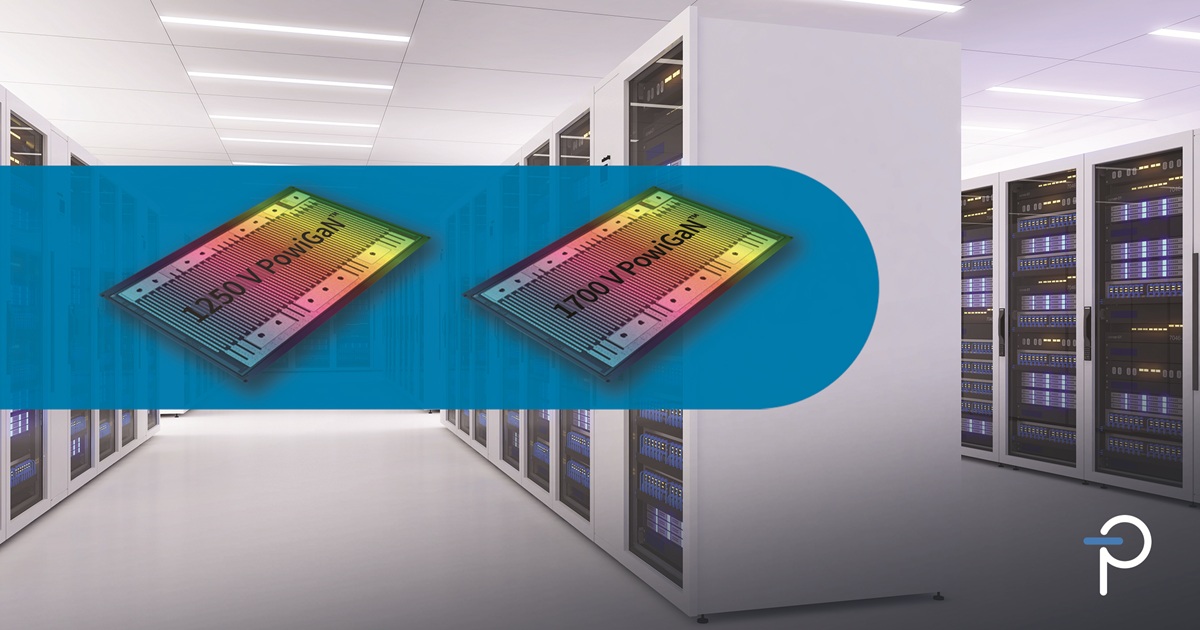
The company’s PowiGaN gallium-nitride technology for next-generation AI data centers can operate at 1250 volts and will head toward 1700 volts over time. The company made the announcement at the 2025 OCP Global Summit in San Jose, California.
Chris Lee, director of product marketing at Power Integrations, said in an interview with GamesBeat that the PowiGaN technology for 800 VDC power architectures is the subject of a new white paper from Power Integrations, published at the 2025 OCP Global Summit in San Jose, where Nvidia provided an update on the 800 VDC architecture.
Lee said that Power Integrations is becoming a data center ecosystem partner with Nvidia because of its unique position for its high-voltage GaN technology that can address AI data center architecture’s needs for power density.
Power Integrations’ 1250-volt PowiGaN HEMTs can deliver more than 11 times more voltage than a standard wall outlet, and the chips are already in production for automotive customers.
Roland Saint Pierre, vice president of product development, said in an interview with GamesBeat, “We’re ecstatic to talk about our GaN developments and how we will participate in AI data center products.”
Power Integrations is collaborating with Nvidia to accelerate the transition to 800 VDC
power and megawatt-scale racks.
The new white paper details the performance advantages of Power Integrations’ industry-
first 1250 V PowiGaN HEMTs, illustrating their field-proven reliability and their ability to
meet the power-density and efficiency requirements (>98%) of the 800 VDC architecture.
Further, the paper demonstrates that a single 1250 V PowiGaN switch delivers greater
power density and efficiency compared to stacked 650 V GaN FETs and competing 1200 V
SiC devices.
The white paper also highlights Power Integrations’ InnoMux2-EP ICs as a unique solution
for auxiliary power supplies in 800 VDC data centers. The InnoMux-2 device’s integrated
1700 V PowiGaN switch supports 1000 VDC input voltage, while its SR ZVS operation
provides greater than 90.3 percent of 12 V system efficiency in a liquid-cooled, fan-less 800 VDC architecture.
“With rising AI power demands, moving to an 800 VDC input simplifies rack design, makes
more efficient use of space and reduces copper usage,” said Saint-Pierre, vice
president of product development at Power Integrations. “With rising rack power demands, we see 1250 V and 1700 V PowiGaN devices as ideal choices for main and auxiliary power supplies, delivering the efficiency, reliability and power density required in 800 VDC data centers.”
Origins
Power Integrations is the only supplier of high-voltage 1250 V and 1700 V GaN switches in
volume production, Lee said.
“That means so we have not reached the end yet,” Lee said. “We are still very confident our technology can actually bring us far beyond 1700 volts.”
The company introduced its first GaN chips in 2018 and currently has more than 175 million GaN switches in use in end products ranging from fast chargers to data centers to EVs. Those chips debuted in consumer markets, but now they’re heading into the data center in a very big way.
Rival technologies use two 650-volt silicon carbide chip solutions that aren’t as efficient or cost effective or simple as the single 1250-volt GaN product, Lee said. There is one expected 1200-volt silicon carbide produce expected, but it is not necessarily suitable for a high-frequency environment, Lee said.
“If you want to really increase the power density, you want to increase your switching frequency to minimize the magnetic size. With that constraint, if you cannot do the high-frequency operation, then that doesn’t really move the needle to the next step to bring the total solution to a smaller size,” Lee said.
In short, using GaN instead of silicon carbide delivers proven reliability, Lee said. He said that Power Integrations launched its GaN products in 2018 and they’re in high-volume production. Another rival, Efficient Power Conversion, pioneered the GaN low-power chip market in 2009. Led by Alex Lidow, EPC is still around competing in the space.
Back in 2018, Power Integrations moved forward with 750-volt technology and again in 2022 with 900-volt tech. In 2023, it introduced its first 1250-volt tech, and it is planning on 1700-volt tech as well. Lee said no one else is in production on 1250 volts.
The confidence in the reliability of the technology matters a lot because running a system at a voltage that is too high can result in a catastrophic failure, dubbed an “avalanche,” Saint Pierre said. A single spike upward in the power usage can cause a breakdown, and GaN turns out to be a lot more reliable on this than silicon carbide, Saint Pierre said.
When it works properly, 1250-volt GaN chips can deliver far better power density for the servers that are packed together in a data center, Saint Pierre said. The size of the power conversion system can take a third of the area that it usually does. And this means that the AI processing won’t have as many speed limits forced upon it, thanks to the improved ability of GaN chips to handle the power running through the system.
This allows Nvidia to more fully utilize the space in a data center and get the optimal and best power density possible, Saint Pierre said.
“Power is only going to go higher and higher, as these data centers will need nuclear power plants. So this is well-positioned to address the power density concerns of the future,” Saint Pierre said.