
This month marks 10 years of AR Gaming Pioneer, Pokémon Go, and its anniversary year is shaping up to be one of the biggest in the game’s history.
All three of this year’s in-person Go Fest events — held in Tokyo, Chicago, and Copenhagen — sold out for the first time ever, with Chicago alone setting a North American attendance record. The anniversary celebration continues this weekend with Pokémon Go Fest 2026: Global, a live event running July 11-12, which will be free to all players for the first time and will introduce Mega Mewtwo and the mythical Zeraora to the game.
Michael Steranka, vice president of product for Pokémon Go at Scopely, spoke with GamesBeat about the milestone, the record-breaking turnout at this year’s live events, and how the game has evolved since Niantic launched it in July 2016.
The game has now been downloaded and played by over 800 million people worldwide, a figure Steranka says still surprises him a decade in.
Here’s some more exclusive stats provided to GamesBeat: In total, more than three million players took part across Tokyo, Chicago and Copenhagen. For comparison, the cumulative attendance across all 2022 FIFA World Cup games was 3.4 million.
“We didn’t expect just how much of a pop culture phenomenon it would be,” he said. While Pokémon’s brand recognition gave the game a head start, Steranka credits its longevity to something less obvious than the franchise’s popularity: the fact that Pokémon Go was built around a mission beyond growth metrics.
“A lot of the decisions that we’ve made over the past 10 years might actually seem a little bit counterintuitive for people that are looking at things as a pure business,” Steranka said. Alongside standard product metrics, he said the team has long tracked things like how many kilometers players walk on average, how many real-world social interactions the game fosters and how many new places people discover because of it.
That focus on real-world connection is personal for Steranka, who joined the Pokémon Go team shortly after its 2016 launch. He recalled a vacation to Hong Kong that same year with his then-girlfriend, now wife, spent chasing down Farfetch’d, a Pokémon exclusive to the Asia region at the time.
“We ended up spending eight hours walking around in the summer humid heat of Hong Kong looking for this region exclusive Pokémon,” he said. “I swear the smile on my wife’s face in that moment is more joyous than our wedding day.” He said it’s the kind of memory, tied to a place rather than a screen, that the team has tried to build the entire game around ever since.
That philosophy extends to how the team thinks about its audience today. Steranka said Pokémon Go continues to add millions of new players every month even a decade in, but he pushed back on the idea that its player base is defined only by day-one loyalists.
Scopely, which is owned by Savvy Games Group, acquired Niantic for $3.5 billion in May 2025. Niantic Spatial remains a separate company.
“I feel like we can confidently say that Pokémon Go is one of, if not the only, truly multi-generational game out there,” he said, describing family groups of grandparents, parents and kids who play together. Steranka, who has a 3-and-a-half-year-old and a 6-month-old at home, said his mother even plays alongside them.
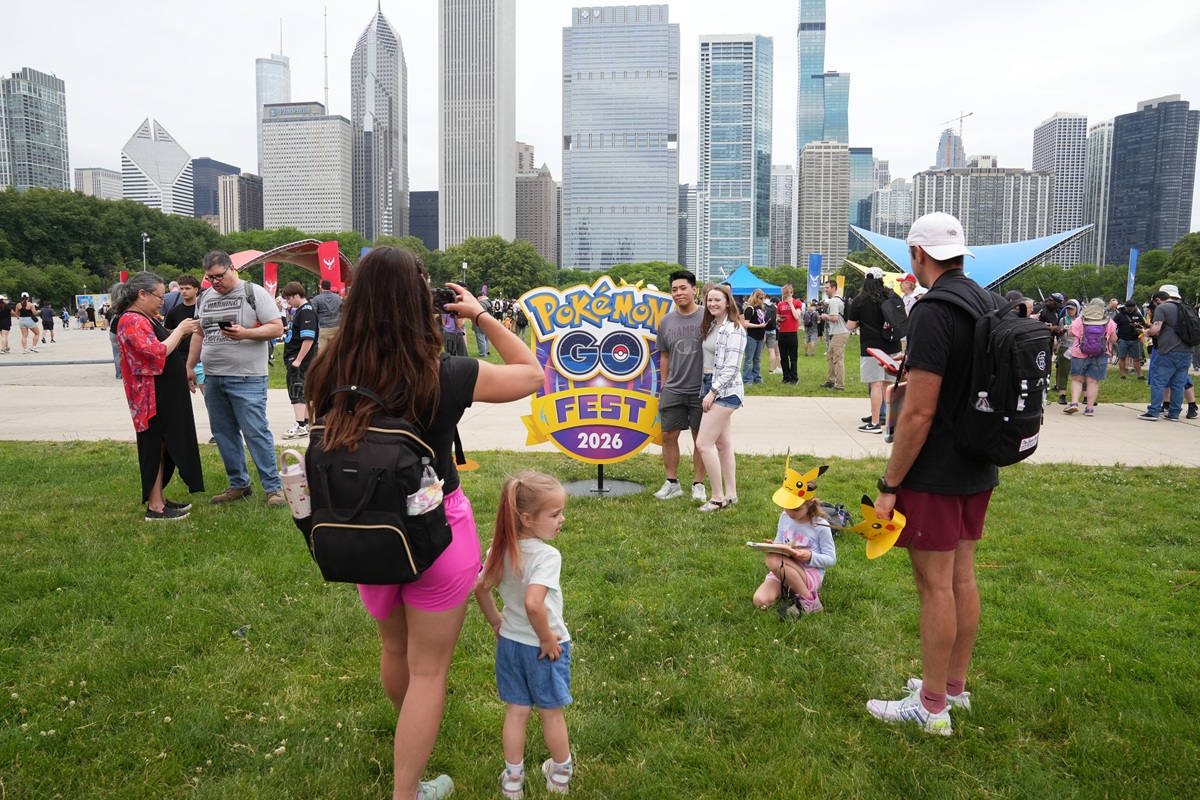
This year’s Pokémon Go Fest lineup underscored that growth. All three in-person events — Tokyo, Chicago and Copenhagen — sold out for the first time in the event series’ history. Chicago, host to the very first GO Fest nine years ago, drew over 103,000 ticketed attendees and set a new North American attendance record, with more than 717,000 unique players participating across the city over the three-day event. Tokyo’s numbers were larger still: more than 115,000 tickets sold for the in-person experience, with 1.7 million players logging in across the city during the event window.
“There’s just so much excitement in our community around Pokémon Go right now,” Steranka said, pointing to a mix of well-received recent updates and what he called the “nostalgic, celebratory vibe” of the anniversary year as key drivers behind the sellouts.
“This 10-year anniversary is such a monumental milestone for us,” Steranka said. “What better way to celebrate that than bring anybody who’s interested into the fold, to experience Pokémon Go at its best.” He was careful to note that ‘at its best’ means more than access to powerful in-game Pokémon: “I mean a moment where tens of millions of people are all going outside to play the game together… fostering those in-person communities and relationships.”
The free global event will also mark the debut of Mega Mewtwo and the mythical Zeraora. Steranka said the choice of Mewtwo in particular had been settled for years. “We’ve known for years that Mega Mewtwo was going to be one of the hero Pokémon for Pokémon Go Fest this year,” he said, calling it “one of the most iconic legendary Pokémon in the entire franchise” and noting that both its Mega X and Y forms rank among the most powerful ever released.
The anniversary also arrives a little over a year after Scopely completed its acquisition of Niantic’s games division, bringing Pokémon Go, Pikmin Bloom and Monster Hunter Now under its ownership. Steranka said he approached the deal warily at first.
“I candidly was very nervous about this acquisition,” he said. “But I’ve been actually so thrilled with how that acquisition has played out over the past year.” He said day-to-day development has largely stayed the same, with the Pokémon Go team retaining control over its own product roadmap and priorities, while gaining access to data practices and feature learnings from other titles in Scopely’s portfolio. “For the first time ever, Pokémon Go now resides in an organization that is 100% dedicated to the craft of making great video games,” he said.
Looking beyond this monumental anniversary, Steranka outlined three priorities he said will guide the next decade of development: deepening community features, including a possible overhaul of the game’s gym system; designing more explicitly around what he called “core memories,” the kind of singular, often serendipitous moments players associate with major events or rare catches; and leaning further into the game’s multi-generational appeal.
“Pokémon Go will always start with community,” Steranka explained, “We want to continue to lean into that even further going forward.”