
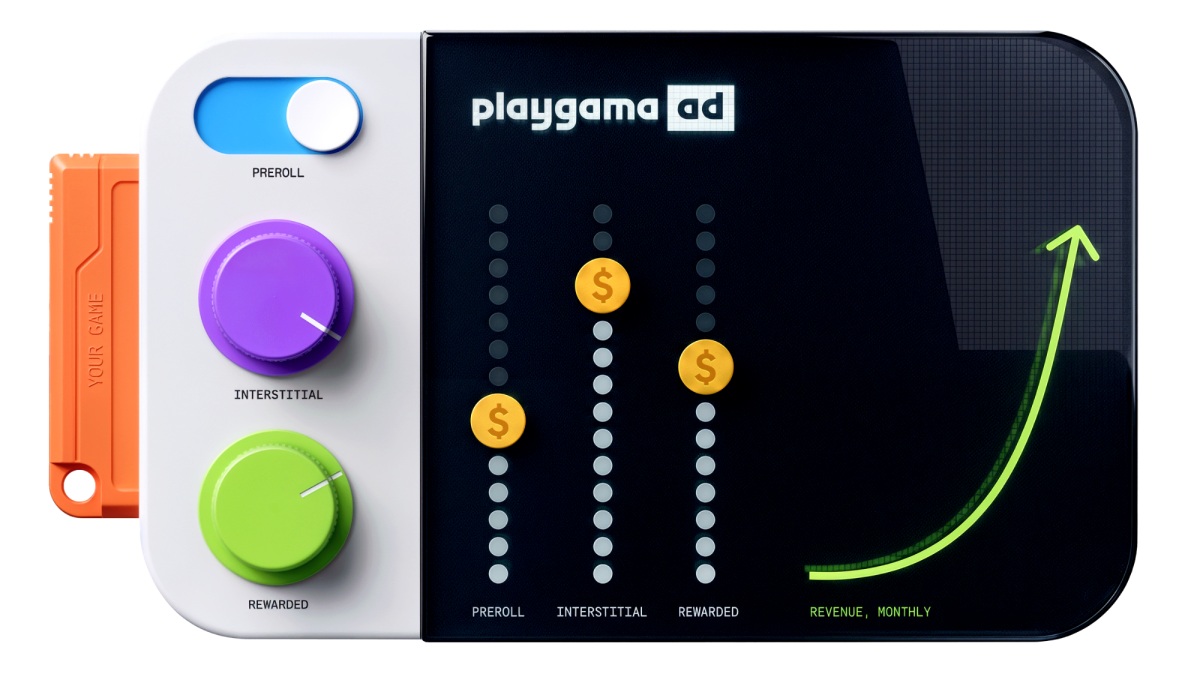
Playgama, a web gaming infrastructure startup, announced this week the launch of Playgama Ad, a specialized advertising solution for web games.
The platform is engineered to maximize revenue while maintaining a precise equilibrium between ad load, session length and player UX.
It was successfully tested by industry players like Pocket Heaven Games and Play-Games.com, and is now moving into open beta phase, allowing to onboard more html5 game developers, publishers and portals looking to grow their monetization said Dmitry Kachmar, CEO of Playgama, in an interview with GamesBeat.
Recognized for its “master-key” Playgama Bridge SDK and a proprietary platform-as-a-service (PaaS) for web game distribution, with this launch, Playgama expands its product stack and dives deeper into the AdTech space, leveraging internal expertise in high-frequency testing and yield optimization across diverse geographies, the company said.
Playgama Ad provides web game developers and gaming portal operators with a high-yield, scalable monetization solution beyond traditional ad networks. It is designed as a complementary monetization layer that can be used as a primary solution or a fallback, without locking partners into exclusive agreements.
“Developers have a huge problem right now in the market. Web gaming is still really fragmented. It’s been like that for many years. Everybody has their own solution. We are trying to accumulate them and fix the issues that are happening with these types of ads,” Kachmar said. “It’s like the wild west in the market, and we are trying to fix that.”
Web gaming is growing

The global browser game market was $15.98 billion in 2025 and it is expected to grow to $38.34 billion by 2034, according to Proficient Market Insights.
Many pundits expected HTML5 gaming to explode a decade ago. But now it’s coming true with the combination of WebGPU technology, which delivers near-native GPU performance for browser-only games with no downloads. It is up to 1,000% faster at rendering than WebGL in complex 3D scenes. It gives developers low-level control that WebGL did not offer.
“I’m not thinking but only about the web developer. Rather, I’m talking more about the platform-agnostic games,” Kachmar said. “Steam has grown rapidly as the desktop has grown, and the desktop is still focused on the browser. Unity is helping with integration. And iOS is supporting WebGPU in a bigger way. There are many things happening now.”
WebGPU removes the CPU bottlenecks and shader translation overhead that held WebGL back. So developers can deliver high-quality 3D games, real-time physics, large-scale multiplayer browser games and advanced visualization tools.
Now Playgama Ad is built to web gaming monetization, not generic display ads. It optimizes ad load vs session length, which is critical to keep players in the game. Developers are reporting considerable uplift thanks to hybrid ad stacks and smart fallback logic.
And this, in turn, makes web games more financially sustainable for small studios and larger ones. Playgama works with Anzu to bring real-world in-game ads to browser games. And Playgama’s Bridge SDK connects developers to major portals.
Key features of Playgama Ad

- Unified format support: comprehensive coverage of both in-game (pre-roll, mid-roll, rewarded video) and portal-based formats (interstitials and various display banner sizes).
- AI-driven ad frequency logic designed to balance monetization and engagement.
- For gaming portals and game developers with more than one game: fallback cross-promotion to capture incremental value from unsold inventory.
- A fast rollout enabled by a lightweight SDK integration, without the need for manual ad setup or ongoing optimization on the partner side.
- Granular customization: partners can maintain brand integrity with customizable ad loaders, logos, and flexible controls over ad categories to prevent churn.
- Dedicated analytics dashboard that delivers granular performance metrics and timely visibility into key KPIs, without reliance on manual reports.
The first testing began in the second quarter of 2025. Kachmar is trying to offload developers so they don’t have to develop ad monetization solutions on their own.
“It’s easier for them just to integrate one solution and start getting revenue as fast as they can,” Kachmar said.
Kachmar believes the whole mobile game industry is still struggling. Revenues disappeared in part because of Apple’s focus on privacy over targeted ads — something that happened a few years ago.
“But we’re in a post-App Store era now, with many direct-to-consumer app stores going up,” he said. “That means that for the whole industry, there are new ways to distribute games, new ways to reach the audience, with direct-to-consumer approach. And I believe this year will be a huge shift.”
Developers are starting to adopt new waves of AI tools for ad tech, and many are developing the tools on their own.
“We will try to help developers optimize their games,” he said. “They are speeding up their ability to get to the market, and we could see a huge number of games this year. By the end of this year, I believe we will have a completely different landscape. With WebGL and WebGPU, where you can write once and it runs everywhere, we will see platform agnosticism.”
He added, “Disrupting the app stores is kind of like a fairy tale. But right now, I’m proud that my previous fairy tales are coming to life.”
The company has 14 people, with the headquarters in Dubai and the team spread out across the Middle East, Cyprus and Europe. Dubai has gotten more serious about supporting game companies and attracting game jobs to the emirate.
Naghi Stefan, cofounder of Play-Games.com, said in a statement, “Playgama Ad integrated smoothly with our setup, and the collaboration with their technical team allowed for custom modifications that aligned perfectly with our portal. The lack of exclusivity is a major benefit, this flexibility allows us to test what works best for our revenue without restrictions, while their transparent, easy-to-read dashboard provides the granular daily insights we need to monitor performance effectively.”
Valeria Svistunova, head of monetization at Playgama, said in a statement, “We’ve spent the last year stress-testing our advertising logic across our own partner network to find the balance between monetization and player retention. Now we are opening up a solution that handles the heavy lifting of ad tech—frequency capping, pricing optimization and multi-format delivery—so developers and portals can focus on building great player experiences while ensuring every impression is fully leveraged.”
Kachmar said, “The web gaming renaissance is being held back by a high level of fragmentation and a lack of sophisticated, gaming-first ad tech. We are launching Playgama Ad to empower the entire ecosystem: providing ad networks with higher-quality demand while ensuring developers and platforms maximize their earnings.
Developers, game studios, gaming portals and potential partners interested in integrating Playgama Ad can apply for the program via playgama.com/adv. More than 10 companies are using it already in testing.
Playgama connects developers, platforms, advertisers and players through web games. The company develops a stack of tools and services used by more than 3,500 developers, including its own distribution and monetization platform, open source SDK reaching 450 million players, QA tool, advertising solutions and more.
Founded in 2023, Playgama raised $3 million in venture funding in 2024.