

Pixel Doors, a new independent publishing label founded by industry veterans Jacek Pudlik and Nic van ‘t Schip (Former World of Warships, Dungeons & Dragons, Warhammer, Star Trek), today announced its official launch.
In an industry currently defined by risk aversion and mass layoffs, Amsterdam-based Pixel Doors is introducing a new “Ethical Publishing” model designed to stabilize the indie ecosystem. It’s a turnabout where publishers typically “recoup first,” and developers have to wait until the publishers’ costs are covered first.
Unlike traditional agreements where publishers prioritize recouping their investment before a developer sees a royalty check, Pixel Doors has flipped the financial script. The publisher operates on a Developer First structure, ensuring that the studio secures its financial footing and stability before the publisher begins to take a share of the success.
The Philosophy: Alignment Over Extraction

“We are seeing an industry that increasingly values the predictability of a spreadsheet over the opportunity of creativity,” said Nic van ‘t Schip, cofounder of Pixel Doors. “The final straw for us was seeing too many brilliant games get rejected or homogenized because they didn’t fit a template. We built Pixel Doors to be the antidote to that ‘pencil pusher’ culture. We are opening doorways for the breakthroughs, not just the blockbusters.”
Jacek Pudlik, cofounder of Pixel Doors, said in a statement, “Our model is simple: we place the financial health of the studio above our own short-term ROI. Most publishers act like banks that need to be repaid immediately. We act like partners who only succeed when the developer is already winning. If the developer doesn’t survive, the industry doesn’t survive.”
There is a cost to getting money early. About 60% of the money goes to developers, while Pixel Doors keeps 40%. van ‘t Schip said he thinks that’s fair.
“We do not take IP. It stays with the developer. We do not need to take equity in the studio. We’re open to it,” he said.
But the aim is to hit a 60-40 rev share, with 40% to Pixel Doors.

Developers could be paid in 14 days, a normal time for payments due. He said he is confident the majority of the studios that his team talks to will find that 60% is larger than the amount of money they would make if they self-published.
“The reality of that is, and we’re very transparent about that with our devs as well, is that there’s a whole period where it’s not a very good deal for us, right? If the game doesn’t make any money, or it makes 130,000 on Steam, we don’t make anything,” van ‘t Schip said. ” It’s not a very good deal for us.”
“Then there is a period where it’s better and better and better deal for us,” van ‘t Schip said. “Then there’s a moment where it’s a great deal for us, and then at that point where it’s between a good and a great deal for us, our time would start ramping up on this project. Because it’s apparently such a great game that it’s that it’s breaking that 100,000 and it’s doing much better than that.”
And he said, “So it’s more cost for us, like on our customer support team for tickets, on our technical team for updates, we’re now going to more platforms. So there is periods where, yeah, that 60-40 is in the advantage of the dev and there’s per periods we might fall exactly where the 40% feels like it’s a bit too much.”
Origins

van ‘t Schip has been in gaming for 20 years and he spent the last five at a mid-size publisher where he and his cofounder were both on the game evaluation team.
“We saw thousands of pitches in the years. They said thousands of ‘no’s, and the majority of those, we fully stood behind them. But there was a big chunk of them.”
They remembered about 80 of those that they felt bad about. They thought there were opportunities left on the table. These projects would have been profitable, they thought.
“We should be able to support them,” van ‘t Schip said. “We often asked the question. What should a publisher look like? What’s the business model of a publisher where they can say yes to these teams and many other indie teams around that are just not fitting within the very tight, defined spaces that publishers are signing right now? How can we make sure that there’s more room for indie publishers with a slightly riskier profile?”
Those questions led them to form Pixel Doors. They’re going to be there for the developers that don’t have money.
“We are a great alternative,” van ‘t Schip said. “For us to be sustainable, we don’t offer the traditional path of funding development. In the beginning, we thought this would be a big roadblock. But the industry has been changing.”
He added, “Lots of developers have already discovered that they’re not getting funding anymore. They’ve been looking at new ways of finding funding, doing work for hire, not working full time, finding their own funding through VC or friends and family funding. And they are now in the market for support on the publishing side.”
The Pixel Doors team decided that they would not make money until the game itself makes a significant amount.
If you look at the odds on Steam in 2024, about one in 38 games made $250,000. If you cut out the games that were weak, you could maybe have a one in 24 chance.
“So the odds are stacked against success, and current publishers are only looking for success,” van ‘t Schip said. “It needs to make a quarter million or more for the game to be interesting to them. What if we move that line together and the developer can keep working. The lights stay on. They can get the reviews and turn out small updates for the game.”
One of the problems is that if a free-to-play game takes off, then the developer’s costs soar because they have to spend money on infrastructure costs because the game has so many users. Games can have high costs, but if players don’t spend in the game, the revenues can be low. The same could happen with games that use a lot of AI tokens.
van ‘t Schip said that the company isn’t focused on free-to-play games at the moment. The company is focused on where it has relationships and it’s not so much in free-to-play games. The team has just four people and it wants to stay lean to keep its costs low.
Helping devs out
If a game does well, the team can set up the developer for success and to buffer costs. van ‘t Schip said the focus is on maximizing the return-on-investment by using data. Pixel Doors doesn’t want to fund copycats, and it doesn’t take equity. It contract is usually about eight pages — the shortest such contract van ‘t Schip has ever seen.
van ‘t Schip said he has a lot of experience with user acquisition. But he’s “letting go” of that network because the majority of games he’s looking at won’t work with user acquisition spending.
“It’s buying users that will never return,” he said. “We’re spending our money on our marketing budget. It’s much more grassroots focused. It’s much more than building the community. It’s de-stressing the developer from how to run their social media channels, how to operate their Discord server. “
But if a game comes along that requires user acquisition, then he would “have to get back on the bike,” van ‘t Schip said.
The team is starting now with solo devs or small teams.
“We have three people, and we will not touch the first 100,000 that the game makes on Steam or other platforms,” van ‘t Schip said. “We’re putting our money, I guess, or our lack of money, where our mouth is.”
In so many developer-publisher deals, the publisher recoups their investment first and the developer only sees a small amount of money in the first month.
But that’s the time when it’s the hardest. The Steam reviews come through and the honest feedback comes in from the community. The team wants to respond to feedback and fix flaws that fans discovery, but they can’t do it without more money. It’s a key time where the devs react to fans and fix the game.
“We want to make sure that by delaying gratification for us, delaying the payout for us and the maybe even moving it to a point where we don’t make any money,” van ‘t Schip said. “If the game makes exactly 130,000, Steam takes 30%. We get 100,000 and we ship it on to the developer, that’s a failure.”
Funded games
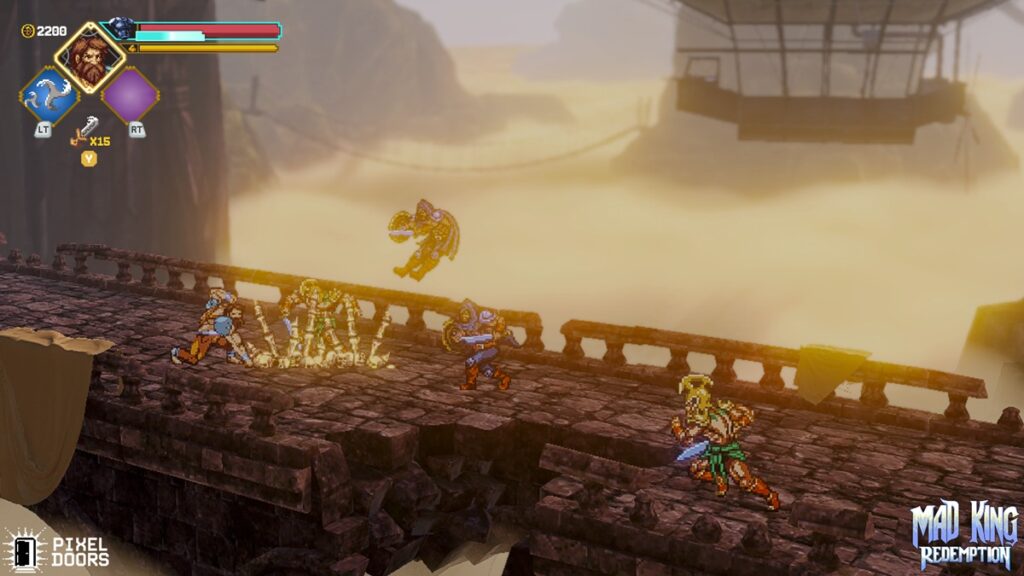
The Launch Title: Mad King Redemption Pixel Doors is launching with a title that perfectly demonstrates their strategy of backing bold, uncompromising creative visions:
Mad King Redemption (Secret Mission): Developed by Secret Mission, Mad King Redemption is a Dark Fantasy Roguelite Beat’em Up that fuses the crunch of 90s arcade combat with modern narrative depth and progression. It is a love letter to the 16-bit era, built by a three person team that refuses to compromise on difficulty or atmosphere.
The launch window for early access is the first quarter of 2026.
“The vast experience Pixel Doors brings to our daily rhythm is a game-changer,” said Nicolò Girotti, cofounder of Secret Mission, in a statement. “They give us the peace of mind that the business side is being handled by people who truly know their craft. That trust allows us to stop worrying about the noise and focus entirely on making the best possible game.”
Pixel Doors will be at GDC 2026 to meet folks. The Pixel Doors team will be attending GDC in San Francisco this March. They are actively seeking to meet with independent developers who are tired of traditional publishing politics and have a clear, unique vision for their game.
Pixel Doors is an independent game publisher founded by game-industry veterans on the belief that publishing can be smarter, kinder, and more effective.
Backed by 40+ years of combined experience in global publishing, marketing, and licensing, Pixel Doors offers a transparent partnership model where developers retain their IP, their equity, and their creative control. Great games deserve the right doorway. Let’s build it together.
Developers, media or anyone else with a question can easily reach them here.