
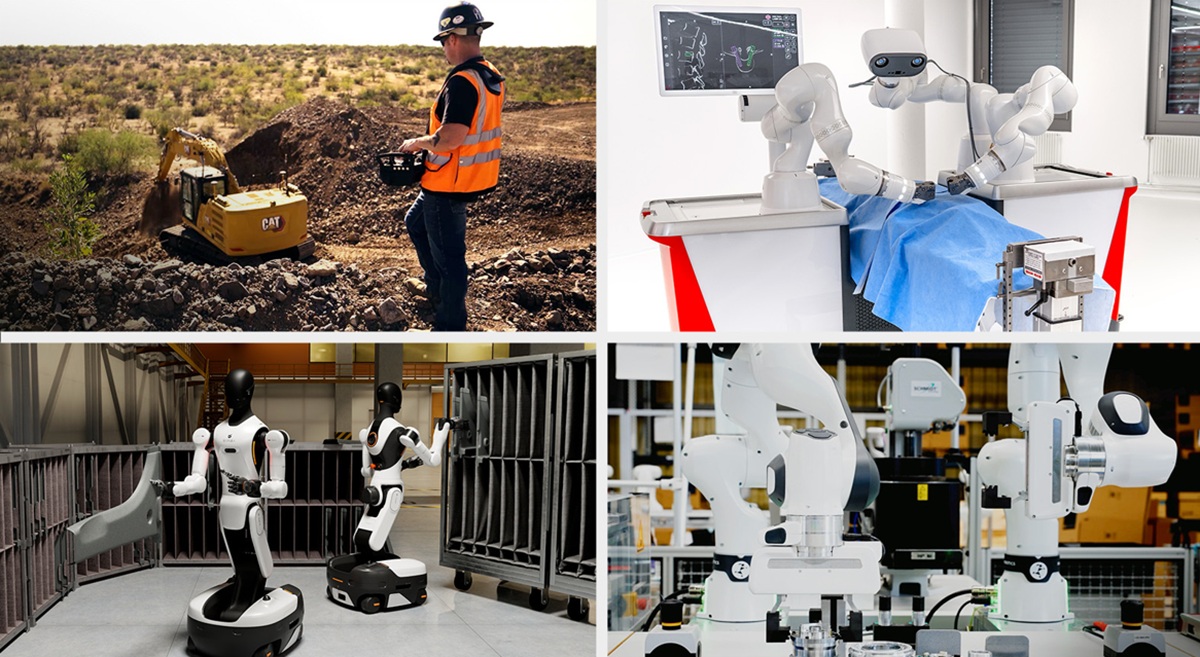
Nvidia announced at CES 2026 new open models, frameworks and AI infrastructure for physical AI, and unveiled robots from global partners in many industries.
The new Nvidia technologies speed workflows across the entire robot development
lifecycle to accelerate the next wave of robotics, including building generalist-specialists
robots that can quickly learn many tasks.
Global robotics companies Boston Dynamics, Caterpillar, Franka Robotics, Humanoid,
LG Electronics and Neura Robotics are using the Nvidia robotics stack to debut new
AI-driven robots. It’s an impressive array of partners, and it’s what Jensen Huang, CEO of Nvidia, promised a year ago at CES 2025 as he said that virtual testing would enable the acceleration of the deployment of reliable physical world robots with advanced AI.
“The ChatGPT moment for robotics is here. Breakthroughs in physical AI — models that
understand the real world, reason and plan actions — are unlocking entirely new applications,” said Huang, in a statement. “Nvidia’s full stack of Jetson robotics processors, CUDA, Omniverse and open physical AI models empowers our global ecosystem of partners to transform industries with AI-driven robotics.”
New Open Models Advance Robot Learning and Reasoning
Turning today’s costly, single-task and hard-to-program machines into reasoning “specialist generalist” robots requires enormous capital and expertise to build foundation
models.
Nvidia is building open models that allow developers to bypass resource-intensive pretraining and focus on creating the next generation of AI robots and autonomous
machines. These new models, all available on Hugging Face, include:
● Nvidia Cosmos Transfer 2.5 and Nvidia Cosmos Predict 2.5 — open, fully customizable world models that enable physically based synthetic data generation and robot policy evaluation in simulation for physical AI.
● Nvidia Cosmos Reason 2, an open reasoning vision language model (VLM) that
enables intelligent machines to see, understand and act in the physical world like
humans.
● Nvidia Isaac GR00T N1.6, an open reasoning vision language action (VLA) model,
purpose-built for humanoid robots, that unlocks full body control and uses Nvidia
Cosmos Reason for better reasoning and contextual understanding.
Franka Robotics, Neura Robotics and Humanoid are using GR00T-enabled workflows to
simulate, train and validate new behaviors for robots. Salesforce is using Agentforce,
Cosmos Reason and the Nvidia Blueprint for video search and summarization to analyze
video footage captured by its robots and reduce incident resolution times by two times.
LEM Surgical is using Nvidia Isaac for Healthcare and Cosmos Transfer to train the
autonomous arms of its Dynamis surgical robot, powered by Nvidia Jetson AGX Thor and Holoscan.
New Open-Source Simulation and Compute Frameworks for Robotics Development
Scalable simulation is essential for training and evaluating robots, but current workflows
remain fragmented and difficult to manage. Benchmarking is often manual and hard to
scale, while end-to-end pipelines require complex orchestration across disparate compute
resources.
Nvidia today released new open-source frameworks on GitHub that simplify these complex pipelines and accelerate the transition from research to real-world use cases.
Nvidia Isaac Lab-Arena is an open-source framework, available on GitHub, that provides a
collaborative system for large-scale robot policy evaluation and benchmarking in simulation, with the evaluation and task layers designed in close collaboration with
Lightwheel. Isaac Lab-Arena connects to industry-leading benchmarks like Libero and
Robocasa, standardizing testing and ensuring robot skills are robust and reliable before
deployment to physical hardware.
Nvidia Osmo is a cloud-native orchestration framework that unifies robotic development
into a single, easy-to-use command center. Osmo lets developers define and run workflows such as synthetic data generation, model training and software-in-the-loop
testing across different compute environments — from workstations to mixed cloud instances — speeding up development cycles.
Osmo is now available and used by robot developers such as Hexagon Robotics, and
integrated into the Microsoft Azure Robotics Accelerator toolchain.
Nvidia and Hugging Face Accelerate Open-Source Physical AI Development
The number of robotics developers is surging, supported by a vibrant open-source
community.
To bolster this community, Nvidia is working with Hugging Face to integrate open-source
Isaac and GR00T technologies into the leading LeRobot open-source robotics framework, providing streamlined access to integrated software and hardware tools that accelerate
end-to-end development. This collaboration unites Nvidia’s 2 million robotics developers
with Hugging Face’s global community of 13 million AI builders.
GR00T N1.6 and Isaac Lab-Arena are now available in the LeRobot library for easy
fine-tuning and evaluation. Hugging Face’s open-source Reachy 2 humanoid is fully
interoperable with the Nvidia Jetson Thor robotics computer, letting developers run any
VLA, including GR00T N1.6. Hugging Face’s open-source Reachy Mini tabletop robot is also
fully interoperable with Nvidia DGX Spark to build custom experiences with NVIDIA large
language models, and voice and computer vision open models that run locally.
Humanoid Robot Developers Adopt Nvidia Jetson Thor
Nvidia Jetson Thor meets the massive computing requirements for humanoid robots with
reasoning, the company said. At CES, humanoid developers are showcasing new state-of-the-art robots now integrated with Jetson Thor.
Neura Robotics is launching a Porsche-designed Gen 3 humanoid, as well as a smaller-sized humanoid optimized for dexterous control. Richtech Robotics is launching Dex, a mobile humanoid for sophisticated manipulation and navigation across complex industrial environments. AGIBOT is introducing humanoids for both industrial and consumer sectors, and Genie Sim 3.0, a robot simulation platform integrated with Isaac Sim. LG Electronics unveiled a new home robot built to perform a wide range of indoor household tasks.
Boston Dynamics, Humanoid and RLWRLD have all integrated Jetson Thor into their existing humanoids to enhance their navigation and manipulation capabilities.
Bringing Physical AI to the Industrial Edge
Providing a cost-effective, high-performance upgrade path for NVIDIA Orin customers, the
new Nvidia Jetson T4000 module brings the Nvidia Blackwell architecture to
autonomous machines and general robotics for $1,999 at 1K-unit volume. It delivers four times the performance of the previous generation with 1,200 FP4 TFLOPS and 64GB of memory, all within a configurable 70-watt envelope ideal for energy-constrained autonomy.
IGX Thor, which will be available later this month, extends robotics to the industrial edge,
offering high-performance AI computing with enterprise software support and functional
safety. Archer is using IGX Thor to bring AI to aviation, advancing critical capabilities in
aircraft safety, airspace integration and autonomy-ready systems.
Partners including AAEON, Advantech, ADLINK, Aetina, AVerMedia, Connect Tech,
EverFocus, ForeCR, Lanner, RealTimes, Syslogic, Vecow and YUAN offer Thor-powered
systems equipped for edge AI, robotics and embedded applications.
In addition, Caterpillar is expanding its collaboration with Nvidia to bring advanced AI and
autonomy to equipment and job sites in construction and mining. Caterpillar CEO Joe
Creed will share details alongside Nvidia Vice President of Robotics and Edge AI Deepu
Talla during a keynote on Wednesday, January 7, at CES 2026.