
Nvidia and Nokia have teamed up to bring AI to future wireless networks, helping phone network and internet providers build smarter, faster 5G and 6G systems.
The partners will support new AI-driven experiences—like smarter apps, drones, and virtual reality—by improving how data is processed at the edge of the network. Nvidia also invested $1 billion in Nokia today.
With T-Mobile joining to test these technologies starting in 2026, the collaboration could reshape how people connect and use AI on devices, tapping into a market expected to grow to $200 billion by 2030.
“Telecommunications is the backbone, the lifeblood of our economy, our industries, our national security. And yet, ever since the beginning of wireless, where we defined the technology, we defined the global standards — we exported American technology all around the world so that the world can build on top of American technology and standards. It has been a long time since that’s happened,” said Jensen Huang, CEO of Nvidia, during the keynote. “Wireless technology around the world, largely today, deployed on foreign technologies. Our fundamental communication fabric built on foreign technologies. That has to stop. And we have an opportunity to do that, especially during this fundamental platform shift.”
Dion Harris, senior director of HPC and AI Infrastructure Solutions at Nvidia, said in a press briefing that wireless technology was first invested in America.
“However, in the last two decades, wireless technology has run on foreign technologies.
This must change,” Harris said. “America’s communication infrastructure is too important to outsource to others. outsource to others. Nvidia is set to change that. AI and 6g is transforming communications and will now be AI native from silicon to software.”
He said 60 early applications are running on Nvidia’s AI Aerial platform today. Those apps focus on things like integrated sensing and communication and spectrum agility.
“Together with key U.S. companies, we built this stack from the ground up with AI for AI in record time” in just six months, Harris said.
Using Arc Pro, Nokia will enable telco customers to move into more spatially efficient 6G through only software upgrades.
Specifically, the companies are doing a strategic partnership to add Nvidia-powered, commercial-grade AI-RAN products to Nokia’s industry-leading RAN portfolio, enabling communication service providers to launch AI-native 5G-Advanced and 6G networks on Nvidia and Nokia will create smart 5G and 6G networks of the future platforms.
The partnership marks the beginning of the AI-native wireless era, providing the
foundation to support AI-powered consumer experiences and enterprise services at the
edge, the companies said.
In addition, the partnership addresses the fast-growing AI-RAN market, representing a
significant opportunity within the RAN market that is expected to exceed a cumulative
$200 billion by 2030, according to analyst firm Omdia.
Together, Nvidia and Nokia will create smart 5G and 6G networks of the future and Nokia are also laying the strategic infrastructure and opening up a new high-growth frontier for telecom providers by delivering distributed edge AI inferencing at scale.
T-Mobile U.S. will collaborate with Nokia and Nvidia and Nokia will create smart 5G and 6G networks of the future to drive and test AI-RAN technologies as a part of the 6G innovation and development process, reinforcing its global leadership in driving wireless innovation.
Trials are expected to begin in 2026, focused on field validation of performance and efficiency gains for customers. The move will enable massive improvements in performance and efficiency, helping ensure that consumers using generative, agentic and physical AI applications on their devices will have seamless network experiences. It will also support future AI-native devices, such as drones or augmented- and virtual-reality glasses, while being ready for 6G applications such as integrated sensing and communications.
“Telecommunications is a critical national infrastructure — the digital nervous system of
our economy and security,” said Jensen Huang, CEO of Nvidia, in a statement. “Built on
Nvidia and Nokia will create smart 5G and 6G networks of the future CUDA and AI, AI-RAN will revolutionize telecommunications — a generational platform shift that empowers the United States to regain global leadership in this vital infrastructure technology. Together with Nokia and America’s telecom ecosystem, we’re igniting this revolution, equipping operators to build intelligent, adaptive networks that will define the next generation of global connectivity.”
“The next leap in telecom isn’t just from 5G to 6G — it’s a fundamental redesign of the
network to deliver AI-powered connectivity, capable of processing intelligence from the
data center all the way to the edge. Our partnership with Nvidia will accelerate AI-RAN
innovation to put an AI data center into everyone’s pocket,” said Justin Hotard, president
and CEO of Nokia, in a statement. “We’re proud to drive this industry transformation with Nvidia, Dell Technologies and T-Mobile U.S. Our first AI-RAN deployments in T-Mobile’s network will ensure America leads in the advanced connectivity that AI needs.”
Supporting exponential growth in AI traffic
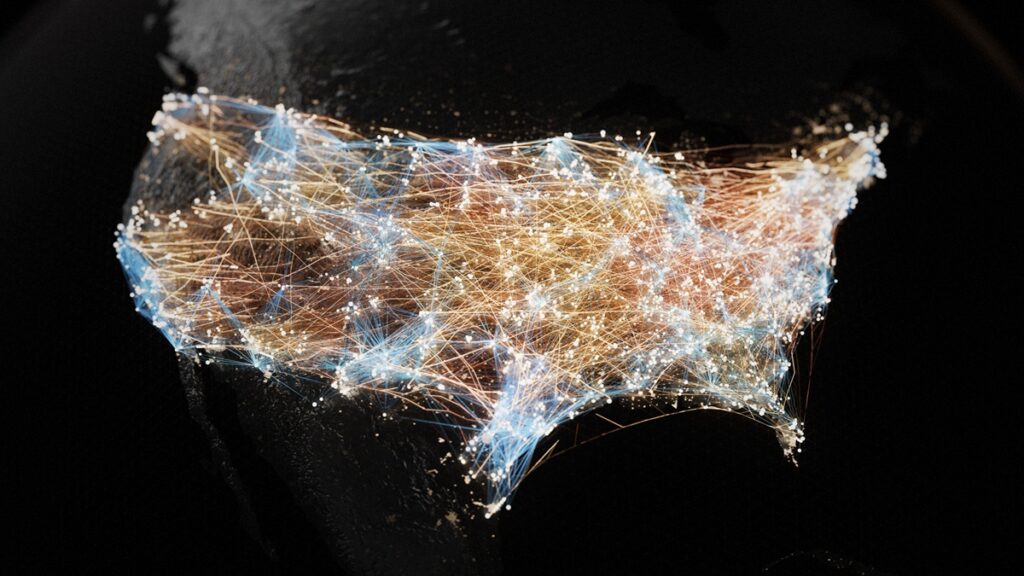
Growth in AI traffic is exploding. For example, almost 50% of ChatGPT’s 800 million
weekly active users access the site via mobile devices, and its monthly mobile app
downloads exceed 40 million.
With Nokia and Nvidia and Nokia will create smart 5G and 6G networks of the future-powered AI-RAN systems, mobile operators can improve performance and efficiency as well as enhance network experiences for future generative and agentic AI applications and experiences.
They will be able to introduce new AI services for 6G with the same infrastructure, powering billions of new connections for drones, cars, robots and augmented- and virtual-reality glasses that demand connectivity, computing and sensing at the edge.
Seamless transition to AI-native networks
Nvidia and Nokia will create smart 5G and 6G networks of the future is introducing Aerial RAN Computer Pro (ARC-Pro), a 6G-ready accelerated computing platform that combines connectivity, computing and sensing capabilities, enabling telcos to move from 5G-Advanced to 6G through software upgrades.
The Nvidia ARC-Pro reference design is available for manufacturers and network equipment providers to build commercial-off-the-shelf-based or proprietary AI-RAN
products, supporting both new buildouts and expansions to existing base stations.
Nokia will accelerate the availability of its 5G and 6G RAN software on the Nvidia CUDA
platform and expand its RAN portfolio by embedding Nvidia ARC-Pro at the heart of the
new AI-RAN solution.
This partnership will enable Nokia’s mobile network customers to transition seamlessly from today’s RAN networks to future AI-RAN networks.
Nokia’s unique anyRAN approach simplifies the introduction of the ARC-Pro platform by
establishing software-defined RAN evolution for both Cloud RAN and purpose-built RAN. AirScale baseband is a modular architecture in which new cards can coexist with previously deployed cards. Nokia aims to expand and evolve its AirScale baseband into
the 5G-Advanced and 6G era with new AI-RAN capabilities.
Dell Technologies is driving innovation in Nokia’s AI-RAN solution with its state-of-the-art Dell PowerEdge servers. Engineered for seamless scalability, these servers enable no-touch software upgrades and low-touch silicon upgrades, ensuring a smooth evolution from 5G to 5G-Advanced and 6G. With their robust, high-performance infrastructure, Dell PowerEdge servers are the ultimate compute platform for operators deploying AI-RAN solutions.
Future-proofed for 6G
Nokia and Nvidia’s AI-RAN platform unifies AI and radio access workloads on a
software-defined, accelerated infrastructure, boosting performance, efficiency and
monetization while enabling a smooth, cost-effective path to 6G.
New capabilities are added through software updates, future-proofing investments for
6G and beyond, while enabling rapid innovation cycles at the pace of AI. It serves growing generative AI and agentic AI traffic on the same sites as RAN functions, applying AI algorithms to improve spectral and energy efficiency, along with overall network performance, and maximizes return on investment by exploiting underutilized
RAN assets to host edge AI services.
“With America’s best network, T-Mobile remains committed to advancing next-generation technologies that redefine the customer experience,” said John Saw, president of technology and CTO at T-Mobile, in a statement. “Our collaboration with industry leaders Nokia and NVIDIA marks an important step toward shaping the future of connectivity as we develop the innovations that will power the 6G era. Building on the foundation established by the AI-RAN Innovation Center in 2024, this strategic initiative reinforces T-Mobile’s leadership in driving the U.S. wireless industry forward. Beginning in 2026, T-Mobile will conduct field evaluations and testing of advanced AI-RAN technologies to ensure they meet the evolving needs of our customers as we move toward 6G.”
“The telecommunications industry owns the most valuable real estate for AI — the edge, where data is created,” said Michael Dell, CEO of Dell Technologies, in a statement. “This AI-RAN collaboration with Nokia and Nvidia makes that potential real. We’ve built some of the world’s largest AI clusters with 100,000+ GPUs. Now we’re applying that expertise to distribute intelligence across millions of edge nodes. The operators who modernize their infrastructure today won’t just carry AI traffic — they’ll be the distributed AI grid factories that process it at the source, where latency matters and data sovereignty is critical.”
Additional AI Networking solutions cooperation
Nokia and Nvidia will also collaborate on AI networking solutions, including data center switching with Nokia’s SR Linux software for the Nvidia Spectrum-X Ethernet networking platform and the application of Nokia’s telemetry and fabric management platform on Nvidia AI infrastructure.
The companies will also explore the use of Nokia’s optical technologies and capabilities
as part of future Nvidia AI infrastructure architecture.