
Presented by Xsolla
As traditional venture funding becomes more selective, developers are turning to user acquisition financing, completion financing, project funding, and hybrid models to bring games to market.
For much of the past decade, game financing followed a familiar playbook. Studios raised venture capital, signed publishing deals, or relied on internal funding to bring projects to market. But as investment capital has tightened, developers are exploring a growing range of alternative financing options.
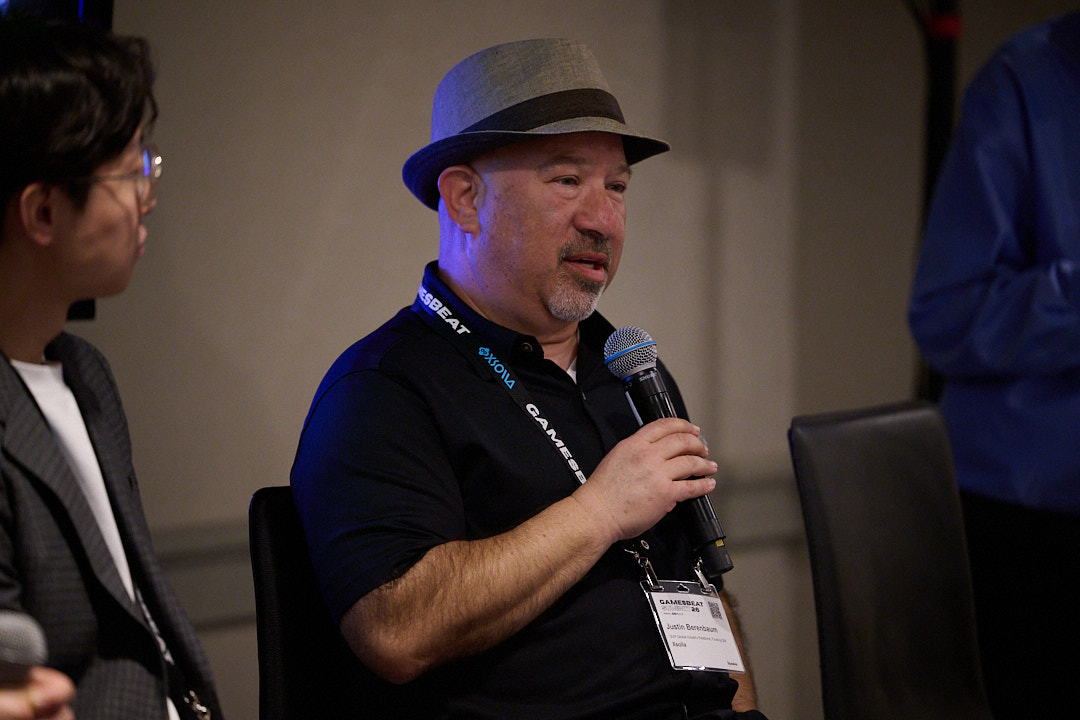
During a sponsored session at GamesBeat Summit 2026, industry experts gathered to discuss how financing is changing and what studios need to know when evaluating new funding opportunities. The panel featured Dara Willoughby, managing director at The Raine Group, Justin Yuan, partner at TIRTA Ventures, and Justin Berenbaum, SVP Global Industry Relations and Funding GM at Xsolla. The session was moderated by Eric Goldberg, co-founder of Playable Worlds.
User acquisition financing continues to grow
One of the panel’s central themes was the rise of user acquisition (UA) financing, particularly in mobile gaming. Studios with proven products are turning to financing tied directly to marketing and player acquisition efforts.
“UA financing has emerged as an amazing non-dilutive solution,” Willoughby said, adding that the method has been pioneered by the venture capitalist firm General Catalyst. Financing through equity is often limited. “The opportunity to get that financed through a user acquisition vehicle where that capital is derisked for the fund side, they get that first dollar back against anything they lent out. The metrics are very, very clear and readable. It’s just a unique financing method.”
Unlike equity financing, UA financing allows developers to access growth capital without giving up ownership. Financiers are paid back through the direct revenue generated by the acquired users. Panelists noted that the model typically works only after a game has already demonstrated traction and predictable returns.
“This kind of financing can be great when it’s used at the right time and place,” Berenbaum said. “But it doesn’t help you create the studio, get the game out the door, or with early testing. The money tends to go where someone’s already making money, so it’s better suited to a studio that’s further along than one just getting started.”
Berenbaum also noted that capital can become expensive, with financing structures often carrying rates well above those of traditional lending products.
Hybrid funding models are becoming more common
As financing options expand, panelists highlighted the growing use of blended structures that combine multiple forms of capital. Yuan pointed to examples where studios have raised both equity and UA financing simultaneously, allowing venture capital to support product development while marketing growth is financed through separate channels.
For companies that have already demonstrated monetization, hybrid models can reduce dilution while providing access to larger amounts of capital.
“Oftentimes in mobile genres and mobile adjacent categories we find that this model works super well where the equity is really there for the development of the product,” Yuan said. “But if you’re there to go to market to power growth and marketing it’s a very expensive form of capital.”
Completion financing is gaining traction
Another financing category attracting attention is completion financing, a model long used in film production that is increasingly finding its way into games. Completion financing focuses on projects that are already near launch and need additional capital to reach the finish line. Because much of the development risk has already been removed, financing providers can often offer more favorable terms than earlier-stage funding sources.
“Essentially, it’s last money in, first money out,” Yuan said. “And the effective [interest rate] that they’re looking for could be substantially less than project financing since you’re not taking the development and content risk itself.”
Berenbaum noted that the strongest candidates are typically projects that are only months away from release and have already demonstrated meaningful progress toward launch. The broader message from the panel was consistent: funding becomes easier and less expensive as uncertainty decreases.
“The best time to ask for money is when it looks like you don’t need it,” Berenbaum said. The way to get there, he added, is to know what investors and publishers are looking for and to make it easy for them to say yes, showing traction, a community, and an audience that’s excited to play and pay.
Financing is tied to publishing expertise
As the market becomes more competitive, investors are expected to provide publishing guidance and operational support alongside capital.
“The teams that have been hugely successful have hired the right people and had a publishing strategy,” Berenbaum said, citing games like Balatro and Dave the Diver, which are often misconstrued as indie successes despite having significant publishing support.
This trend is particularly important for PC and console games, where revenue forecasts can be more difficult to model than in mobile.
Proof matters more than ever
If there was one clear takeaway from the session, it was that developers seeking funding must arrive with evidence. Whether that evidence comes in the form of a playable prototype, community engagement, wishlists, revenue data, or demonstrated product-market fit, investors expect tangible proof that a project has the potential to succeed.
“If you don’t have something for me to play, touch, and feel, even if it’s early, you’re probably not getting signed,” Berenbaum said. “Because your competition’s got something for me to touch and feel and play.”
Regardless of the funding path, the panel agreed that strong execution, market validation, and clear evidence of demand remain the foundation for raising capital in today’s environment.