
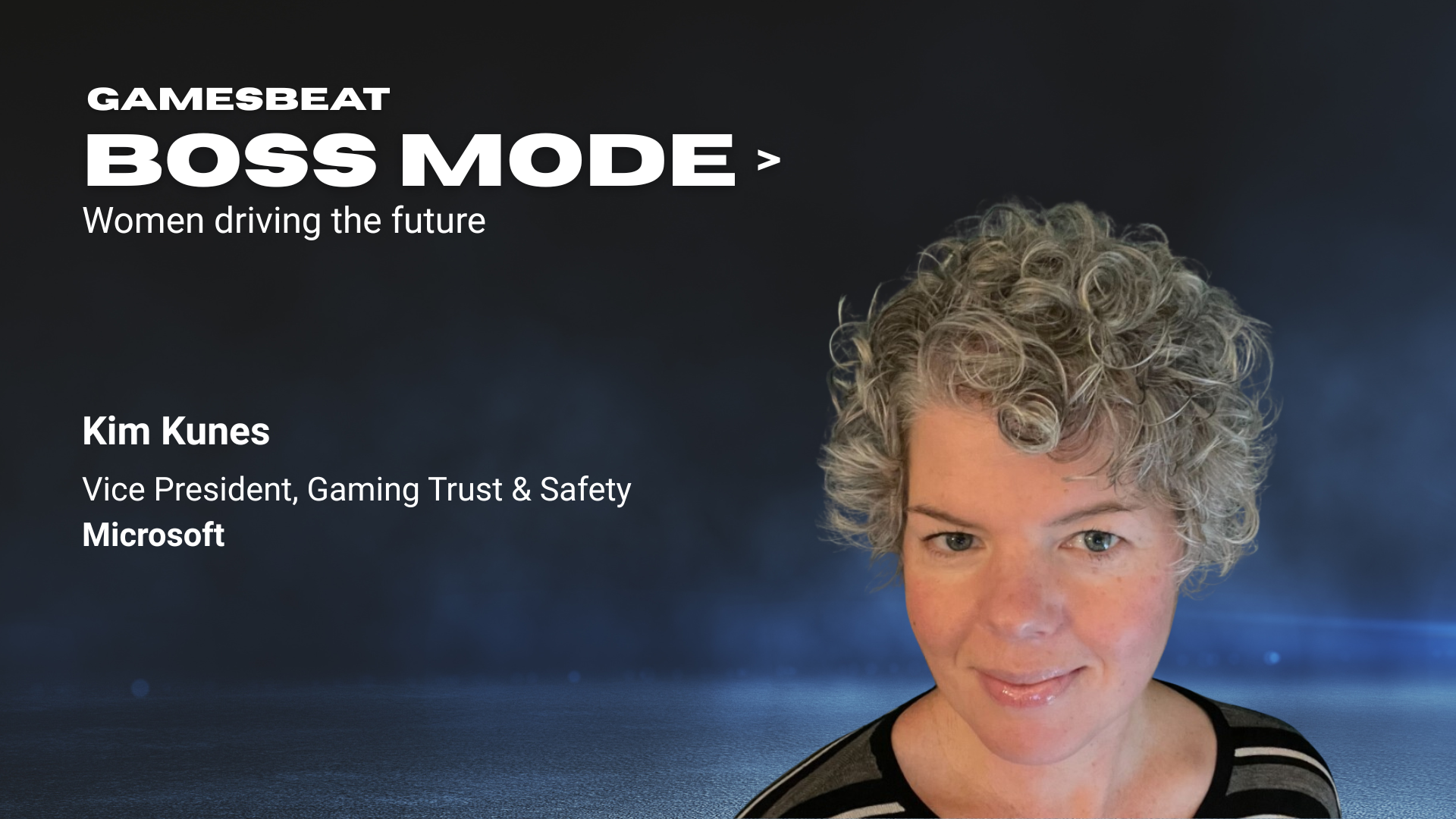
One of the best things about gaming is how many people you can meet and interact with — with billions of people around the world playing games on a regular basis, one can never run out of fellow gamers with whom to play. However, that means that regulating the space and making it safe for all players is more important than ever before.
As Kim Kunes, VP of Gaming Trust & Safety for Microsoft, told me, it’s not only important to make the space safe, but to be transparent about how you do. Listen to your players, she told me, and they’ll help you understand the context and culture of your community, which will make keeping them safe and secure easier.
I previously met Kunes when we both participated in a fireside chat at GamesBeat Summit 2024. We spoke about her work in trust and safety then, too, but I didn’t get the chance to dig deep into the topic with her. When the chance came up to interview her for BOSS Mode, I jumped at it so I could pick her brain about the topic.
Below is an edited transcript of our conversation.
GamesBeat: Could you tell me a little bit more about your career and how you got where you are?
Kunes: My mom was actually a computer engineer for 40 years, starting in the 1970s, which is pretty rare, before it was even called computer engineering. She had a math degree and her first programs were trays full of punch cards.
When I was a teenager and going off to college, I thought, “I don’t want to do this boring work that my mom does.” I actually went to school to be a veterinarian. We see how that worked out for me.
While I was in school, I started working as a technical support repo for TurboTax, and there is nothing that teaches you about good software design like supporting customers late at who are desperately trying to finish their tax returns in time for a deadline. I got the bug for software when I did that job.
[Safety is] very mission-driven. It’s extremely technical and also deeply human.
The rest is kind of history. My career grew in tech, and I ended up at Microsoft about 18 yeas ago. I spend about half of my career at Microsoft on the enterprise product side and about half in gaming. I first worked in safety at Xbox in 2012 when my team was responsible for implementing family settings on the Xbox One console.
I realized, doing that work, that safety was kind of the perfect fit for me because it’s very mission-driven. It’s extremely technical and also deeply human.
GamesBeat: Do you have a personal relationship with gaming as well?
Kunes: I’ve been somewhat of a gamer all my life. When I was a kid, I was all-in on Nintendo and Super Mario Bros. I’m still a gamer now. My favorite game is Hearthstone Battlegrounds — so much so that, a couple of years ago, my husband actually got me a two-hour private coaching session with one of Europe’s top-rated Battlegrounds players, which was incredibly fun!
Gaming’s always been part of my life to some degree, but it’s changed a lot between being a kid, a young adult and then also a parent. To me, gaming has always been more than just screen time. It’s a community, it’s creative. It’s a way for kids to stay in touch with friends, for people all over the world to engage with each other in ways that they wouldn’t have an opportunity to in real life.
Gaming crosses those cultural and socioeconomic boundaries in a way different from other forms of engagement. It feels like it makes our world smaller and teaches us that there’s a lot more than brings us together than divides us. I feel that it’s a great equalizer.
That’s also why trust and safety matters so much in that context, because gaming for everyone really only works if people can play within the boundaries that they set.
GamesBeat: In terms of numbers and behavior, can you describe the impact you’ve had on the trust and safety space. I remember — it’s almost memetic at this point — people my age and older would say, “Back in my day you, wouldn’t believe the things that were said in video game chat.”
Kunes: I think there are a couple of lessons that can help other industries. Gaming is the largest global form of entertainment, and it’s also one of the most intense live community environments. People show up with passion, their own identity, real emotion. When I think about the kind of things we’ve learned, one of the big things is empowerment.
Safety is not one-size-fits-all. Not every player has the same expectations of safety. The best communities give people tools to be able to set boundaries and control the experience that they want in that context. Not every context is the same for the same player. A 35-year-old woman who’s playing Minecraft with her kids has a different expectation of that experience than if she’s playing Call of Duty with her friends. That kind of layered approach is super important.
Gaming crosses those cultural and socioeconomic boundaries… it makes our world smaller and teaches us that there’s a lot more than brings us together than divides us.
The other part is the multi-disciplinary approach — not only technology, but also the community standards, and those expectations for the players. No one system catches everything. Context, culture, language itself actually is constantly evolving and so your systems have to be evolving with that.
The third thing fits back into that as well: Transparency. With transparency, you build trust. When we explain what we’re doing, we invite better feedback loops with our players. That’s fuel for us in improving safety and that player experience over time. It’s part of what I’ve learned in this role, that is such a critical piece of that approach that we take. Humility, in that we’re not always going to get it right the first time, but a willingness to be transparent and to listen is super-critical.
GamesBeat: Ordinarily, I would ask what you think non-gaming communities can learn from Xbox’s approach to trust and safety, but in this case I want to know what you think other people in the space can learn as well.
Kunes: It really goes back to listening to your players, understanding that players expect different environments and being flexible with the approach that you provide. Giving players the ability to set settings that let them control the environment that they’re in, letting them learn from other players and learn from our safety teams about how their interactions are being perceived.
I think we also have such an incredible opportunity to work together across boundaries. You’re probably familiar with our Good Game Initiative between Microsoft, Sony and Nintendo. It’s really important to put competition aside, even between gaming companies, and learn from each other because this industry and this space of trust and safety is so complex.
It’s always changing, and having that community between companies where we can learn from each other and where we can be sort of vulnerable and introspective about how we’re doing things, what’s working and what’s not, is really important to all of us getting better.
GamesBeat: What advice would you give to smaller studios? Studios who maybe don’t have a huge trust and safety team like Microsoft does? What would you say to them about how important it is?
Kunes: One of the things that’s really interesting in this time — and I always think about this a lot when I think about smaller studios, and beyond the gaming environment as well — is that technology is changing our lives in a pretty incredible way with advanced AI. I see this as an awesome opportunity in the safety space to really use AI for good, and I talked about how we’ve been investing there.
Digital safety is hard and there is no one system or approach that is perfect. But, if we as businesses can be introspective, open with our players, open with regulators and with each other about what works and what doesn’t work, we are all so much better.
The key part, here, for smaller studios, it’s historically been really tough for smaller providers that don’t have the depth and breadth of Microsoft to build systems that can scale to the volumes of content that can be user-generated. Even in a smaller title from a small studio, if they’ve got multiplayer and social features, that volume is enormous.
That’s really tough for a smaller company to handle, but the AI solutions out there today are making that easier. Especially when we talk about things that are, thankfully, very rare but higher priority harms that we care about deeply, like child grooming. That can be like finding a needle in a hay stack.
AI provides us with a unique ability because it’s able to reason over enormous amounts of data. It’s changing the game there and it enables smaller companies to do more. I really believe this is going to be critical to our future to protect the most vulnerable audiences in digital spaces. That’s something I’m really excited about.
GamesBeat: How do you define leadership in the games industry and as part of your job?
Kunes: One of the things that I think is important for leaders to be clear on, especially when it comes to safety — safety is not a trade-off against growth. It’s a prerequisite for sustainable growth. When people feel safe and respected, they engage more. They come back. They’re more likely to build real community.
The second part is humility. There is no one-size-fits-all approach. There is no single company that can solve online harms alone. It takes collaboration across the industry. It takes collaboration with regulators, across society, communities, with each group playing a different role. Be open. Be transparent. Be willing to be wrong. That’s vitally important for leaders in this space.
GamesBeat: Can you tell me, in your own words, what kind of impact you think you’ve had on the space?
Kunes: If my mark on the industry can be about the leading the way for how we use this new technology to protect our most vulnerable audiences and digital spaces and improve the world this way, I will be very happy. I feel like we’ve started out on an incredible journey with that, and I want to continue and push that forward.
Be open. Be transparent. Be willing to be wrong. That’s vitally important for leaders in this space.
Here at Microsoft, given our history with technology and our gaming organization, we have a unique opportunity. That’s important to me, and something I feel is a legacy I can leave.
GamesBeat: What is your boss music, which would play if you’re a boss in a video game?
Kunes: I love the song “Thunder” by Imagine Dragons! I played a ridiculous amount of Beat Saber on my Oculus during the pandemic, and “Thunder” was my favorite beat in that game.
The reason I love it is that the lyrics mean a lot to me. I’m from a very small town in northern Wisconsin. I’ve never really wanted to be in the limelight. I’m okay being in the background. Many of my career years, I’ve worked in supporting-type background services. Safety is kind of this, right? We’re not out front in the player side of it, necessarily. We’re a little bit more quiet in the background.
But I have the tenacity to do the hard work that usually isn’t center stage. Then being really bold about the success of that or the success of the team. As the lyrics in that song outline, the lightning kind of happens quietly at first in the background and then the thunder comes later. That always resonates with me.
GamesBeat: What would you say is your Boss Move, the decision that defined your career?
Kunes: When I first came into the role of leading trust and safety for Xbox, four-and-a-half years ago, I recognized that we had an opportunity to be more transparent. I pushed really hard for transparency, and our transparency report, because I felt strongly that it forced a clarity and a conversation that would actually help us to drive real progress.
Digital safety is hard and there is no one system or approach that is perfect. But, if we as businesses can be introspective, open with our players, open with regulators and with each other about what works and what doesn’t work, we are all so much better. When you share what you’re doing and why you do it, you’re getting better feedback loops.
It was super-important to me. I pushed hard on it, and we did that and the results have been awesome.