

Discord AI insights platform Levellr, which uses AI to glean insights from Discord, raised $2.5 million in seed funding.
Levellr is a platform helping the world’s biggest games and global brands make sense of their Discord and next-generation communities. Discord is increasingly important with 200 million monthly active users who are passionate game fans, and Discord plans to go public sometime soon as a result of its popularity.
Fuel Ventures and some of the most influential leaders in the video games industry led the round. The funding round included support from industry legends, including Mark Pincus’ Workplay Ventures (Zynga Founder), Bing Gordon (Duolingo & T2 board member), Frank Gibeau (CEO Zynga), Phil Mansell (former Jagex CEO), Simon Hade (Space Ape founder), Norman Cheuk (ex-Microsoft executive) & Playformant.
“We’ve got some great folks on board in this round,” said Tom Gayner, CEO of Levellr, in an interview with GamesBeat. “We are just really excited. Not only are we seeing our revenue growth and customer growth but also so many games industry legends are really seeing the opportunity that community data and Discord provide, and in a Discord IPO year. It’s a really exciting time for us to be coming out with the announcement.”
Levellr’s platform provides enterprise-level tools and services to help the biggest game studios and global brands turn their community conversations on Discord and other next-generation communities into clear, actionable insight — helping them to spot issues early to reduce user churn, and make smarter product and engagement decisions with confidence.
The investment will be used to support Levellr’s next stage of growth through building further data infrastructure that allows customers to unlock even deeper player insight, enabling companies to act faster and ensure customer retention.
The new investors join existing games industry notaries who have previously invested in Levellr such as Mitch Lasky (Benchmark partner), Owen Mahoney (ex-Nexon CEO), Dylan Collins (SuperAwesome founder), Mika Salmi, Matt Bilbey (former EA Executive) and Rich Barnwell (Digit founder).
Origins
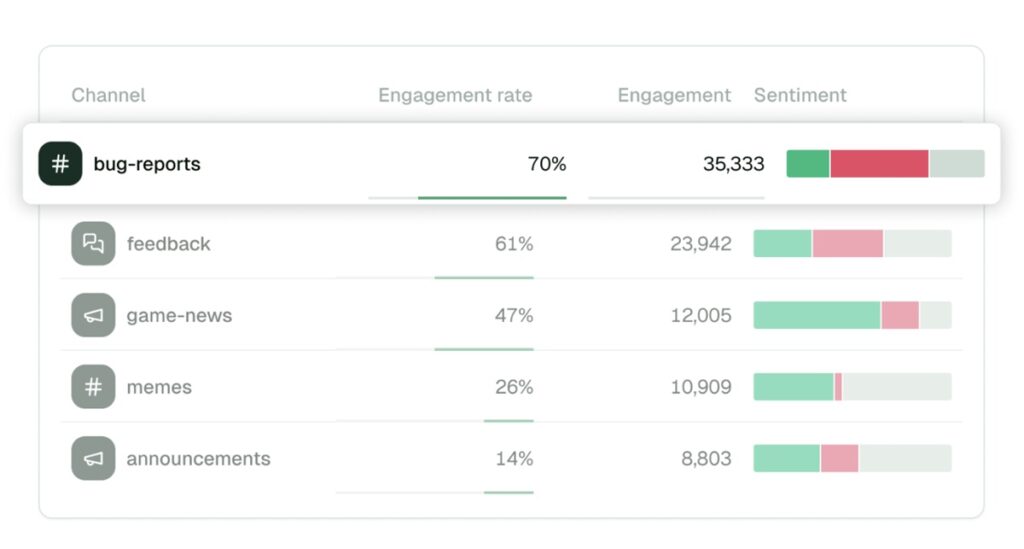
Levellr is headquartered in London and backed by investors including Mitch Lasky, Owen Mahoney and Dylan Collins alongside senior executives from Krafton, Riot Games, and SuperAwesome.
Gayner and CTO Ben Barbersmith, formerly of YouTube, started the company in 2021, while Gayner was working for a streaming platform. They got together to talk about what they liked about web-based platforms and other social platforms where the analytics were more transparent and it was easier to understand community sentiment.
With the shift to Discord in games, they felt like they needed to help game companies glean insights from their players. The company had previously raised around $3 million.
As Discord has become one of the most important communities, global brands and games companies need enterprise-grade tools and services to support real-time player insights.
The company has 34 people across a variety of locations in the U.S. and Europe. The company processes more than six billion data events a month for customers, Gayner said. Those pieces of data might be a reaction to a message, sending a message, logging into Discord, or other interactions.
The team has built out the AI search functions so that users can use Levellr to get answers to questions about community data and understand the sentiment of the community. Gayner said the company respects Discord’s privacy policies and it is aligned with them so that it can collect anonymized opt-in data on players and still comply with privacy regulations.
How it works
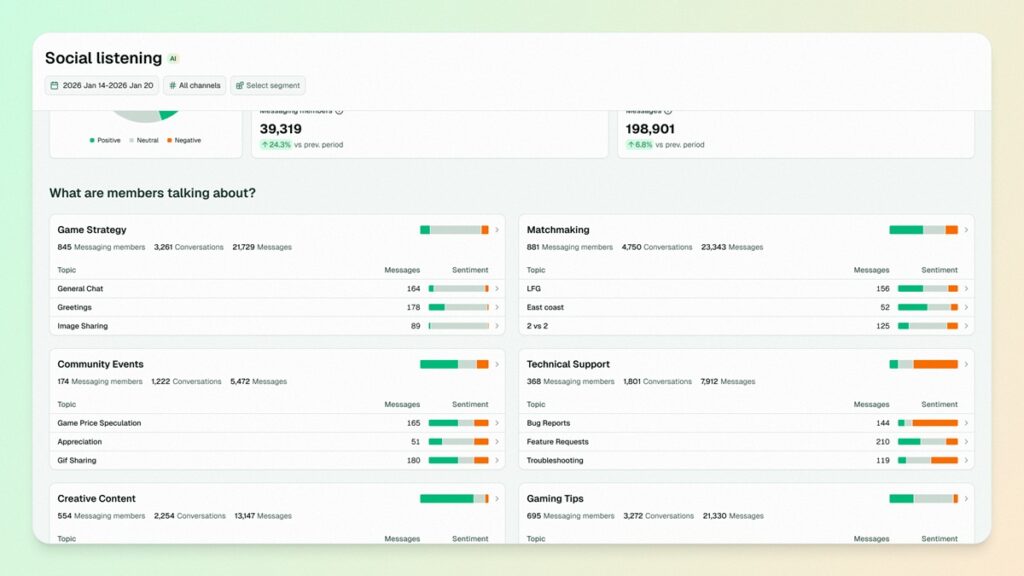
Levellr unifies player conversation and engagement signals from the newest generation of social platforms such as Discord to provide real-time intelligence on critical events to support product, live ops, game design, community and support teams. With community increasingly becoming a commercial driver of consumer revenues, Levellr has seen growing demand for its enterprise products, doubling revenue in back-to-back years.
As the video games industry continues to face disruption from shifting UA bottlenecks and increasingly atomized audiences, retention and re-engagement have become a core focus. This has created an urgent need to listen to player experience signals from newer platforms like Discord and connect them to product KPIs.
Gayner said the gamer conversation is fragmented across many spaces. What is the data that should be acted upon? That’s what Levellr does. If 50 whales, or high-spending players, are complaining about one thing, that’s more meaningful. But if they’re brand new players who haven’t spent anything, do you really need to listen to them, particularly if it contradicts what veteran players are doing?
“It’s really hard to make decisions with conversational data today, and we’re fixing a lot of that piece by piece in real-time, granular prioritization to help teams decide when to act and quantify behavioral impact and, importantly, predict chat,” he said. “Customers have seen the value we provide.”
Players who seek out conversations about games on Discord are valuable in that they’re seeking answers in a community of players. The average revenue associated with an engaged community member is 3.5 times a non-community member, Gayner said.
“Remarkably, we’ve seen a customer validate that their Discord users were up to 90 times more valuable,” he said. “If you’re a live services game, your typical ARPDAU for a user is 10 cents. If we are 3.5 times that, that’s 35 cents. If you have 250,000 players in your Discord community, that one community could be spending $32 million on your game alone, almost $90,000 a day.”
Levellr is used by both gaming and consumer companies including Epic Games, Krafton, Scopely, YouTube, and Google to assist with:
Data Fragmentation & Lack of Context: Unifying community and player voice data with product KPIs to contextualize the “why” behind changes in telemetry and monetization data.
Signal-to-Noise & Prioritization: Reducing the difficulty distinguishing true impact from isolated noise, memes and negativity. Product teams can evolve from over-or underreacting to viral posts due to a lack of volume context, segmentation and representativeness to support when to act, quantify behavioral impact, and predict churn.
Reporting Latency: Removing slow, manual reporting cycles which were causing crucial insights to arrive too late for product and live operations.
Bing Gordon, an early Electronic Arts exec and board member at Duolingo and Take-Two Interactive, invested in the round.
“I’ve tracked Levellr’s impressive growth and it’s clear they’re solving a critical industry gap. Levellr are shifting the way teams can bring intelligence from core platforms like Discord into the business with real-time sentiment and relationship analysis,” Gordon said in a statement. “But that’s just the start. They’re essentially building the CDP layer – the customer data platform – that can amplify value and unlock more revenue for companies with Discord communities and beyond.”
Use of proceeds
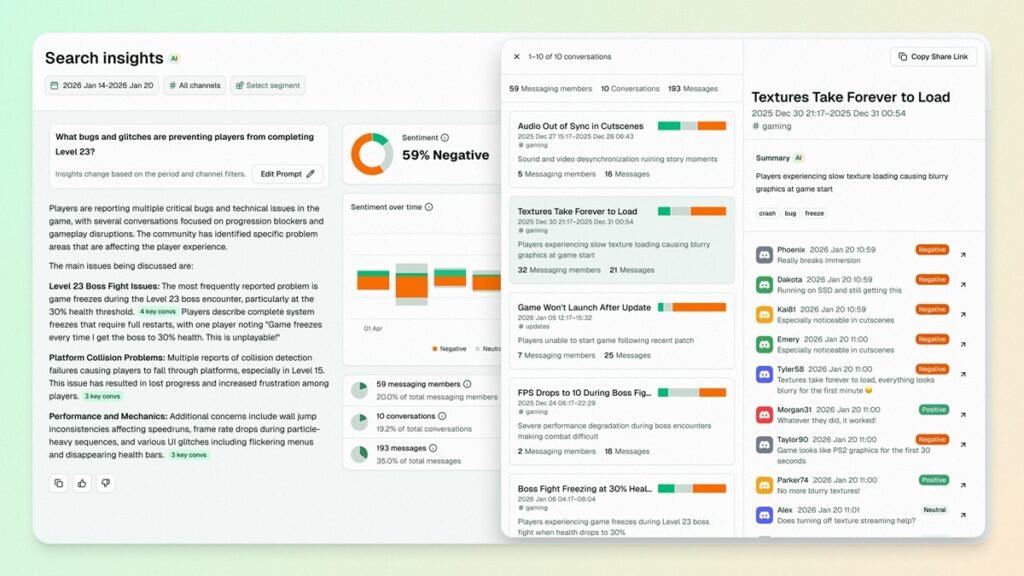
The new financing will enable Levellr to expand its product footprint, building data infrastructure that gives customers access to a wider set of player signals which can be combined with agentic solutions that proactively provide recommendations and take action on player feedback to support both product and marketing goals.
Gayner said, “Our customers told us that while they had clarity on what was happening via telemetry and monetization data, they often lacked the why behind changes in metrics like DAU and ARPDAU. They needed real-time data from the player voice to help their teams to make smarter decisions.
“Before using Levellr, our customers were manually scrolling through platforms like Discord, which frequently led to product teams undervaluing community signals until a bug or issue had already spiralled and led to player churn. Community reports often lacked sophistication in the form of segmentation, cohort analysis or weighting, so even if customers could see player signals, there was a real lack of clarity as to whether product teams should actually act on it.
With Levellr, product & game design teams can now understand the “why” behind telemetry shifts and prioritize roadmaps based on genuine player pain, live ops and monetization teams get real-time intelligence on critical events (monetization failure, mass bug reports) that threaten revenue and retention to act faster, community and customer support can filter signal from noise, prove the impact of their work, and remove significant manual work whilst marketing teams can keep players in and moving along the funnel with user-level automation.”
The market opportunity
I also wrote recently about Wildfire doing ad and media campaigns on Discord. But Gayner said he doesn’t see them as a rival. Rather, he says it’s possible for them to partner. He also doesn’t think it’s likely for Discord to compete with Levellr.
“We’re an AI-first software business really focused on helping customers to unlock the significant revenue opportunity on Discord and building enterprise tools for Discord,” Gayner said. “What we’re trying to do is bring real-time player intelligence into games publishers and studios to help them mitigate player churn and community risk.”
He added, “If we think about some of the challenges that we hear gaming organizations face today, I break it down into three key areas. The first is around signal-to-noise and prioritization. So we hear frequently how product, live ops, game design, marketing, and the C-suite really struggle to distinguish the true impact from an isolated meme post.”
Is a specific comment on Discord or Reddit simply noise, or should product teams react to it?
If you are also flooded with data and it contradicts itself and you don’t know what it means, you can’t act on that data, he said.
Gayner said, “Our customers focus on what is happening with their products. And they do that via telemetry data, and they do that via monetization data. They can see if there’s been a drop in ARPDAU. They can see if there’s been a spike in game time. But what those customers tell us is that they lack is why changes are happening. And so there’s a real kind of break between quantitative telemetry, monetization data and qualitative player voice data today.”
By using AI in the form of large language models and “enriching conversational data from platforms like Discord and Reddit, we’re starting to build this into in-game chats, customer support tickets,” he said.
Making the data from so many players valuable to an enterprise customer requires going extremely deep, Gayner said.
“Customers want to have one source of truth on the player experience,” he said. “With this funding round, we’re now expanding the platforms that we’re working with, building into a Reddit stream and working with customers and internal data.”
The risk for game studios, publishers and enterprise brands is really significant on Discord if they get it wrong.
“That’s what’s leading to our growth,” he said. “The great investors we’ve brought on board shows the industry is really waking up to the value of those players, the value of those communities. They want enterprise tools that bring insight back into the business.”
Game companies can get more data by integrating Discord into their game chat inside their games and then players can connect their Discord IDs. Then the companies can understand data about those players.
“We can help them do the integration work so they can get a higher level of analysis from those who opt-in,” he said. “What we’re trying to help a customer do is get user-level analysis.”
Discord is important not only because it’s where players are congregating, it’s also because the industry has had user-acquisition challenges where it costs more to acquire players who will spend money in games.
“There isn’t one unified solution that’s bringing all of that data into one place and then connecting that to product KPIs to really help you make faster, smarter decisions. If we think about how that data is being brought in today, we have kind of community managers that are often being tasked with scrolling through Discord or Reddit,” Gayner said.
It’s time to listen to players
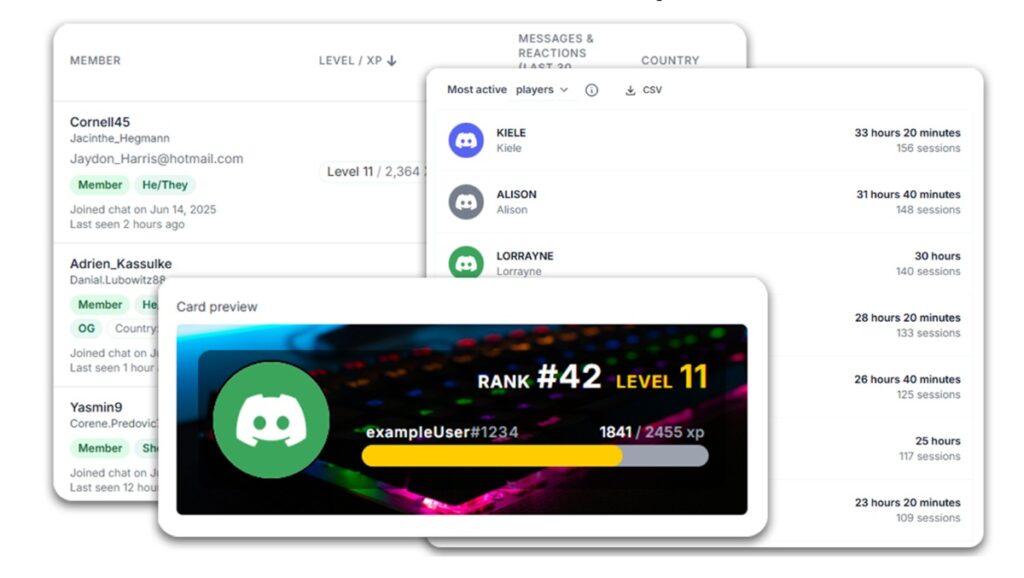
Looking out at the industry, Gayner sees a need for this kind of product and service because we are seeing the impact on businesses if they fail to lean in and listen to the community voices, he said.
“There is a genuine want from leaders within game studios and publishers to do a better job of that and in a pre-AI world, that has been extremely challenging to do,” Gayner said. “It’s extremely heartening to see the reaction and excitement and the usage around the insights that we’re providing customers.”
As for the state of fandom, Gayner sees so much engagement from players on Discord and Reddit that it’s clear fans are still very excited about games.
“We’ve seen some challenges around the attention economy. The games industry doesn’t just compete with other games in the industry. It starts to compete with short form content and platforms like Tiktok and YouTube for a share of time,” he said. “The quantity of options available too a consumer today are really significant.”
If developers and publishers don’t properly segment their data, they will build the wrong set of features for players.