
Tesoro XP, a new rewards platform that enables retailers to fund in-game currency for gamers, announced it has raised $5.4 million in seed funding.
It’s a pretty significant change in the way that game publishers and developers can make money from local retailers, said Sami Khan, cofounder of Tesoro XP and Atlas: Earth, in an exclusive interview with GamesBeat.
The company recently announced the funding, which was co-led by Treasury, a New York–based fintech fund, and TK MediaTech Ventures, a new venture firm focused on the next generation of media technologies. Jeff Cruttenden, Founding Partner at Treasury and co-founder of Acorns, has joined Tesoro’s Board of Directors, and TK’s Jim Ward is observing.
Tesoro opens access to premium in-game currency for the 220 million U.S. free-to-play gamers, many of whom have been unable to participate meaningfully in virtual economies.
Today, just 15% of players generate more than 65% of App Store gaming revenue due to traditional pay-to-play currency models. Nearly every major game sells virtual currency, yet access is often limited, especially for young or lower-income players, creating both frustration and social pressure.
“Players often feel excluded in today’s top games when they can’t access the latest in-game items,” said Khan. “Publishers want to monetize virtual currency, but they don’t necessarily care who pays for it. Retailers are already spending billions on marketing, and Tesoro connects those budgets to the gaming world in a way that’s performance-based, trackable, and a win for everyone.”
“For the first time since microtransactions in gaming were introduced, Tesoro is creating the next generational revenue model for free-to-play games. And for brands, we’re building a marketing platform that drives loyalty outside of closed-loop systems,” added Khan.
Tesoro gives game publishers a plug-and-play way to integrate real-world retail offers directly into their games. Players earn in-game currency through everyday purchases, and retailers only pay Tesoro when those purchases are verified, creating one of the first performance-driven marketing systems linking real-world spend to game engagement. While details are still confidential, Tesoro is currently in discussions with several major game studios and national retail brands as it prepares for launch.
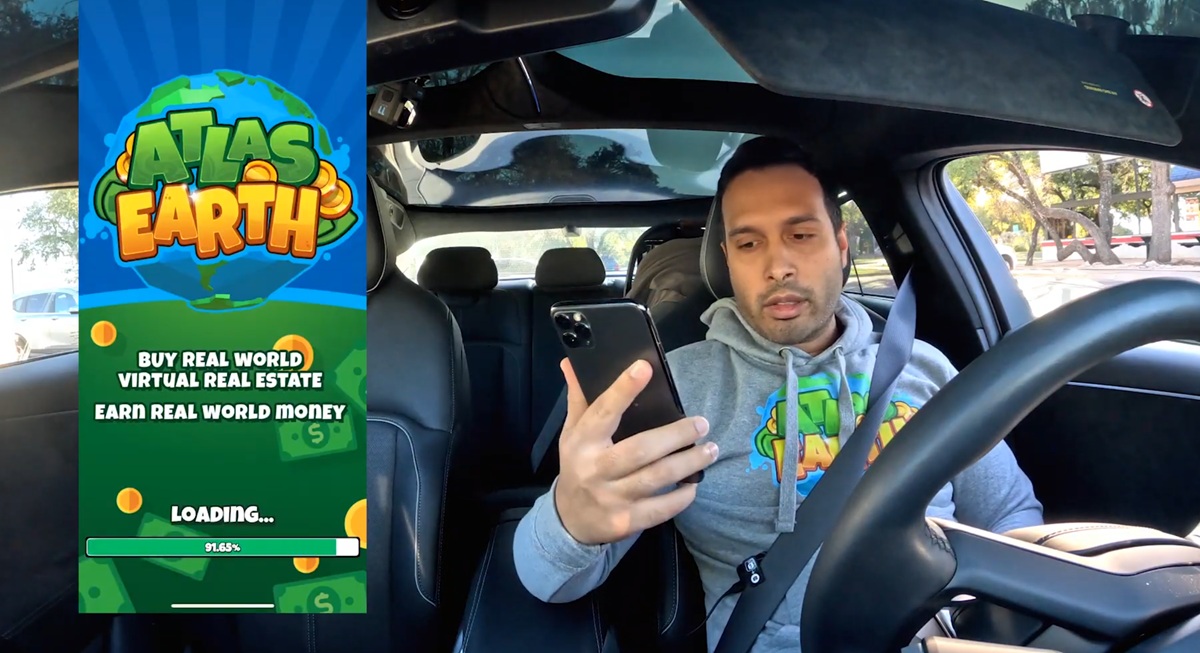
I saw a video that Khan made while visiting a drive-through. He was able to get his in-game reward in real time, even before he got his food at the drive-through window. He can’t reveal the food chain just yet. But the video showed a full transaction, where he saw and accepted an offer, went to buy food, and then was rewarded with virtual currency inside his game, Atlas: Earth.
“Gamers represent one of the most passionate, engaged consumer bases in the world,” said Jeff Cruttenden of Treasury, in a statement. “Tesoro has built a model that aligns incentives for retailers, publishers, and players in a way we’ve never seen before. This is the rare kind of category-defining innovation we look for.”
“Tesoro is redefining how players, publishers, and retailers interact inside and outside the game,” said Jim Ward of TK MediaTech Ventures in a statement. “This model sits at the intersection of media, technology, and consumer behavior, exactly the kind of next-generation platform we’re excited to back.”
The new capital will accelerate Tesoro’s core product and partnership roadmap, including development of its developer SDK, expansion of the publisher portal, and growth of its merchant and publisher partner pipeline. Tesoro will also continue building its engineering and business development teams to support its planned Q1 2026 launch.
Origins
Tesoro XP was founded by Sami Khan, Tim Mahler, and Beau Button in Austin, Texas.
Khan and Button previously co-founded Atlas Reality, Inc., the company behind Atlas: Earth, a mobile rewards gaming app that recently surpassed $100 million in lifetime revenue. Their experience building large-scale gaming and virtual economy infrastructure uniquely positions them to deliver Tesoro’s vision to publishers and retailers worldwide.
Tesoro XP is the first rewards engine that allows retailers to fund in-game currency for free-to-play gamers. Through Tesoro, game publishers can integrate real-world offers directly into their experiences, creating new revenue channels, deeper player engagement, and performance-driven marketing opportunities.
The team has 18 people. The company “dog-fooded” this idea within Atlas: Earth, Khan’s own game, for the last four years. So it’s not a new invention. It used to be called Amp, the Atlas Merchant Platform. It has already generated millions of dollars of retail transactions, he said.
“We had that ‘aha!’ moment, which was, ‘Wait a second. Why are we just doing this only for Atlas Earth? We can white-label this and bring this to the gaming industry at large, and that’s what led to us spinning out this technology out of Atlas: Reality into a new company called Tesoro XP,” he said.
The spinout was completed in late 2025.
“The beauty of it for the brands is they’re not paying anything upfront,” Khan said. “They’re not paying any integration fees. The arrangement with the brands is strictly pay-per-performance, meaning, when we drive a transaction, you give us a cut of that transaction.”
Solving the three-fold problem of game ads
“The vision behind Tesoro XP is to diversify game monetization in free-to-play games, primarily those that sell virtual currency,” said Khan. “The problem we’re solving is a threefold one where, with Tesoro, everyone wins.”
The first problem is that even the best free-to-play games are lucky to have 20% of their monthly active users actually spend money on in-app purchases. Yet 80% of monthly active users are willing to watch rewarded ads or take part in rewarded behavior.
“The question is how do we allow the game publisher to earn dollars, not pennies, from rewarded behavior?”
He added, “The second problem is how can game companies enable players who can’t afford or don’t want to spend money for in-game currency to feel like they can partake in that in-game currency economy? Because that obviously increases engagement for the player, and they already want it. They’re motivated to want it.”
The third notion is perhaps the biggest. As a marketer at a retail company, as an offline channel retailer, you have to worry about how you can create good digital channels where you can get a good return on ad spend, or ROAS.
“What we’ve seen in digital ads, like, if you look at ads, is that 80% of the ads are for other games and 20% are for e-commerce. There is basically zero advertisements from physical retail companies because the sales are hard to track,” he said.
Khan said, “That’s where Tesoro XP comes in. We’ve created a performance marketing platform that enables retailers and offline brands to basically place ads in games that players already love playing.”
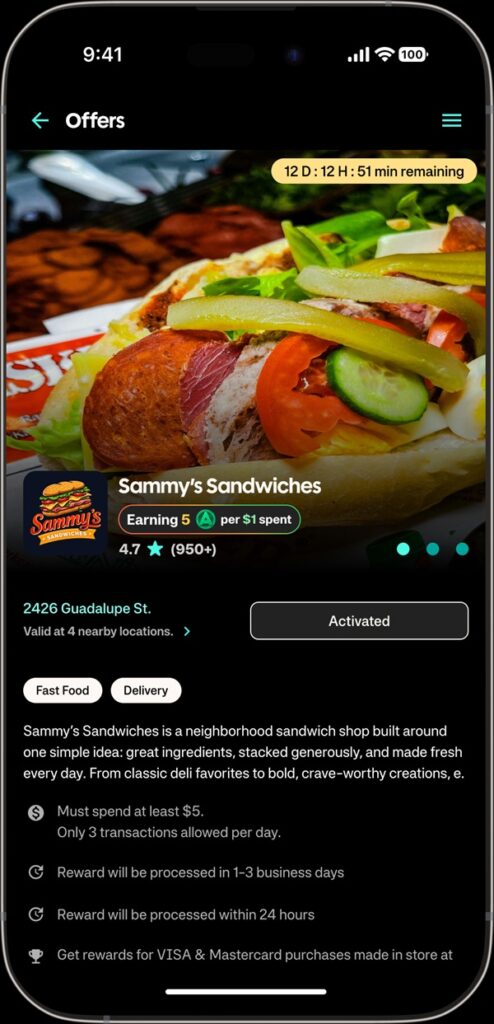
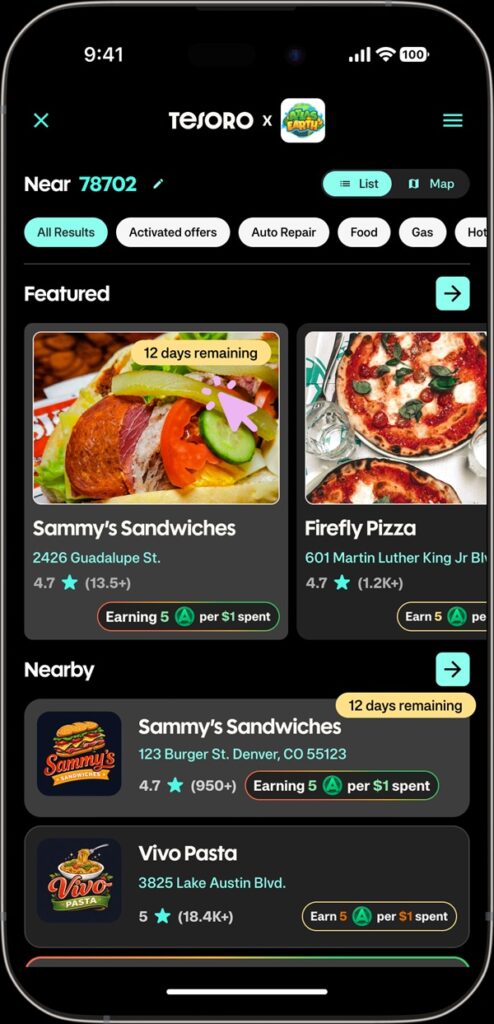
The game publishers add a simple few lines of code to allow players to browse location-based retail offers for nearby businesses, like a drive-through fast food restaurant. Then you use your credit card to make the purchase.
Using credit cards
Tesoro, which is available only in the U.S., asks players to add a 16-digit credit card number. They don’t need to put in their billing name or zip code or their bank logins.
“Then, when players accept the mission in their favorite game, assuming the game is integrated with Tesoro, they accept the mission and within that mission time window,” he said.
If there is a mission to go get a burger, you accept the mission in the game and it says you may have seven days to fulfill that visit to the fast-food place. You swipe your card at that restaurant, and in real time, they will get game credits for every dollar spent at the fast-food place.
“They don’t have to do anything,” he said. “They don’t have to talk to someone. They don’t have to upload a receipt. All of that is done in the magic of the background of Visa and MasterCard technology with Tesoro,” Khan said.
This means that Tesoro is creating a two-sided marketplace where Tesoro gathers brands and brings them together with game companies.
Reaching game publishers by making them dollars, not pennies
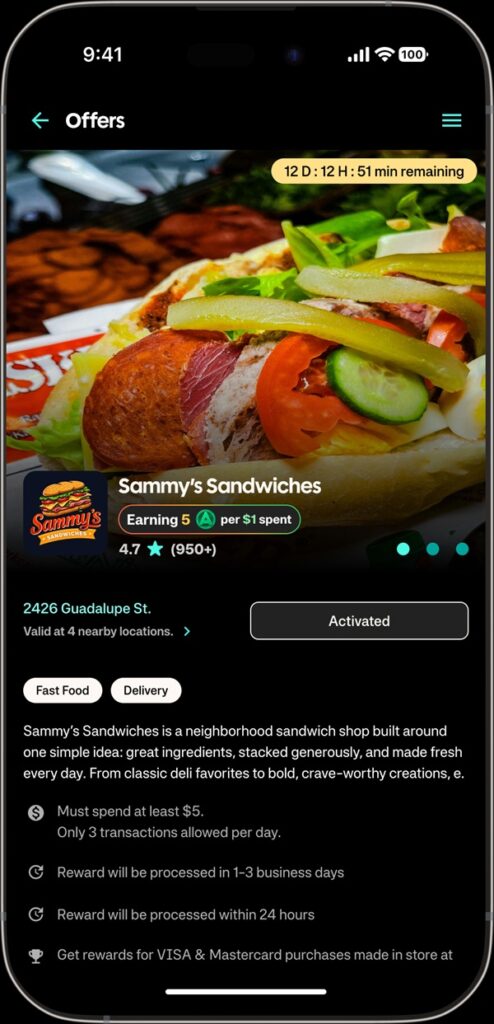
Khan said the company will use a “pull model” where he is educating publishers to integrate this kind of offering into their shops and showing them the positive impact for ARPDAU, or average revenue per daily active user, a common performance metric.
“We are talking to some of the biggest game publishers already,” Khan said.
Khan said he is making use of his relationships in gaming from eight years.
“This probably comes to no surprise to you, but they’re all dying to not show ads of competitors’ games inside their game. They would love to have other monetization that doesn’t involve churning their users,” Khan said.
While Khan’s solution may resemble an offer wall, where you can get a reward as a player if you accept an offer to do something, like sign up for Netflix. Many of those offers are meant to be used only once, and so the company has to keep finding new offers.
“But with retail, they care about frequency,” Khan said. “The beauty of Tesoro is these offers are aligned with how the retailer wants you to keep coming back.”
The value wall
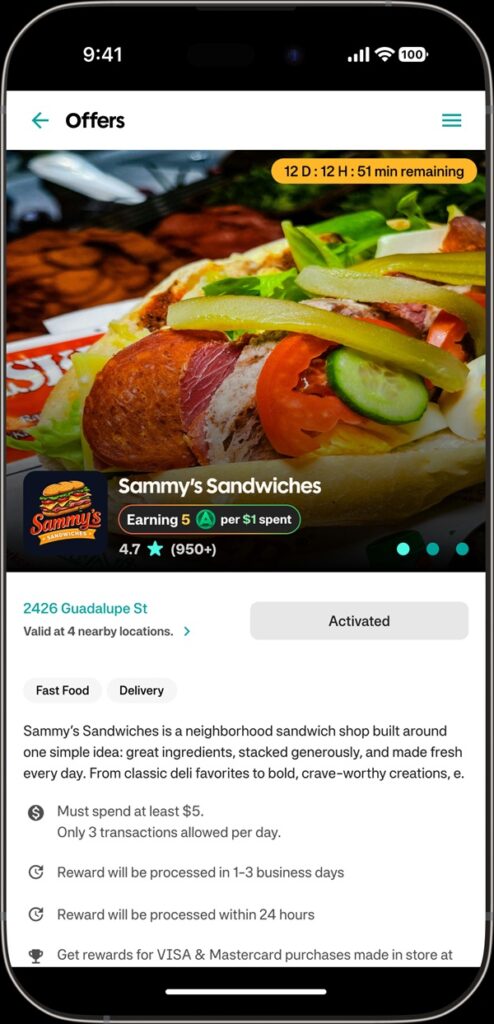
“Transparently, what’s happening is the we’re opening what we call ‘The Value Wall.’ We hate the word ‘offer wall.’ We open a location-based value within the game where the player can get that value customized to the game they’re playing.”
He added, “If you’re playing Candy Crush, you’re going to earn gold bricks. You can think of it as an almost a universal in-game loyalty platform for gamers to earn whatever credit they want the most with in-game currency.”
For the game publisher, the lion’s share of the commission goes back to the game publisher, Khan said.
Back to the point about making publishers dollars and not pennies. When you run a rewarded ad, where someone watches a video and you give them a reward, those ads can maybe generated 1.5 cents, with luck.
“But a brand or a game publisher could make 3% to 4% commission on a player going down the street eating dinner at an Indian restaurant, which could be $50 bucks, right? So all of a sudden, that transaction of an Indian restaurant of $50 is generating you almost $2 of revenue for the game publisher — a lot better than a penny and a half,” Khan said.
The result, he said, is “massive, massive, massive.”
This is important because free-to-play monetization hasn’t improved much since perhaps 2016, he said. Tracking is kind of broken, and even then it requires a user accept cookie permissions.
With Tesoro, everything is card linked, so there is no one swooping in to intercept an affiliate deal. The card verifies that the spending took place, as Tesoro can note the time and amount of the spending that happened at the retailer’s location.
“We’re not asking the user to leave the experience to do a click-based purchase,” he said.