
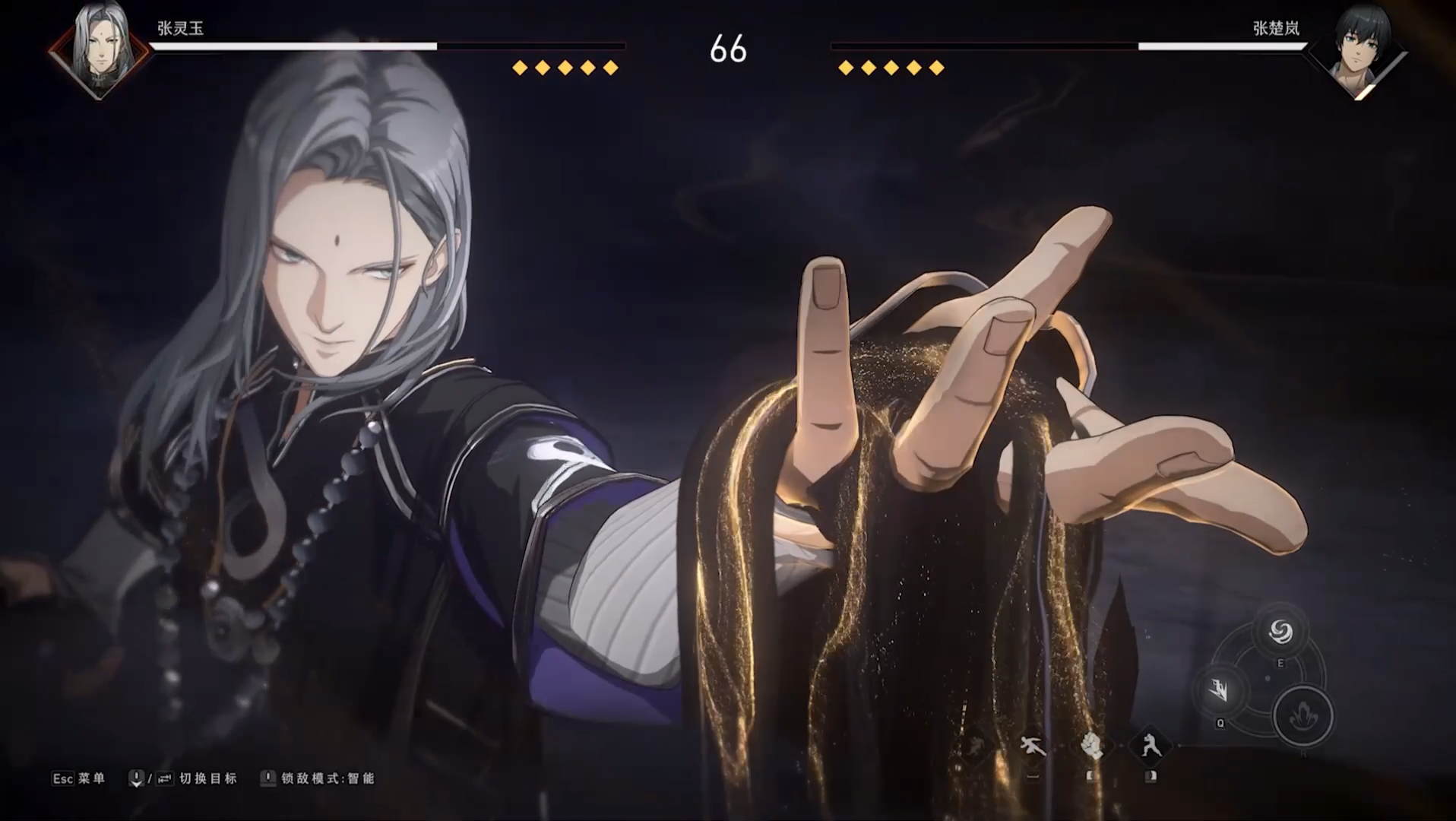
Tencent is leveraging AI tools to enhance the realism of its fighting games.
Tencent Games studio MoreFun studios is using generative AI to fine-tune its characters movements in real time, presenting a potential solution to the age-old challenge of creating fluid animations without sacrificing performance. At last month’s GDC Festival of Gaming, MoreFun Studios head of AI Elvis Liu shared a presentation on his studio’s use of AI to animate and inform its upcoming fighting game The Hidden Ones — and elaborated on the topic in an interview with GamesBeat. Here are some of the key takeaways.
Connecting key frames
Traditionally, fighting game developers have used motion capture to record key frames for characters’ moves, then extrapolated the rest of their movements with a variety of mathematical models. However, this can strain the performance limits of some devices and often results in minor errors, such as characters’ weapons clipping through parts of their bodies. For The Hidden Ones, MoreFun Studios is using generative AI to extrapolate characters’ movements in real time, sidestepping these potential issues.
“Another critical problem be foot sliding,” Liu said in an interview with GamesBeat. “If you get hit, you will go back a little bit, but sometimes the foot gesture is not natural — it’s just a slide backwards. That’s what we call foot sliding, and AI-generated movements can avoid this kind of problem.”
Training for millions of rounds
In addition to leading MoreFun Studios’ AI animation development, Liu is in charge of the company’s AI agent product, a computer player that can learn, adapt and otherwise play in similar ways to a human opponent. MoreFun’s AI agents are trained through self-play, fighting against each other again and again for “millions of rounds” to learn how to play, per Liu. Each playable character in The Hidden Ones has its own dedicated agent, and each agent has to be trained separately for every individual character matchup — an arduous process that is only possible thanks to AI.
“If we only have a pool of 20 characters, it takes two or three days to train them [without AI]. When we have 400 characters, it takes a year to train all of them,” Liu said. “Two years ago, I presented a way to train all 400 characters within a week.”
Looking to the future
Tencent’s AI animation technology makes game worlds more lifelike by reducing the repetitiveness of movement that is inherent to the fighting game genre. Since characters’ movements between key frames are generated by AI in real time, they move in truly unique ways. Movements between key frames will always look similar, but they will never be exactly the same, depending on variables like camera angle and character positioning.
But Liu believes the technology can still improve further. Instead of simply generating movement between key frames, he said, AI can be used to integrate characters into the physics of their virtual environments, increasing the realism of games like The Hidden Ones even further.
“Right now, if you have two key frames and you generate the motion between them, it doesn’t have a physics interaction with the environment. For example, if you throw a stone to hit the characters between these motions, it will not affect the animation,” Liu said. “Maybe, in the future, we will have physics simulations as well, together with the motion generation.”